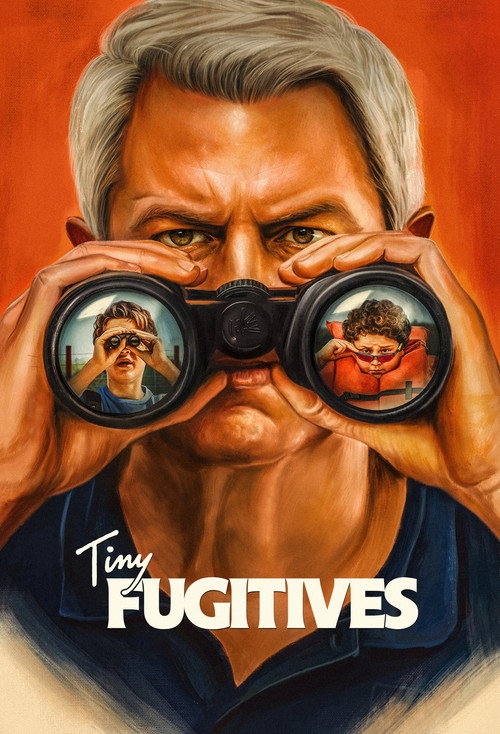
Tiny Fugitives (2026)
Directed by Michael Lewen
Seth Rogen and Evan Goldberg, the artisans responsible for bringing the world Superbad and Good Boys, have returned to their preferred subject matter: children saying things that children should not say.
Consciousness Markers
The ensemble of young campers is ethnically and racially mixed in a way that reflects the demographics of a contemporary American summer camp. The casting feels organic to the setting rather than programmatic, though it is clearly deliberate.
The camp is described as expensive, and the children's desire to permanently escape adult society carries a faint whiff of opting out of the economic order. The film does not appear to develop this into a thesis.
The film's Jewish summer camp setting gives it a specific cultural identity rooted in autobiography. This is ethnic specificity in service of character, not a meditation on racial consciousness or systemic injustice.
A character delivers a brief critique of AI and ChatGPT in response to being bullied via an AI-generated image. This is a single, topical moment rather than a sustained sermon, but it registers as a small pulse of contemporary consciousness.
No LGBTQ+ characters, themes, or subplots are present in the research or critical coverage.
Female characters are present in the ensemble but no feminist agenda, gender commentary, or girl-power framing is evident in any available material.
No environmental themes, climate anxiety, or ecological messaging of any kind appears in the film's premise or critical reception.
No body positivity themes or commentary are present in any available material.
No neurodivergent characters or related themes are identified in the research or critical coverage.
The film is a contemporary comedy with no historical setting or revisionist intent.
Why it received this score
Seth Rogen and Evan Goldberg, the artisans responsible for bringing the world Superbad and Good Boys, have returned to their preferred subject matter: children saying things that children should not say. Tiny Fugitives follows a group of twelve-year-olds at Camp Fineman, an expensive Jewish sleepaway camp, as they attempt to simply never leave. The antagonist is Bob, a fifty-year-old lifer counselor described as deranged and relentless, which in this context appears to be a job description rather than a diagnosis. The filmmakers have cited Stand By Me, Boyhood, and Eighth Grade as inspirations, a lineage that does a great deal of cultural work for a film in which the young cast reportedly required reassurance before delivering their scripted profanity.
The film's social consciousness footprint is, by the standards of its era, modest to the point of near invisibility. The ensemble is diverse in the casual, unremarked-upon way that a real summer camp might be, which is either a refreshing absence of agenda or simply good casting, depending on one's disposition. A brief moment in which a character objects to an AI-generated bullying caricature and critiques ChatGPT by name represents the film's most concentrated engagement with contemporary culture. It is the equivalent of a single olive at a banquet. The Jewish camp setting is autobiographical and specific, drawn directly from the writers' own childhoods, which gives it the texture of memory rather than the texture of a statement.
Johnny Knoxville plays Bob, and the filmmakers have stated this was a deliberate choice, leveraging his association with the Jackass franchise's celebrated philosophy of grown men refusing to mature. The casting is, on reflection, the most intellectually coherent decision the production made. A film about children who refuse to grow up, opposed by an adult who never did, is a reasonable premise for a comedy. It is not a brief for any political platform. The markers here are faint, the lecture energy is minimal, and the overall reading is of a film that simply wants to be funny. We have seen worse crimes.
Analysis generated by our Consciousness Algorithm
Synopsis
A reckless group of twelve year olds set out on a mission to spend the rest of their lives at sleepaway camp. They'll just have to get past Bob - the camp's deranged, relentless, 50-year-old lifer counselor.