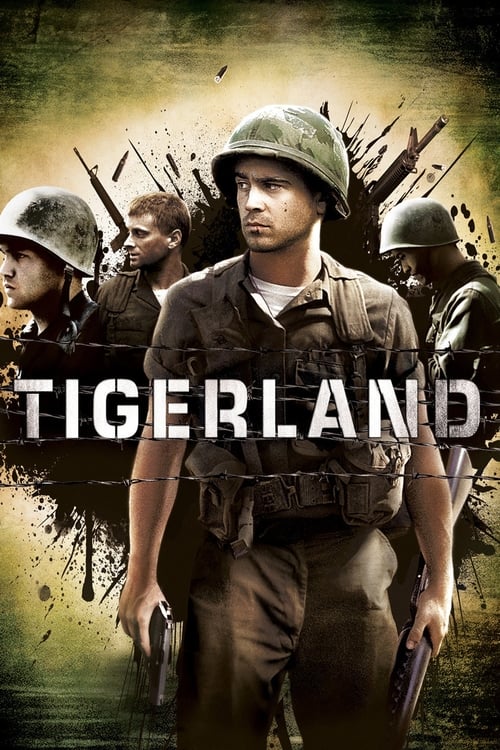
Tigerland (2000)
Directed by Joel Schumacher
No — Tigerland is not especially woke, scoring 23 out of 100 on our wokeness meter.
Joel Schumacher's Tigerland arrives in 1971 Louisiana with handheld 16mm grain and a platoon of draftees waiting to be shipped to Vietnam.
Consciousness Markers
The platoon is notably integrated for a 2000 studio war film, with Black and Latino actors (Clifton Collins Jr., Russell Richardson, Neil Brown Jr., Tory Kittles) in substantive roles, though their presence is largely naturalistic rather than foregrounded as a statement.
Private Wilson is explicitly characterized as a racial bigot who demeans the Latino soldier Miter, giving the film a thread of racial antagonism, but it functions as character conflict rather than a thematic thesis.
The film's anti-war sentiment is embedded in character and story rather than delivered as direct moralizing, with only mild didactic undertones about the pointlessness of the conflict.
No LGBTQ+ characters, themes, or subtext appear anywhere in the film.
Women appear only in fleeting background roles (Sheri, Claudia); the film is an entirely male military milieu with no feminist framing or commentary.
No environmental or climate themes are present in this Vietnam-era training drama.
Bozz's anti-war stance and his efforts to get fellow soldiers discharged are about the futility of conscription, not economic critique or class warfare against capital.
No body-positivity themes or body-diverse representation are present.
No neurodivergent characters or themes are depicted.
The film is a fictional narrative set against the real Fort Polk training camp; it offers no revisionist reframing of historical record.
Why it received this score
Joel Schumacher's Tigerland arrives in 1971 Louisiana with handheld 16mm grain and a platoon of draftees waiting to be shipped to Vietnam. It is a war film that despises the war, which is not the same thing as a film with a message. Colin Farrell's Roland Bozz works the system on behalf of his fellow soldiers, finding loopholes, extracting the broken and the unwilling, and the camera watches him do it with a cool, observational patience. The politics on offer are the politics of futility: conscription as a machine that grinds young men down, not an argument about empire or economics. There is no lecture waiting at the end of the tunnel. The despair is structural, baked into the setting, and the film trusts us to feel it without a narrator arriving to explain the moral.
The platoon is integrated in the manner a 2000 studio production could manage without ceremony. Black and Latino soldiers hold substantive roles, and the film treats their presence as ordinary, which is its own quiet achievement and also the outer limit of its ambition. The single thread of racial antagonism belongs to Private Wilson, a bigot who needles the Latino recruit Miter, and it plays as character friction instead of thesis. Wilson is a man coming apart, and the film is more interested in his collapse than in the ideology he spouts.
What is absent proves just as legible. No women of consequence, no queer lives, no environmental reckoning, no bodies celebrated for their variety, no minds mapped as divergent. This is a closed room of men and their fear. Schumacher keeps the camera close and the sermonizing minimal, so the anti-war feeling surfaces through behavior, through the misfire of a pistol and the flash of a blank round. It is a modest, well-made picture that never reaches for the pulpit. That restraint is the whole of its virtue, and it is enough.
Analysis generated by our Consciousness Algorithm


Synopsis
A group of recruits go through Advanced Infantry Training at Fort Polk, Louisiana's infamous Tigerland, last stop before Vietnam for tens of thousands of young men in 1971.
Questions about Tigerland
Is Tigerland woke?
No — Tigerland is not especially woke, scoring 23 out of 100 on our wokeness meter. That earns it a verdict of Based.
Does Tigerland have any woke elements?
1 of the 10 markers register at 30 or above, led by Representation Casting (35). On Representation Casting: The platoon is notably integrated for a 2000 studio war film, with Black and Latino actors (Clifton Collins Jr., Russell Richardson, Neil Brown Jr., Tory Kittles) in substantive roles, though their presence is largely naturalistic rather than foregrounded as a statement.
How does Tigerland compare to other 2000 movies?
It ranks #21 of the 125 films from 2000 we've scored; their average is 13. The wokest is But I'm a Cheerleader (72).
How is the Woke Score calculated?
An AI-assisted process researches the film and its reception, scores it 0–100 on ten markers, then combines those into one 0–100 Woke Score. It measures a specific set of 2020s cultural themes, not film quality.