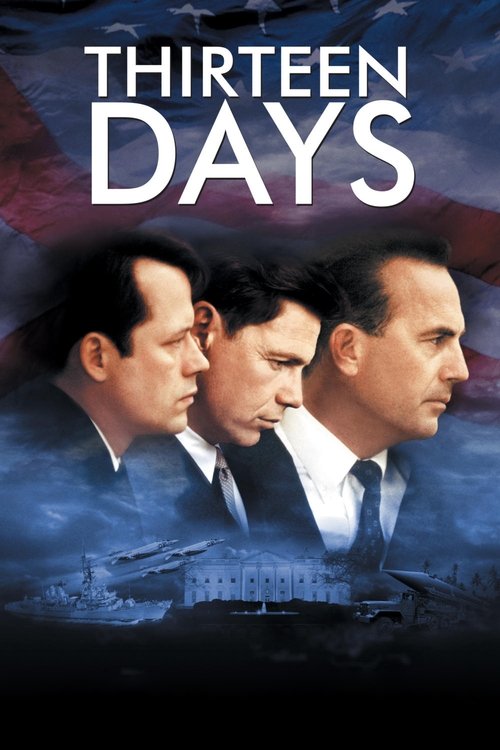
Thirteen Days (2000)
Directed by Roger Donaldson
No — Thirteen Days is not woke, scoring 4 out of 100 on our wokeness meter.
Thirteen Days arrives as a sober historical political thriller, the kind that treats the Cuban Missile Crisis as a procedural nightmare of men in unknotted ties and bad coffee.
Consciousness Markers
The nature of the subject matter requires significant exposition regarding policy and strategy, which borders on didactic, but it is framed within a thriller structure.
While based on declassified tapes, the film primarily dramatizes the established historical narrative rather than fundamentally challenging it with a progressive lens.
The film features a large ensemble of white, established actors portraying the American political elite, offering minimal representation of diverse perspectives.
The film critiques the immense power of the military-industrial complex, but this is framed as geopolitical power, not modern economic class warfare.
The film is a strictly historical political drama focused on Cold War geopolitics and contains no LGBTQ+ themes or representation.
The narrative is entirely centered on the decision-making processes of powerful men, offering no feminist agenda or significant female agency.
The geopolitical focus on the Soviet Union and Cuba means that domestic racial issues are entirely absent from the narrative scope.
The existential threat depicted is nuclear annihilation, not environmental collapse, so the climate crusade is non-existent.
The characters are presented in standard period attire, and there is no commentary on body image or diversity of form.
There is no evidence of characters being portrayed with or discussing neurodivergent traits.
Why it received this score
Thirteen Days arrives as a sober historical political thriller, the kind that treats the Cuban Missile Crisis as a procedural nightmare of men in unknotted ties and bad coffee. Roger Donaldson's film is competent, tense, and resolutely uninterested in the modern progressive checklist. Its ensemble is a wall of white, established actors portraying the American political elite, which gives representation casting almost nothing to work with. The narrative belongs to powerful men in smoke-filled rooms, and female agency is not on the agenda. This is not a flaw in the film's own terms; it is simply the record of what the film chooses to see.
The film's social consciousness is period-accurate and narrow. Cold War geopolitics consumes the frame, so domestic racial questions, environmental collapse, and LGBTQ+ lives are absent. There is a faint anti-capitalist pulse in the suspicion of the military-industrial complex, but it reads as a warning about institutional momentum, not class warfare. Body positivity and neurodivergence have no purchase in a story where the body is mostly a vessel for a suit and the mind is mostly a vessel for strategy. The screenplay's exposition about quarantine lines, DEFCON levels, and back-channel messages is heavy, though the thriller machinery keeps the lecturing from becoming a sermon.
Where the film does take liberties, they are dramatic rather than ideological. Kenneth O'Donnell is inflated into the crisis's chief consigliere, a choice that annoyed actual Kennedy hands and gives the movie its star. That is revisionist history of the showbiz variety, not a progressive rewriting of the past. The result is a well-made, well-acted museum piece with a low cultural temperature. It wants us to admire the machinery of restraint, and it succeeds. It does not want to challenge our sensibilities, and it does not. A film about the end of the world can still be a film about very little in the way of contemporary social signaling.
Analysis generated by our Consciousness Algorithm


Synopsis
The story of the Cuban Missile Crisis in 1962—the nuclear standoff with the USSR sparked by the discovery by the Americans of missile bases established on the Soviet-allied island of Cuba.
Questions about Thirteen Days
Is Thirteen Days woke?
No — Thirteen Days is not woke, scoring 4 out of 100 on our wokeness meter. That earns it a verdict of Ultra Based.
Does Thirteen Days have any woke elements?
Very few. None of the 10 markers reaches 30, the level where a marker counts as present; the highest is Lecture Energy at 20.
How does Thirteen Days compare to other 2000 movies?
It ranks #92 of the 125 films from 2000 we've scored; their average is 13. The wokest is But I'm a Cheerleader (72).
How is the Woke Score calculated?
An AI-assisted process researches the film and its reception, scores it 0–100 on ten markers, then combines those into one 0–100 Woke Score. It measures a specific set of 2020s cultural themes, not film quality.