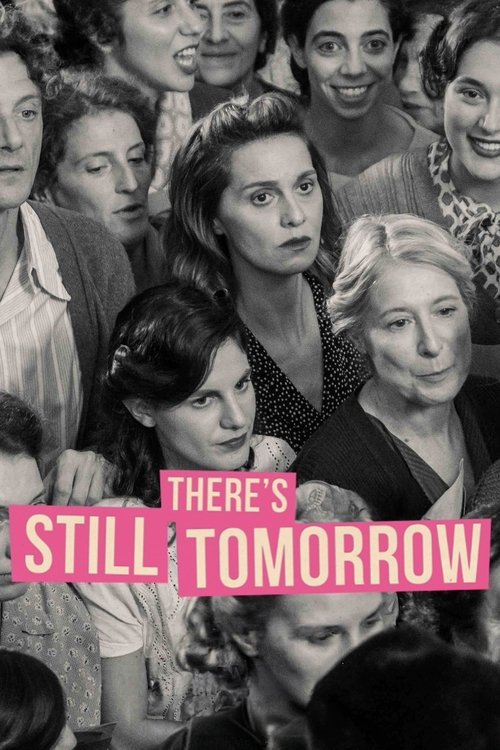
There's Still Tomorrow (2023)
Directed by Paola Cortellesi
Yes — There's Still Tomorrow is woke, scoring 60 out of 100 on our wokeness meter.
There's Still Tomorrow opens in a black-and-white Rome of 1946, where Allied jeeps roll past courtyards and Delia, played by director Paola Cortellesi, absorbs her husband's fists with the practiced silence of a woman who has learned to schedule her bruises around the laundry.
Consciousness Markers
The entire film is a sustained indictment of patriarchy and domestic abuse, culminating in Delia's defiant exercise of the newly won women's vote; critics explicitly framed it as a feminist work about self-determination.
Critics noted the film's 'exemplary and didactic' register and its direct address to men to choose a side in the feminist struggle, giving the finale a pronounced moral-instruction quality.
A female-directed, female-led ensemble with a Black American soldier (William) as a sympathetic helper, though the cast is otherwise a naturalistic Italian period ensemble rather than a self-conscious diversity showcase.
The wealthy Moretti family is portrayed as corrupt collaborators whose fortune is ill-gotten, and class divides between the borgate and the bourgeoisie are drawn sharply, though this is backdrop rather than thesis.
The film recovers the overlooked history of Italian women's first vote in the 1946 referendum, reframing a familiar postwar moment around female agency, though it works within documented events rather than rewriting them.
The African American soldier William is a recurring presence and ally, and the film gestures at postwar racial dynamics, but race is not a central thematic concern.
No LGBTQ+ characters, themes, or subtext appear anywhere in the narrative.
No environmental or climate themes are present in the film.
No body-positivity themes or messaging appear in the film.
No neurodivergence themes or characters are present.
Why it received this score
There's Still Tomorrow opens in a black-and-white Rome of 1946, where Allied jeeps roll past courtyards and Delia, played by director Paola Cortellesi, absorbs her husband's fists with the practiced silence of a woman who has learned to schedule her bruises around the laundry. The film is a domestic-abuse drama dressed in neorealist pastiche, complete with musical numbers and a comic register that keeps threatening to wander off. It never does, quite. Cortellesi's camera holds on the ordinary, a walk, a meal, a beating treated as routine, and the effect is a slow accumulation of outrage that the picture is in no hurry to relieve.
At its center sits a sustained argument about patriarchy, and the argument is not subtle. Delia's father-in-law advises his son to moderate the violence so the victim does not grow numb, the neighbors watch and shrug, the daughter is being steered toward a husband cut from the same cloth. The wealthy Moretti family, whose fortune smells of wartime collaboration, supplies a class dimension, though the moneyed villains function mostly as scenery for the moral. William, an African American soldier, drifts through as friend and accomplice, a gesture at the wider postwar world that never develops into a thesis. Then comes the vote, and the film's real subject declares itself.
The final act addresses itself, with some insistence, to men, asking them to choose a side in a struggle the film has spent two hours illustrating. That directness is the point, and it is also the limitation. There is no room here for ambiguity, no interest in the interior life of the oppressor beyond his function. The picture recovers a genuine historical moment, the first Italian women's vote, and bends it toward a clean moral. What it does not do is leave us anything to chew on afterward. It has already done the chewing.
Analysis generated by our Consciousness Algorithm


Synopsis
In postwar Rome, a working-class woman dreams of a better future for herself and her daughter while facing abuse at the hands of her domineering husband. When a mysterious letter arrives, she discovers the courage to change the circumstances of her life.
Questions about There's Still Tomorrow
Is There's Still Tomorrow woke?
Yes — There's Still Tomorrow is woke, scoring 60 out of 100 on our wokeness meter. That earns it a verdict of Woke.
What makes There's Still Tomorrow woke?
3 of the 10 markers register at 30 or above, led by Feminist Agenda (88), Lecture Energy (60) and Representation Casting (45). On Feminist Agenda: The entire film is a sustained indictment of patriarchy and domestic abuse, culminating in Delia's defiant exercise of the newly won women's vote; critics explicitly framed it as a feminist work about self-determination.
How does There's Still Tomorrow compare to other 2023 movies?
It ranks #14 of the 200 films from 2023 we've scored; their average is 24. The wokest is Origin (84).
How is the Woke Score calculated?
An AI-assisted process researches the film and its reception, scores it 0–100 on ten markers, then combines those into one 0–100 Woke Score. It measures a specific set of 2020s cultural themes, not film quality.