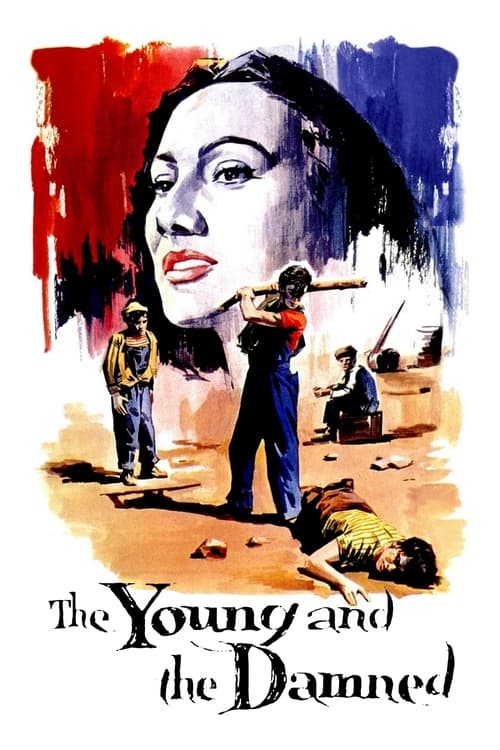
The Young and the Damned (1950)
Directed by Luis Buñuel
No — The Young and the Damned is not woke, scoring 11 out of 100 on our wokeness meter.
Luis Buñuel's Los Olvidados, released in 1950 and sold to American audiences as The Young and the Damned, arrives at the classification desk like a museum piece that has been told, repeatedly, that it is important.
Consciousness Markers
Buñuel indicts the systemic poverty and social neglect that produce the children's brutality, a genuine social critique, though it is a mid-century leftist-humanist one rather than the modern 'eat the rich' register.
The film carries a bleak social message about the cycle of poverty, but Buñuel pointedly refuses to romanticize or moralize, delivering no explicit sermon to the audience.
The cast is entirely Mexican and includes non-professional actors drawn from the milieu depicted, but this reflects the film's national origin and neorealist method rather than any modern casting-consciousness agenda.
No LGBTQ+ characters, themes, or subtext appear anywhere in the film.
Women appear only as the resentful mother and the peripheral Meche; the film offers no feminist critique or gendered framework.
The film's subject is class and poverty within a single Mexican society, not race or racial identity; no racial consciousness is articulated.
Environmental themes are entirely absent from this urban slum drama.
No body-positivity themes or messaging are present.
No neurodivergence is depicted or addressed.
The film is a fictional social-realist narrative, not a revisionist retelling of historical events.
Why it received this score
Luis Buñuel's Los Olvidados, released in 1950 and sold to American audiences as The Young and the Damned, arrives at the classification desk like a museum piece that has been told, repeatedly, that it is important. It is. The film follows Pedro and El Jaibo through the slums of Mexico City with a cold eye that never once asks us to admire its own compassion. The cast is Mexican, drawn largely from nonprofessionals and the actual milieu, a fact that registers as a faint tremor on the representation dial. This is national cinema and neorealist method, not a casting directive. The needle barely moves.
On the remaining dials, the silence is close to total. No LGBTQ characters or subtext. No feminist framework, only a resentful mother and a girl named Meche drifting at the margins. No racial consciousness, because the film's subject is class within a single society, not race. No climate anxiety. No body positivity. No neurodivergence. No revisionist history, since the narrative is invented. The one dial that stirs is the economic one. Buñuel indicts the poverty and institutional neglect that manufacture his young predators, and the indictment is genuine. It is also a mid-century leftist-humanist article of faith, not a modern eat-the-rich register. A faint pulse, no more.
The film's bleak social message lands without a sermon. Buñuel refuses to romanticize anyone, including the blind beggar who preys on children and sells fake elixirs. There is no lecture, no moral, no uplift. Pedro is killed, El Jaibo is shot, and Meche dumps the body down a garbage-covered cliff while Pedro's mother, finally, goes looking for him. The alternate happy ending, unearthed decades later, is instructive by its wrongness. This is a hard film made by a man uninterested in flattering his audience or his country. It scores low across the modern ledger not because it lacks seriousness but because its seriousness is of an older, stranger vintage. The classification stands. The film does not care.
Analysis generated by our Consciousness Algorithm
Synopsis
A group of juvenile delinquents live a violent life in the infamous slums of Mexico City; among them Pedro, whose morality is gradually corrupted and destroyed by the others.
Questions about The Young and the Damned
Is The Young and the Damned woke?
No — The Young and the Damned is not woke, scoring 11 out of 100 on our wokeness meter. That earns it a verdict of Ultra Based.
Does The Young and the Damned have any woke elements?
Very few. None of the 10 markers reaches 30, the level where a marker counts as present; the highest is Eat the Rich at 25.
How does The Young and the Damned compare to other 1950 movies?
It is the wokest of the 10 films from 1950 we've scored; their average is 4.
How is the Woke Score calculated?
An AI-assisted process researches the film and its reception, scores it 0–100 on ten markers, then combines those into one 0–100 Woke Score. It measures a specific set of 2020s cultural themes, not film quality.