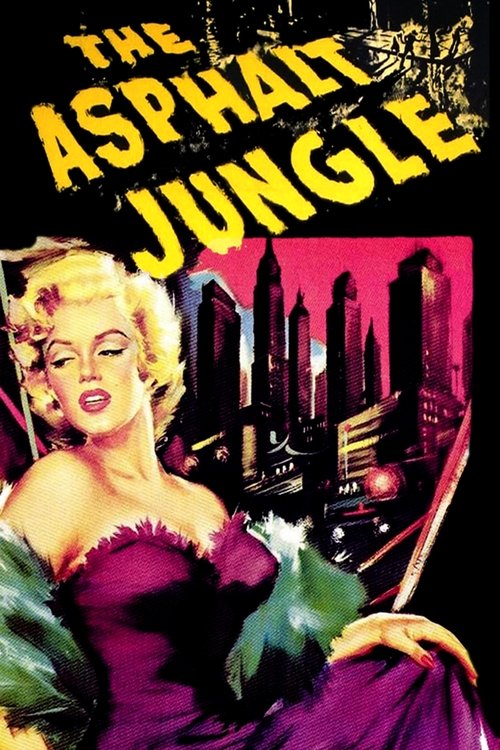
The Asphalt Jungle (1950)
Directed by John Huston
No — The Asphalt Jungle is not woke, scoring 0 out of 100 on our wokeness meter.
John Huston's The Asphalt Jungle (1950) assembles a crew of veteran criminals in an unnamed Midwestern river city and watches them dismantle themselves with the patience of a man observing a leaking roof.
Consciousness Markers
The cast is uniformly white, with no meaningful racial minority representation or commentary on inclusive casting.
There are no LGBTQ+ characters, themes, or subtext.
Female characters are confined to girlfriend, mistress, and wife roles; the film offers no feminist critique or agenda.
The film does not engage with race or racial injustice in any substantive way.
There are no environmental or climate-related themes.
It depicts corrupt individuals and criminals, but this is standard noir fatalism rather than a systemic anti-capitalist critique.
There are no body-positivity themes or celebrations of diverse body types.
No neurodivergence themes are present; a physically disabled character is not framed through a neurodivergence or body-positivity lens.
The film is a period crime drama adapted from a novel and does not attempt to revise historical narratives.
The film’s moralizing is conventional crime-drama material, not modern social-justice lecturing.
Why it received this score
John Huston's The Asphalt Jungle (1950) assembles a crew of veteran criminals in an unnamed Midwestern river city and watches them dismantle themselves with the patience of a man observing a leaking roof. Doc Riedenschneider leaves prison with a plan, a bankrupt lawyer fronts the money, and a safecracker named Ciavelli drills through a brick wall for a jewelry haul that no one will ever enjoy. The film is a machine, and Huston runs it with the neorealist restraint he borrowed from the Italians. Nobody makes speeches. Nobody explains the meaning of the heist. The vault opens, an alarm trips, and the whole enterprise begins to rot from the inside.
The moral accounting here is old-fashioned and grim. Emmerich, the corrupt attorney, shoots himself instead of facing a courtroom, and the film treats this as an inevitability, not an indictment of any system. Women appear as girlfriends, mistresses, and wives, and the camera regards them as furniture with better lighting. Gus Minissi's hunchback is a physical fact the plot uses and never interrogates. Dix Handley wants his Kentucky horse farm back, a dream of property and lost inheritance, and he dies in the pasture reaching for it. This is fatalism, not a critique. The criminals are laborers, and the film mourns them without proposing that anything ought to be rearranged.
The result is a near-perfect crime picture from a moment before films were expected to carry a message beyond the obvious one, that greed ends badly. The Criterion crowd adores it. The Library of Congress preserved it. Louis B. Mayer called it trash. He was wrong about the craft and correct about the mood, which is nasty, elegant, and entirely content to let the audience draw its own conclusions. A sommelier might call this a dry vintage. It does not ask to be admired for its conscience, because it does not have one.
Analysis generated by our Consciousness Algorithm


Synopsis
Recently paroled from prison, legendary burglar "Doc" Riedenschneider, with funding from Alonzo Emmerich, a crooked lawyer, gathers a small group of veteran criminals together in the Midwest for a big jewel heist.
Questions about The Asphalt Jungle
Is The Asphalt Jungle woke?
No — The Asphalt Jungle is not woke, scoring 0 out of 100 on our wokeness meter. That earns it a verdict of Ultra Based.
Does The Asphalt Jungle have any woke elements?
No. All 10 markers score zero.
How does The Asphalt Jungle compare to other 1950 movies?
It ranks #9 of the 10 films from 1950 we've scored; their average is 4. The wokest is The Young and the Damned (11).
How is the Woke Score calculated?
An AI-assisted process researches the film and its reception, scores it 0–100 on ten markers, then combines those into one 0–100 Woke Score. It measures a specific set of 2020s cultural themes, not film quality.