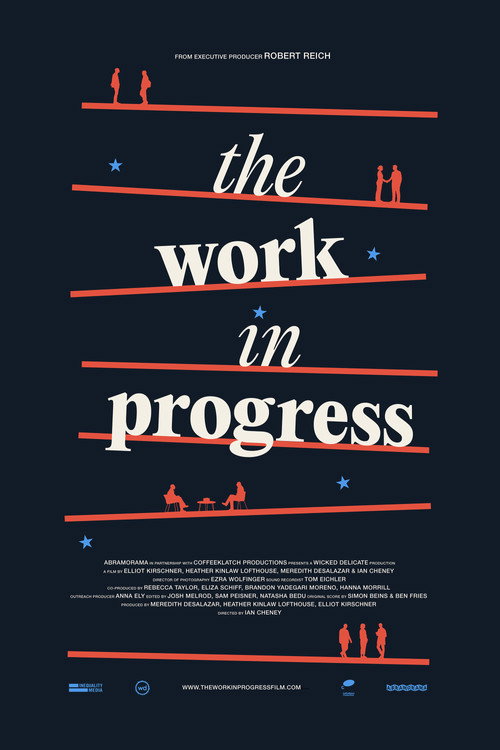
The Work in Progress (2026)
Directed by Ian Cheney
The Work in Progress arrives bearing the full weight of its production company's name: Inequality Media Civic Action.
Consciousness Markers
The film is executive produced by Robert Reich, whose entire public identity is built on income inequality and corporate power critiques, and is distributed through a non-profit he co-founded called Inequality Media Civic Action. Economic division is a central conversation topic. The framing is inherent to the enterprise.
Robert Reich is, by vocation, a man who explains structural inequality to audiences. The film was deployed with roadshow Q&As, town hall discussions, and a custom deck of conversation cards designed to extend the film's civic lesson into viewers' living rooms. This is not passive cinema; it is an organized curriculum.
The documentary explicitly constructs its participant pool to represent diverse racial, ethnic, gender, occupational, and class identities across seven states. The diversity is deliberate and structurally designed, though it serves dialogue rather than symbolic display.
Racial and ethnic diversity is present in the participant pool and racial division is presumably among the 'cultural divisions' addressed. However, the film's stated frame is civic and intergenerational, not explicitly racial, and it deliberately avoids partisan hotspots.
The film frames 2026 against 1976, implicitly inviting reappraisal of the American civic project and its promises. This is more melancholic reassessment than active revisionism, but the contrast is present.
Gender is among the identity dimensions represented in the participant cross-section, but there is no evidence of a feminist throughline or specific feminist framing in the film's thesis.
No specific LGBTQ+ themes are identified in the research. A broad conversation about identity and division may touch on this tangentially, but there is no evidence of it as a featured subject.
No evidence of climate themes in the research or the film's described subject matter. The director has explored environmental topics in other work, but this film is not that film.
No evidence of body positivity themes in the research or the film's described content.
No evidence of neurodivergence themes in the research or the film's described content.
Why it received this score
The Work in Progress arrives bearing the full weight of its production company's name: Inequality Media Civic Action. That is not a name that suggests ambivalence. Director Ian Cheney and executive producer Robert Reich have assembled over one hundred Americans across seven states to sit in rooms together and talk, which is, in 2026, treated as a radical act. The film gathers farmers, veterans, clergy, ranchers, scholars, and men incarcerated on drug charges, pairing the generation that celebrated the Bicentennial with the generation that will inherit whatever remains of the Semiquincentennial. The participant roster is constructed with the care of a sommelier building a flight: deliberately balanced, intentionally representative, and designed to produce a specific emotional effect in the drinker.
What saves the film from pure sermon is its apparent commitment to letting uncomfortable silences exist. The research notes a conscious avoidance of partisan caricature and a refusal to populate the frame with the usual costumed villains of either side. This is a genuine editorial choice, and credit is due. It is also, one observes, the kind of choice that a skilled progressive communicator makes when he has learned that preaching to the choir does not expand the congregation. Reich is a man who has spent decades explaining that the economy is broken and that this is someone's fault, and he has not abandoned that thesis here. He has simply hired a more patient cinematographer.
The film's civic deployment apparatus, conversation card decks, roadshow Q&As, town hall pairings, is where the lecture energy fully crystallizes. This is a documentary that does not trust you to draw your own conclusions; it has prepared supplementary materials. The economic consciousness is baked into the institutional DNA of the production itself. As a document of a country talking past itself, it may be moving. As a neutral artifact, it is something else entirely, which the title, with its quiet suggestion of ongoing construction, seems to acknowledge without quite admitting.
Analysis generated by our Consciousness Algorithm
Synopsis
Follows Americans engaging in face-to-face conversations about cultural, political, economic, and generational divisions across seven states.