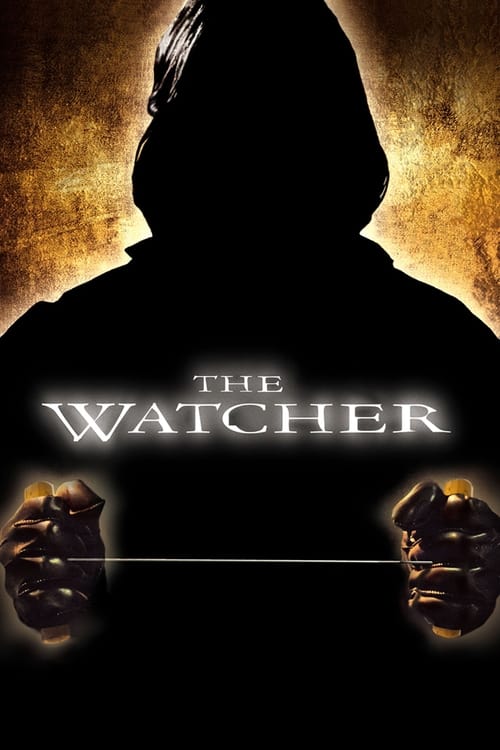
The Watcher (2000)
Directed by Joe Charbanic
No — The Watcher is not woke, scoring 0 out of 100 on our wokeness meter.
The Watcher arrives from the year 2000 with the weary confidence of a film that knows exactly what it is and has no ambition to be anything else.
Consciousness Markers
Cast is predominantly white with Ernie Hudson in a supporting authority role; no deliberate representation casting or commentary.
No LGBTQ+ characters, themes, or subtext.
Marisa Tomei plays a psychiatrist and potential victim, but the film has no feminist agenda or gender-conscious critique.
No engagement with race, racism, or racial identity.
No environmental or climate themes.
No critique of capitalism, wealth, or class.
No body-positivity themes or diverse body representation as a message.
Campbell has migraines and trauma, but the film does not frame this as neurodivergence or advocate for neurodivergent identity.
No historical revisionism; it is a contemporary fictional thriller.
No preachy monologues or didactic social messaging.
Why it received this score
The Watcher arrives from the year 2000 with the weary confidence of a film that knows exactly what it is and has no ambition to be anything else. James Spader plays Joel Campbell, a burned-out FBI agent who retreats to Chicago, develops migraines, and is promptly taunted by a serial killer who has followed him there. Keanu Reeves plays the killer against type, a decision that history records as involuntary: the director forged his signature on the contract, and Reeves performed at union scale while his co-stars collected seven figures. The film is a machine for generating suspense, and it runs about as smoothly as a rental car with a bad alignment.
Scanned for the markers of contemporary social consciousness, the picture returns a clean sheet. The cast is white, with Ernie Hudson in a supporting authority role, and the film asks nothing of that fact. Marisa Tomei's psychiatrist is a hostage and a plot function, not a gender-conscious critique. The migraines are a narrative convenience borrowed from a dozen damaged-detective pictures, not an argument about neurodivergence. There is no money sermon, no climate anxiety, no historical revision, no monologue in which a character explains the moral of the story to a captive audience. Chicago is a location. The killer is a menace. The victims are women who exist to be photographed before the deadline.
It opened at number one in North America on a weekend so dreary that the industry had not seen its equal since the 1980s. That is the film's single claim on cultural memory, and it is a claim about arithmetic, not ideology. We are left with a thriller short on thrills, a villain cast against type through contract fraud, and a score of zero across the board. The sommelier sets down the glass and reaches for the next bottle.
Thematic classification yields one applicable tag: the film reached the top of the domestic box office in its opening weekend. It is not an Oscar winner, a sequel, a remake, a true story, a book adaptation, or a superhero picture. It is simply a bad thriller that made money once, which is its own kind of American story, though not one the film has the wit to tell.
That is the whole of it. No cultural instruction, no sermon, no agenda beyond the reliable business of women being stalked by a man with a camera. The ledger is balanced at zero, and the classification stands.
Analysis generated by our Consciousness Algorithm
Part of


Synopsis
FBI agent Joel Campbell, burnt-out and shell-shocked after years spent chasing serial killers, flees L.A. to begin a new life for himself in Chicago. But five months later, Joel's best laid plans are abruptly cut short when his new hometown becomes the setting for some particularly gruesome murders--murders that could only have been committed by one man: David Allen Griffin. One of Joel's most elusive and cunning nemeses, Griffin has followed his former pursuer to Chicago in order to play a sadistic game of cat and mouse. Taunting Joel with photographs of his intended victims and leaving his crime scenes meticulously free of clues in order to keep the police at bay, Griffin derives as much pleasure out of watching Joel react to every movement as watching his victims die. But when Griffin moves into Joel's inner circle, Joel must quickly find some way to stop him before someone close to him becomes the next one to die.
Questions about The Watcher
Is The Watcher woke?
No — The Watcher is not woke, scoring 0 out of 100 on our wokeness meter. That earns it a verdict of Ultra Based.
Does The Watcher have any woke elements?
No. All 10 markers score zero.
How does The Watcher compare to other 2000 movies?
It ranks #112 of the 125 films from 2000 we've scored; their average is 13. The wokest is But I'm a Cheerleader (72).
How is the Woke Score calculated?
An AI-assisted process researches the film and its reception, scores it 0–100 on ten markers, then combines those into one 0–100 Woke Score. It measures a specific set of 2020s cultural themes, not film quality.