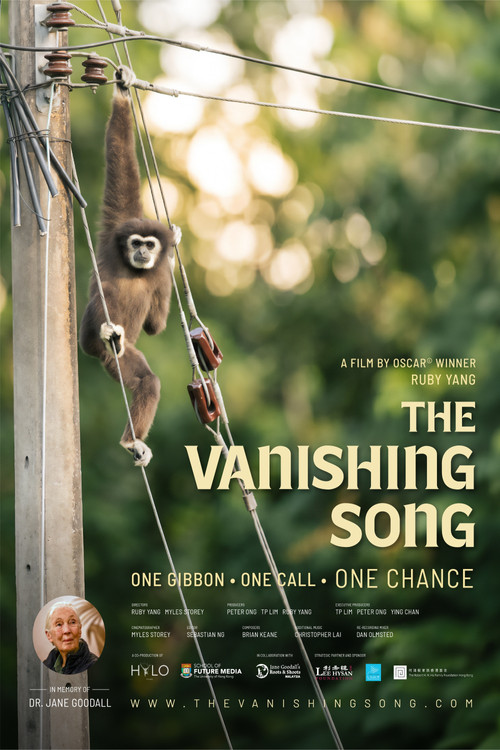
The Vanishing Song (2026)
Directed by Ruby Yang
The Vanishing Song arrives in the documentary short format, which is the preferred vessel for films that have something urgent to say and the discipline not to repeat it for ninety minutes.
Consciousness Markers
Environmental advocacy is the film's entire purpose: habitat fragmentation, endangered species, and the consequences of urban sprawl are not background concerns but the central argument. The rescue mission is inseparable from the film's call for stronger environmental protections.
The documentary genre carries inherent advocacy energy, and the filmmakers are open about their conservationist purpose. Jane Goodall's presence as an inspirational figure adds moral weight, though the film appears to earn its sermon through narrative rather than simply delivering it.
Urban development and highway infrastructure function as the de facto antagonists, implying a tension between economic expansion and ecological survival. The critique is present but incidental, not ideological.
The cast is Malaysian because the story takes place in Malaysia. No identity-conscious casting framework is present or implied.
No LGBTQ+ themes, characters, or subtext of any kind appear in this wildlife rescue documentary.
Ruby Yang is a woman directing the film, but the narrative contains no feminist framing, commentary, or agenda. The gibbon, notably, does not identify as a woman.
The film engages with a Malaysian community on its own terms, with no racial-consciousness framework imposed on the story.
No body-positivity themes are present. The gibbon is in excellent physical condition, which is actually the problem, as a healthier capture would have been easier.
No neurodivergence themes, framing, or representation appear in the film.
The film is set in the present day and makes no attempt to reframe historical events or narratives.
Why it received this score
The Vanishing Song arrives in the documentary short format, which is the preferred vessel for films that have something urgent to say and the discipline not to repeat it for ninety minutes. Ruby Yang and Myles Storey train their cameras on Han, a lone lar gibbon marooned in a shrinking forest fragment in Serdang, Malaysia, surrounded by highways and apartment blocks that have no particular interest in his well-being. The film is, at its core, a rescue story, and it has the good sense to let that story carry the argument rather than interrupting it every eight minutes with a title card about biodiversity loss statistics.
The environmental consciousness here is genuine and total. This is not a film that uses ecological decline as a backdrop for something else. It is the whole subject, earnestly pursued, and the filmmakers make no secret of their advocacy. Jane Goodall's involvement as an inspirational presence gives the proceedings a certain moral gravity that the film does not need to manufacture, having already found it in a single gibbon calling into an indifferent urban sprawl. The anti-development undertone is present, though it functions more as observed reality than political program. Nobody in the film delivers a speech about late capitalism. The highways simply exist, and they are clearly the problem.
Where the film edges toward the sermonizing end of the nature-documentary spectrum, it is saved by the specificity of its subject. Han is a concrete individual with a measurable problem, and the multi-agency effort to relocate him to a national park is documented with the tension of a procedural thriller, which is a sentence that would have surprised everyone involved in making it. The lecture energy is real but proportionate: the film wants you to care about gibbons, and it has done the work of making that a reasonable request.
Analysis generated by our Consciousness Algorithm
Synopsis
Cut off from his kind, a lone gibbon calls out from a vanishing forest patch in the heart of a Malaysian city — and a team races to reach him before time runs out.