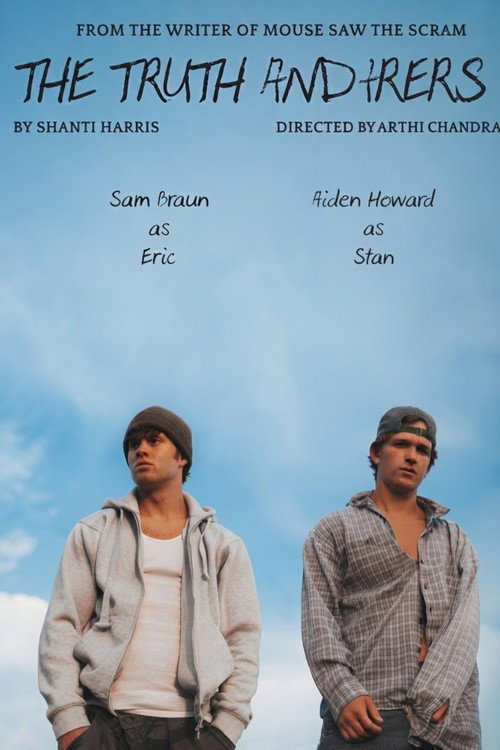
The Truth and Darers (2026)
Directed by Arthi Chandra
The Truth and Darers arrives from the Vancouver Fringe Festival carrying the full weight of its premise: six thirteen-year-olds, a barn, and the ancient social instrument of Truth or Dare.
Consciousness Markers
The ensemble of six thirteen-year-olds features a visibly diverse cast across apparent ethnicity and gender, suggesting deliberate compositional choices. The diversity is present but functions as backdrop rather than thesis.
The setting is explicitly an impoverished rural community, and poverty functions as a meaningful atmospheric and character context. The framing is empathetic rather than systemic, stopping well short of anti-capitalist argument.
No documented LGBTQ content exists in the play's text, but identity formation under social pressure is a central theme, and director Arthi Chandra's body of work is explicitly queer-inflected. The lens is present even if the content stops short of declaration.
The piece is written and directed by women, and features young female characters navigating power dynamics in a peer group. No feminist agenda is documented in the text itself; the creative authorship carries the faint trace.
The diverse casting implies some racial awareness at the production level, but no critic or reviewer frames the work through a racial consciousness lens. The score reflects casting composition only.
Critics specifically praised the play for avoiding sensationalism and heavy-handedness with its difficult themes. The heavy subject matter earns a nominal score, but the execution appears to be restrained and character-driven.
No climate-related content, themes, or imagery are present or documented anywhere in the available research.
No body positivity themes, content, or framing are documented or implied in any available source.
No neurodivergence themes or representation are documented or implied in any available source.
The 2012 period setting is used for nostalgic authenticity rather than historical reinterpretation. There is nothing revisionist in the documented content.
Why it received this score
The Truth and Darers arrives from the Vancouver Fringe Festival carrying the full weight of its premise: six thirteen-year-olds, a barn, and the ancient social instrument of Truth or Dare. It is set in 2012, which is close enough to the present to feel familiar and far enough away to be called a period piece by anyone who needs it to be. The rural poverty and physical isolation of the setting are not incidental. They are the walls of the cage that makes the game matter.
Director Arthi Chandra, whose broader body of work has a documented interest in queer identity and feminist adaptation, here applies her sensibilities with a notably light hand. The result is a piece that carries the DNA of progressive theatrical authorship without loudly announcing it. The diverse ensemble — assembled with the kind of compositional deliberateness that is now simply the default grammar of indie theater — navigates childhood trauma and group conformity without pausing to explain either concept to the audience. Critics noted the absence of sensationalism, which in 2026 is its own form of restraint and arguably its own form of artistic courage.
What the piece does not do is lecture. The poverty is not a platform. The identity formation is not a curriculum. For a work emerging from a director with Chandra's profile and a playwright-actor in Shanti Harris who frames the project around vulnerability rather than argument, this represents a conscious choice to trust the material. The barn smells like horse shit, as the synopsis faithfully reports, and the play appears to have the good sense to leave it at that.
Analysis generated by our Consciousness Algorithm
Synopsis
In a barn that smells like horse shit, pre-pubescent armpits, and an inflated sense of freedom, six thirteen-year-olds strike up an ongoing, high-stakes game of Truth or Dare.