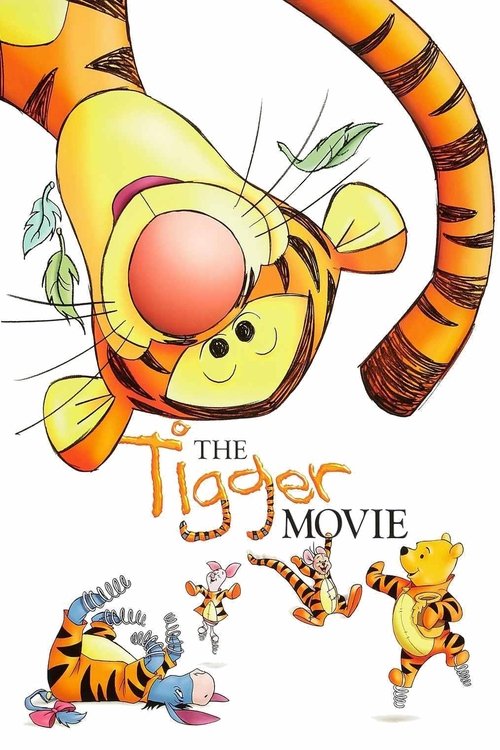
The Tigger Movie (2000)
Directed by Jun Falkenstein
No — The Tigger Movie is not woke, scoring 2 out of 100 on our wokeness meter.
The Tigger Movie arrives in the year 2000 like a hand-stitched heirloom delivered to the wrong decade.
Consciousness Markers
Voice cast is largely legacy Disney performers voicing anthropomorphic animals; no casting choices are framed around representation.
No LGBTQ+ characters, themes, or subtext.
Kanga is a conventional mother figure and the story centers on Tigger's search for family; no feminist agenda.
The Hundred Acre Wood is a race-blind fantasy setting with no engagement with racial identity or politics.
Winter weather and a blizzard are plot devices, not environmental commentary.
No critique of wealth, class, or capitalism.
Tigger's bouncing is a character trait, not a body-positive statement.
Tigger's hyperactivity is played for comedy and not framed as neurodivergence.
No historical revisionism; it is a fictional children's story.
The film delivers a gentle lesson about friendship and family, not a modern social lecture.
Why it received this score
The Tigger Movie arrives in the year 2000 like a hand-stitched heirloom delivered to the wrong decade. It was conceived as a direct-to-video item, then promoted to theatrical release after Michael Eisner heard the Sherman Brothers' songs, which remains the most charming corporate anecdote in the Disney vault. The plot concerns Tigger's conviction that somewhere exists another of his kind, a striped companion with whom he might bounce. His friends, busy winterizing Eeyore's dwelling, find his exuberance inconvenient. He topples a boulder arrangement, snaps a pulley, and is advised to seek his own people. Off he goes.
The search produces a letter-writing campaign, a costume party, and a blizzard, and it resolves in the discovery that family is the company you keep. This is a gentle lesson, offered without a single glance toward the culture wars. Kanga mothers. Rabbit frets. Owl misinforms with scholarly confidence. Nobody's identity is interrogated. Nobody's body is celebrated. No economic order is indicted. The Hundred Acre Wood is a race-blind, class-blind, weather-plagued fantasy in which the only genuine conflict pits a tiger who cannot sit still against a rabbit who wishes he would. Tigger's boundless energy is played for slapstick, not diagnosis. The winter storm is a plot device, not a cry for the planet.
By the standards of modern cultural accounting, this is a blank ledger. The film is not indifferent to kindness. It simply has no interest in the vocabulary that kindness has since acquired. Tigger learns that his friends are his family, Roo lands a difficult bounce, and the credits roll over a Kenny Loggins ballad. A sommelier presented with this vintage would note its clarity, its absence of tannin, and its total lack of agenda. The bottle is sealed. The tiger bounces.
Analysis generated by our Consciousness Algorithm
Part of


Synopsis
Winnie the Pooh, Piglet, Owl, Kanga, Roo, and Rabbit are preparing a suitable winter home for Eeyore, the perennially dejected donkey, but Tigger's continual bouncing interrupts their efforts. Rabbit suggests that Tigger go find others of his kind to bounce with, but Tigger thinks "the most wonderful thing about tiggers is" he's "the only one!" Just in case though, the joyously jouncy feline sets out to see if he can find relatives.
Questions about The Tigger Movie
Is The Tigger Movie woke?
No — The Tigger Movie is not woke, scoring 2 out of 100 on our wokeness meter. That earns it a verdict of Ultra Based.
Does The Tigger Movie have any woke elements?
No. All 10 markers score zero.
How does The Tigger Movie compare to other 2000 movies?
It ranks #108 of the 125 films from 2000 we've scored; their average is 13. The wokest is But I'm a Cheerleader (72).
How is the Woke Score calculated?
An AI-assisted process researches the film and its reception, scores it 0–100 on ten markers, then combines those into one 0–100 Woke Score. It measures a specific set of 2020s cultural themes, not film quality.