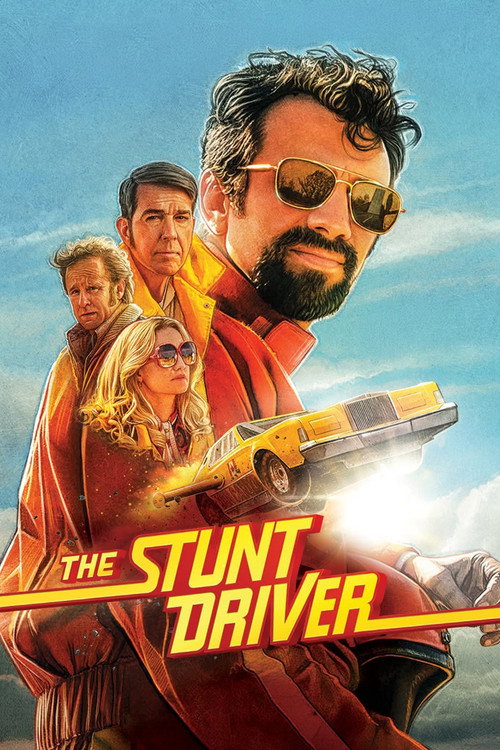
The Stunt Driver (2026)
Directed by Michael Dowse
The Stunt Driver arrives at the intersection of working-class ambition and catastrophic physics, asking a question that no progressive think-piece has yet managed to address: what happens when a man from Montreal tries to jump the St. Lawrence River in a rocket-powered Lincoln Continental.
Consciousness Markers
The working-class underdog framing and the depiction of financial and institutional obstacles facing Carter gesture faintly toward a critique of how capital and showbiz infrastructure chew up dreamers. This is more Capra than Marx, however, and the critique is incidental to the story.
Critics noted that Carter's implied learning difficulties and his deep need for validation rooted in childhood hardship are treated with care rather than used as punchlines. The portrayal is humane and specific, though the film does not appear to foreground neurodivergence as a theme.
The film's subversion of 'macho' daredevil tropes and its examination of male vulnerability and insecurity carry a faint feminist undertone, in the sense that toxic masculinity is gently interrogated. It is not a feminist film. It is a film about a man who wanted to jump a river in a rocket car.
The film's empathetic handling of Carter's physical injuries, cross-eyed vision, and implied learning difficulties avoids mockery and treats his body and neurology with dignity. This is sensitive characterization rather than an agenda, but it registers slightly on the scale.
The cast is predominantly white and male, consistent with the historical 1970s milieu being depicted. Laurence Leboeuf's Gloria and Sophie-Thérèse Stone-Richards represent the film's modest female presence, but there is no evidence of casting chosen to make a contemporary representational statement.
The film is based on documented historical events and a pre-existing NFB documentary, and there is no evidence it reframes the historical record through a modern ideological lens. Minor dramatic license is presumed but no revisionist agenda is reported.
No LGBTQ+ themes, characters, or subtext are present or reported anywhere in the film's content or reception. The score is zero.
No racial consciousness themes are present. The film's cultural contrast is between Canadian and American identity, which is a nationalistic distinction, not a racial one. The score is zero.
No climate themes are present. The film's protagonist is attempting to launch a rocket-powered Lincoln Continental across a body of water. The carbon footprint is not discussed. The score is zero.
Every review and piece of critical commentary describes a film focused on character, comedy, and Canadian identity. No one has accused it of lecturing the audience about anything. The score is zero.
Why it received this score
The Stunt Driver arrives at the intersection of working-class ambition and catastrophic physics, asking a question that no progressive think-piece has yet managed to address: what happens when a man from Montreal tries to jump the St. Lawrence River in a rocket-powered Lincoln Continental. Director Michael Dowse, working from the documented wreckage of Ken Carter's actual life, has produced a biographical comedy-drama that is, by the standards of contemporary cinema, almost aggressively free of social programming. The film's cultural concerns are Canadian identity, male vulnerability, and the specific tragedy of a man who needed the world to watch him. These are old concerns. They are not the wrong ones.
Jay Baruchel's Carter is cross-eyed, injury-worn, and driven by a need for validation that the film traces back to childhood without ever turning into a therapy session. Critics have noted the film's gentle interrogation of the 'macho daredevil' archetype, and this is fair: the loud posturing is shown to be a shell around something much more frightened. This is not a feminist manifesto. It is simply a character study that declines to be stupid about masculinity, which in 2026 apparently qualifies as a notable achievement. Ben Foster's Evel Knievel lurks in the background as the American shadow Carter cannot escape, and the Canada-versus-America dynamic carries more genuine cultural weight than any number of films that announce their themes with a bullhorn.
What the film does not do is equally instructive. It does not retool its 1970s setting to deliver contemporary moral instruction. It does not cast against historical probability to signal virtue. It does not end with a speech. The rocket car either makes it across the river or it does not, and the film is honest about which. On our scale of social consciousness, The Stunt Driver scores in the single digits across nearly every marker, which is to say it is a film almost entirely about the thing it claims to be about. In this office, we treat that as a data point, not a commendation. We simply note it, set down our clipboard, and move on to the next file.
Analysis generated by our Consciousness Algorithm
Synopsis
Based on the true story of Montrealer Ken Carter, the "Mad Canadian" stunt driver who tried to jump the Saint Lawrence River in a rocket car in the mid-'70s. Carter's dream was to end his 30-year career with a big jump, a big paycheck, and mega stardom. In the process of accomplishing it, he hired a big sports manager and enlisted the best in rocket car design, with the National Film Board of Canada filming a documentary leading up to the event.