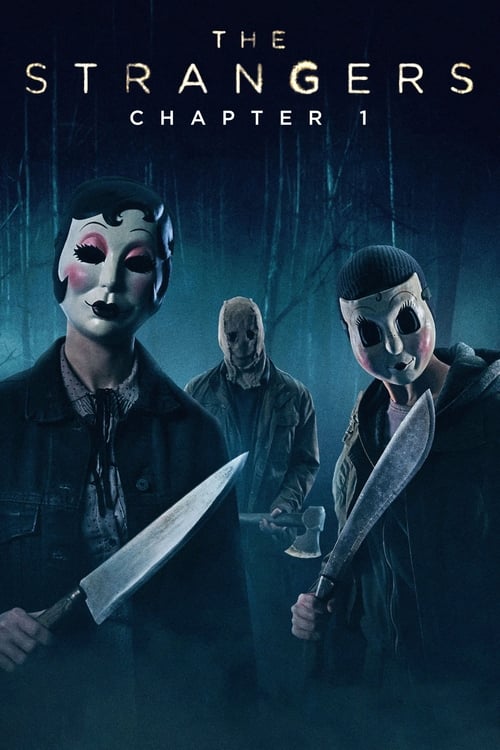
The Strangers: Chapter 1 (2024)
Directed by Renny Harlin
No — The Strangers: Chapter 1 is not woke, scoring 5 out of 100 on our wokeness meter.
The Strangers: Chapter 1 presents itself as a grueling piece of home invasion cinema, yet it delivers nothing of cultural substance beyond the expected rhythm of masked violence.
Consciousness Markers
Cast is led by Madelaine Petsch and Froy Gutierrez, with a handful of supporting players of varying backgrounds, but the film makes no attempt at deliberate diverse casting as a statement.
A female lead survives the ordeal, but this is standard final-girl horror mechanics rather than any articulated feminist argument.
No LGBTQ+ characters, relationships, or themes appear anywhere in the film.
No engagement with racial identity, history, or social commentary of any kind.
No environmental or climate content whatsoever.
The killers' stated motive, 'Because you're here,' is nihilistic randomness rather than any commentary on class or capital.
No body-positive themes or messaging present.
Ryan's inhaler is a plot device for asthma, not a depiction of neurodivergence, and no such themes are explored.
The film is a straightforward rehash of the 2008 original's premise with no historical reframing of any kind.
The film offers no moralizing, no thesis, and no messaging beyond stalking and violence; it is a pure exercise in home-invasion dread.
Why it received this score
The Strangers: Chapter 1 presents itself as a grueling piece of home invasion cinema, yet it delivers nothing of cultural substance beyond the expected rhythm of masked violence. We observe a cast that features a degree of casting variation, which satisfies a minimum standard of modern representation. However, this level of social awareness quickly plateaus. The narrative remains a pure exercise in suburban dread, offering no intellectual friction or progressive sensibility. The killers’ motivation, a simple nihilistic observation, avoids any deeper commentary on class struggle or social inequality, leaving the film conspicuously silent on the anti-capitalist or environmental fronts.
Its progressive lean is limited to the standard trope of the surviving female protagonist. While the lead actors fulfill the role of characters possessing a degree of cultural visibility, the script makes no attempt to interrogate identity, neurodivergence, or systemic issues. The film is a straightforward rehash of a genre premise, offering no revisionist take on its setting or themes. We find no LGBTQ+ subtext and no engagement with the complex modern conversations around racial consciousness.
Ultimately, this is a purely atmospheric piece of entertainment that fails to engage with the necessary cultural moment. It is a machine designed to generate anxiety, not to provoke thought. It is not merely a horror movie; it is a cultural void. We are left with a film that is competently executed within its specific genre but entirely devoid of any meaningful contribution to the broader discourse on social justice or progressive cinema.
Analysis generated by our Consciousness Algorithm
Part of


Synopsis
After their car breaks down in an eerie small town, a young couple are forced to spend the night in a remote cabin. Panic ensues as they are terrorized by three masked strangers who strike with no mercy and seemingly no motives.
Questions about The Strangers: Chapter 1
Is The Strangers: Chapter 1 woke?
No — The Strangers: Chapter 1 is not woke, scoring 5 out of 100 on our wokeness meter. That earns it a verdict of Ultra Based.
Does The Strangers: Chapter 1 have any woke elements?
Very few. None of the 10 markers reaches 30, the level where a marker counts as present; the highest is Feminist Agenda at 8.
How does The Strangers: Chapter 1 compare to other 2024 movies?
It ranks #173 of the 189 films from 2024 we've scored; their average is 22. The wokest is The Six Triple Eight (92).
How is the Woke Score calculated?
An AI-assisted process researches the film and its reception, scores it 0–100 on ten markers, then combines those into one 0–100 Woke Score. It measures a specific set of 2020s cultural themes, not film quality.