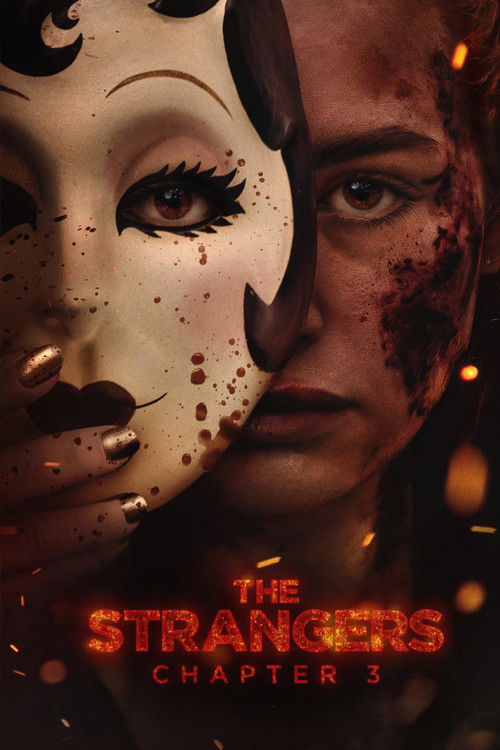
The Strangers: Chapter 3 (2026)
Directed by Renny Harlin
No · Ultra Based
How we score movies →Consciousness Markers
The cast includes actors of various ethnicities and a female lead, but this appears incidental to the story rather than intentional. No meaningful representation narrative is present.
While the protagonist is female and survives through her own efforts, the film engages in no feminist commentary or critique. She is simply a final girl in a conventional horror framework.
The killers are portrayed as childhood murderers with implied psychological abnormality, but this is treated as a plot point rather than any nuanced exploration of neurodivergence or mental health.
No critique of capitalism, wealth inequality, or systemic economic injustice appears in the narrative. The killers' motivations stem from personal pathology rather than social commentary.
No LGBTQ+ themes, characters, or references are evident in this straightforward slasher narrative about masked killers hunting victims.
The film contains no apparent exploration of racial dynamics, systemic racism, or racial justice themes. Killers target victims regardless of race in a generic home invasion scenario.
Environmental or climate-related themes are entirely absent from this horror film, which focuses exclusively on personal survival during a violent encounter.
The film contains no body positivity messaging or commentary on body image, beauty standards, or bodily autonomy beyond the generic violence inherent to horror.
No historical narrative or revisionist historical perspective appears in this contemporary horror setting focused on personal violence rather than historical events.
The film contains no preachy messaging, moral lectures, or attempts to educate the audience about social issues. It is purely a mechanical plot execution.


Synopsis
Tethered by a frightening conclusion, Maya and the Strangers are locked on an unavoidable, unforgiving collision course, a showdown that proves they're far from strangers now.
Why it received this score
The Strangers: Chapter 3 concludes what critics have unanimously described as a failed experiment in horror remake franchise extension. Director Renny Harlin's trilogy, shot in 2022 and released across 2024-2026, appears to have misunderstood the appeal of Bryan Bertino's original 2008 film by methodically explaining away the mystery that made those anonymous killers terrifying. This is a work of pure commercial calculation, designed to capitalize on a recognizable IP without any particular artistic vision or thematic ambition.
The film itself makes no apparent effort to engage with contemporary social consciousness. It is a conventional slasher narrative featuring a female protagonist, Maya, portrayed by Madelaine Petsch, who survives through resourcefulness rather than because the script has anything meaningful to say about gender, trauma, or survival. The cast includes actors of various backgrounds, but their presence reads as demographic coincidence rather than intentional representation. There is no discernible commentary on class, capitalism, or systemic inequality. No environmental concerns intrude upon the masked killers' rampage. The film simply exists as a mechanical exercise in extending a story that was exhausted by its second installment.
What results is a film so narratively and thematically inert that it barely registers as a cultural artifact worth discussing. It is neither offensive nor progressive. It is simply a hollow commercial product, and perhaps that indifference to larger questions is its most honest achievement.
Analysis generated by our Consciousness Algorithm
Critic Reviews
“Director Renny Harlin does his best to maintain the same level of slow-burning dread as he pulled off in the prior film, but it ends up feeling like a mundane, fly on the wall account of the average day at the office for the two surviving killers. ”
“This final chapter, like its immediate predecessors, falls somewhere between footnote and outright detritus, like a plastic bag being blown through the multiplex by a stiff breeze.”
“The third chapter is better than the middle one by virtue of having at least a few new ideas and one less CGI wild boar, but it’s still a shapeless mess, a movie that might have worked as the final act of one film.”
“This is an unconscionably lazy piece of work, the kind of movie that makes you marvel how people will put months of work into creating a feature film whose script seems to have been written in a few hours’ uninspired haste.”