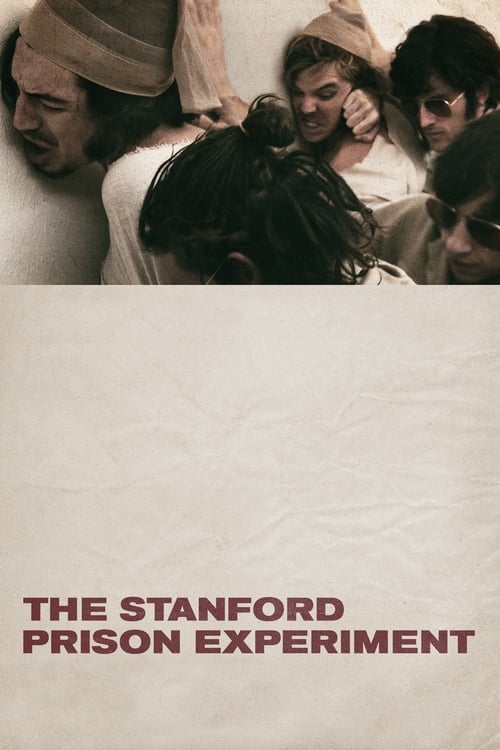
The Stanford Prison Experiment (2015)
Directed by Kyle Patrick Alvarez
No — The Stanford Prison Experiment is not woke, scoring 7 out of 100 on our wokeness meter.
The Stanford Prison Experiment arrives with the sober bearing of a film that knows it is about something.
Consciousness Markers
As a docudrama, the film carries an implicit thesis about situational power and the banality of cruelty, but it dramatizes rather than preaches, letting the events speak for themselves.
The cast is dominated by white male actors, reflecting the historically documented demographics of the 1971 Stanford student body; a few minority performers (Nelsan Ellis, Ki Hong Lee, Moisés Arias) appear without any commentary on their presence.
Dr. Christina Maslach serves as the moral conscience who confronts Zimbardo and ends the experiment, but this is a faithful depiction of the real historical figure rather than an imposed feminist thesis.
The $15-a-day payment and the abuse of institutional authority gesture faintly at exploitation, but the film's focus is psychological, not economic critique.
No LGBTQ+ characters, relationships, or themes appear anywhere in the film.
The film examines power dynamics and role-playing psychology with no engagement of race as a theme or social critique.
No environmental or climate-related content whatsoever.
No body-positivity themes or messaging present.
Prisoners suffer psychological breakdowns under duress, but the film frames this as situational trauma, not neurodivergence as identity or representation.
The film dramatizes the documented events of the Stanford prison experiment with reasonable fidelity; it does not rewrite or reinterpret history for ideological ends.
Why it received this score
The Stanford Prison Experiment arrives with the sober bearing of a film that knows it is about something. Kyle Patrick Alvarez reconstructs the 1971 basement of Jordan Hall with gruesome fidelity, casting a company of young men whose demographics match the historical record of a Stanford psychology department: mostly white, mostly comfortable, mostly willing to accept fifteen dollars a day to be degraded. A handful of minority performers appear among the prisoners, notably Nelsan Ellis and Ki Hong Lee, and the film offers no comment on their presence. They are simply students who signed up. This is either an oversight or a form of restraint, and we are inclined to call it the latter.
The film's conscience is Dr. Christina Maslach, who arrives late, surveys the wreckage, and tells Zimbardo plainly that he has become the thing he studies. That she is a woman confronting a man is a matter of historical fact, not of imposed thesis. The screenplay does not pause to congratulate itself. There is no lecture on race, no environmental lament, no economic sermon, though the fifteen-dollar stipend and the casual cruelty of institutional authority hover at the edges. The breakdowns suffered by the prisoners are treated as situational trauma, the product of a bad room and a worse idea, not as an occasion for diagnosing anyone's identity.
This leaves a chamber piece about power, which lets the events speak. The film is not indifferent to social meaning; it simply declines to explain itself. In an era of cinema that treats the audience as a classroom, this restraint reads as almost antique. We found it bracing. The cruelty accumulates without commentary, which is the most damning commentary available.
Analysis generated by our Consciousness Algorithm


Synopsis
In 1971, Stanford's Professor Philip Zimbardo conducts a controversial psychology experiment in which college students pretend to be either prisoners or guards, but the proceedings soon get out of hand. Based on a true story.
Questions about The Stanford Prison Experiment
Is The Stanford Prison Experiment woke?
No — The Stanford Prison Experiment is not woke, scoring 7 out of 100 on our wokeness meter. That earns it a verdict of Ultra Based.
Does The Stanford Prison Experiment have any woke elements?
Very few. None of the 10 markers reaches 30, the level where a marker counts as present; the highest is Lecture Energy at 20.
How does The Stanford Prison Experiment compare to other 2015 movies?
It ranks #183 of the 289 films from 2015 we've scored; their average is 15. The wokest is Chi-Raq (78).
How is the Woke Score calculated?
An AI-assisted process researches the film and its reception, scores it 0–100 on ten markers, then combines those into one 0–100 Woke Score. It measures a specific set of 2020s cultural themes, not film quality.