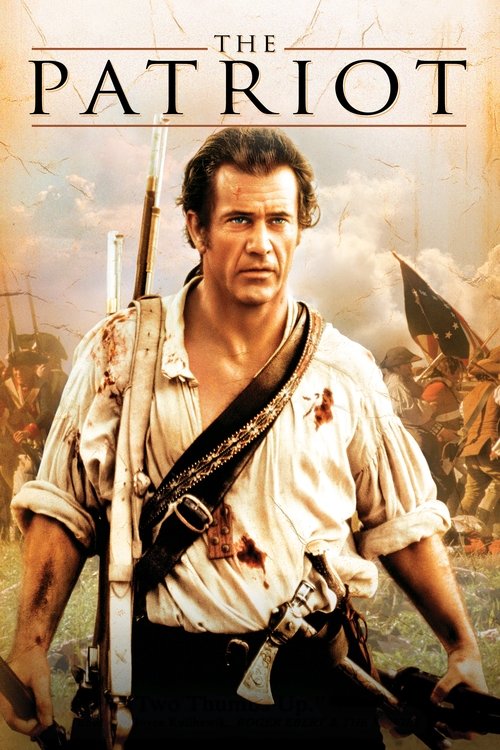
The Patriot (2000)
Directed by Roland Emmerich
No — The Patriot is not woke, scoring 8 out of 100 on our wokeness meter.
The Patriot arrives from 2000, a year when a studio could still spend a hundred and ten million dollars on the American Revolution and trust the audience to bring its own flag.
Consciousness Markers
The film rewrites the Revolutionary War into a clean morality tale: it omits slavery, invents a Black-and-white integrated militia, demonizes the British as serial war criminals, erases French and Loyalist support, and whitewashes the conduct of its Francis Marion-inspired hero.
Predominantly white cast led by Mel Gibson, Heath Ledger, and Jason Isaacs; a handful of Black characters appear as freedmen and Gullah settlers, but the film was criticized for minimizing and romanticizing their presence rather than celebrating diversity.
The film depicts Black freedmen fighting cheerfully shoulder-to-shoulder with white rebels and a Gullah settlement, but historians blasted this as a whitewash that erases slavery; the treatment is oblivious rather than racially conscious.
A rousing, crowd-pleasing patriotic epic rather than a preachy sermon; its messaging is old-fashioned flag-waving, not modern ideological instruction.
Charlotte and Anne exist mostly as caretakers and love interests within a story about fathers, sons, and battlefield honor; no feminist critique or female agency beyond the domestic sphere.
No LGBTQ+ characters, subtext, or themes of any kind.
No environmental or climate themes whatsoever.
No critique of capitalism, class, or wealth; the film celebrates agrarian property and revolutionary nation-building.
No body-positivity themes or commentary on body image.
No neurodivergent characters or themes.
Why it received this score
The Patriot arrives from 2000, a year when a studio could still spend a hundred and ten million dollars on the American Revolution and trust the audience to bring its own flag. Roland Emmerich directs with the appetite for spectacle he brought to alien invasions, and Mel Gibson supplies the wounded gravity of a man who would prefer to farm. It is well-made machinery. The battles have weight, John Williams wrote a nominated score, and the picture earned two hundred and fifteen million dollars worldwide. None of it required a thesis.
Where the film bends toward a modern sensibility is in its memory of the past. The Revolution becomes a clean morality tale. Benjamin Martin, a composite drawn largely from Francis Marion, is a man of conscience who slaughtered surrendering French soldiers at Fort Wilderness and is still our hero. The British are sadists and serial war criminals. The French contribution is airbrushed out, and the Loyalists, who were the majority, are reduced to one sneering informer. Most consequentially, Black freedmen fight cheerfully shoulder to shoulder with white rebels, and the family takes refuge in a Gullah settlement. Historians treated this as a whitewash of the institution the war did nothing to end. Gibson later expressed regret that Martin was not written as a slave owner. That is the film's real cultural footprint, and it is heavy.
Elsewhere the progressive markers are absent, and we should not manufacture them. No environmental sermon, no critique of wealth, no meditation on the body, no neurodivergent character. Women are caretakers and love interests in a story about fathers and sons. The cast is overwhelmingly white, with a few Black faces placed at the margins and asked to smile. The politics are old-fashioned flag-waving, unexamined and unapologetic. It lectures no one. It assumes everyone already agrees. A curious vintage: robust, tannic, best not examined too closely.
Analysis generated by our Consciousness Algorithm


Synopsis
After proving himself on the field of battle in the French and Indian War, Benjamin Martin wants nothing more to do with such things, preferring the simple life of a farmer. But when his son Gabriel enlists in the army to defend their new nation, America, against the British, Benjamin reluctantly returns to his old life to protect his son.
Questions about The Patriot
Is The Patriot woke?
No — The Patriot is not woke, scoring 8 out of 100 on our wokeness meter. That earns it a verdict of Ultra Based.
Does The Patriot have any woke elements?
1 of the 10 markers register at 30 or above, led by Revisionist History (55). On Revisionist History: The film rewrites the Revolutionary War into a clean morality tale: it omits slavery, invents a Black-and-white integrated militia, demonizes the British as serial war criminals, erases French and Loyalist support, and whitewashes the conduct of its Francis Marion-inspired hero.
How does The Patriot compare to other 2000 movies?
It ranks #65 of the 125 films from 2000 we've scored; their average is 13. The wokest is But I'm a Cheerleader (72).
How is the Woke Score calculated?
An AI-assisted process researches the film and its reception, scores it 0–100 on ten markers, then combines those into one 0–100 Woke Score. It measures a specific set of 2020s cultural themes, not film quality.