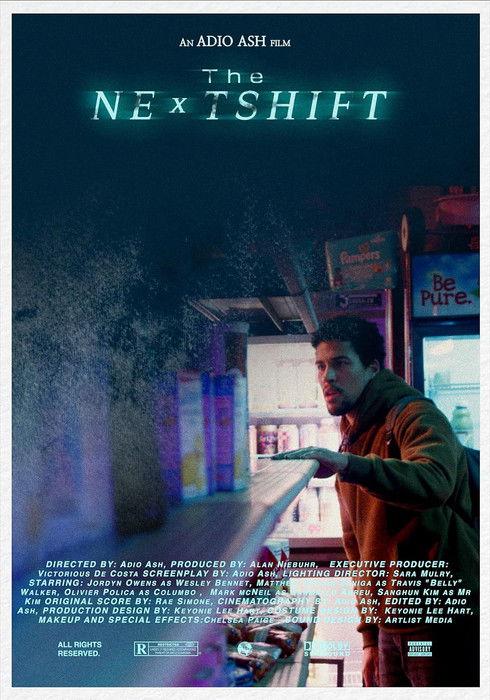
The Next Shift (2026)
Directed by Adio Ash
Adio Ash's "The Next Shift" arrives on Tubi with the quiet confidence of a film that has nothing to prove to anyone, least of all the mainstream critical apparatus that has declined to notice it.
Consciousness Markers
Race, class, and urban identity are described as core thematic threads by the filmmakers themselves. However, the framing appears to be grounded storytelling rather than explicit racial consciousness-raising or commentary on systemic racism.
The film features a predominantly Black cast made by Black independent filmmakers, framed explicitly by its creators as an example of underrepresented urban narratives. This is organic to the story rather than performative, but the intentionality is present at the production level.
The premise involves a formerly privileged character navigating class disparity in a new environment, which carries latent class tension. There is no evidence this rises to explicit anti-capitalist messaging.
Crew and promotional materials frame the film as highlighting underrepresented urban narratives, which hints at a message-driven intent. The film itself does not appear to deliver that message through sermonizing, keeping this score low.
No LGBTQ+ themes, characters, or storylines are identified in the available research or premise.
The central narrative is driven by a male protagonist and his peer group. No feminist framing or agenda is evident in the film's described content.
No climate themes, environmental messaging, or ecological subtext is present in the film's premise or research findings.
No body positivity themes or related content are identified in the research or film description.
No neurodivergent characters or related themes are mentioned in any available material about the film.
The film is a contemporary coming-of-age thriller with no historical setting or revisionist historical framing.
Why it received this score
Adio Ash's "The Next Shift" arrives on Tubi with the quiet confidence of a film that has nothing to prove to anyone, least of all the mainstream critical apparatus that has declined to notice it. Set in Jersey City, it follows Wesley, a formerly comfortable young man now navigating the social physics of a new school, whose bid for acceptance leads him and a small ensemble into a bodega and into the kind of long, consequential night that independent cinema has always handled better than its studio counterpart. The film is, by the account of its own makers, a story about peer pressure, class disparity, and the search for identity. These are old themes. They remain effective because they are true.
The film's racial composition and its celebration within Black independent film circles are organic facts of its production, not programmatic decisions handed down from a studio diversity committee. The characters are not symbols or correctives. Wesley is trying to fit in, which is the oldest story there is. The class tensions embedded in the premise, a kid from privilege stranded in a new social ecosystem, carry real dramatic weight without announcing themselves as a lecture. The film does not appear to have been designed to make an audience feel instructed. That is rarer than it should be.
On the spectrum of films that deploy progressive cultural furniture as load-bearing architecture, "The Next Shift" registers as essentially inert. It is a coming-of-age thriller made by young Black filmmakers about young people in an urban setting, and it declines to weaponize any of that. No climate allegory lurks in the bodega's refrigerated aisle. No character delivers a monologue about systemic structures. The film simply tells its story and trusts the audience to follow. In the current landscape, this qualifies as a form of restraint worth acknowledging, however briefly, before moving on.
Analysis generated by our Consciousness Algorithm
Synopsis
In efforts to try and fit in with his new classmates, Wesley decides to join a couple of them on a night out that leads to a crime that may change the course of his life.