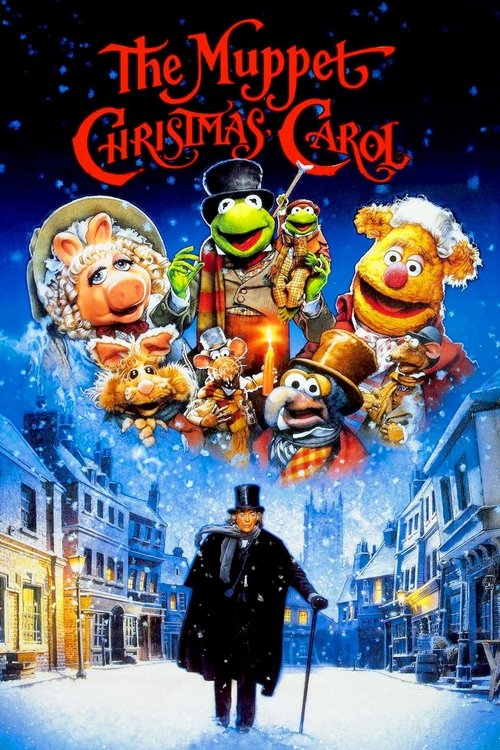
The Muppet Christmas Carol (1992)
Directed by Brian Henson
No — The Muppet Christmas Carol is not woke, scoring 9 out of 100 on our wokeness meter.
There is something almost admirable about a picture that makes no effort to update Dickens for contemporary sensitivities.
Consciousness Markers
Dickensian critique of greed and miserliness is present, with Scrooge's redemption through charity, but it targets individual avarice rather than capitalism as a system.
The cast consists of Muppet performers and British actors; there is no deliberate identity-based casting or commentary on representation.
No LGBTQ+ characters, themes, or subtext are present.
Belle appears as a lost love in Scrooge's past, but the story is not structured around feminist themes or gender critique.
The film does not engage with race, racism, or racial identity.
No environmental or climate themes appear in the story.
No body-positivity themes or diverse body representation as a message.
No neurodivergence themes or characters are present.
A faithful adaptation of Dickens' Victorian London, not a revisionist historical narrative.
Moralizing about charity and kindness is present, but it is a traditional Dickensian Christmas message rather than modern social-justice lecturing.
Why it received this score
There is something almost admirable about a picture that makes no effort to update Dickens for contemporary sensitivities. The Muppets remain felt, the London streets remain Victorian, and Michael Caine plays Scrooge as if the Royal Shakespeare Company were waiting in the wings. The film has no interest in contemporary identity categories, no environmental or racial thesis, no therapeutic celebration of the body, and no diagnostic vocabulary for the mind. It is a Dickens adaptation, not a seminar. The only faint progressive pulse comes from Dickens' own contempt for avarice. That contempt is aimed at a man, not a system. Scrooge's sin is personal miserliness, and his redemption is personal charity. The film does not indict capitalism. It asks a rich man to be nicer. That is an old Christmas message, not a modern ideological project.
Belle exists as a lost love, but her function is to measure Scrooge's moral decline. The story does not critique gender. The film's lecture energy is Dickensian moralizing about kindness, not contemporary social-justice sermonizing. There is no revisionist history and no climate crusade. The Muppets are anarchic but never preachy in the modern sense. The songs by Paul Williams are treacly in places, but they are not trying to reprogram the audience. The film's most radical act is casting a human as the lead in a Muppet movie and letting him treat puppets as scene partners. That is a formal experiment, not a cultural one.
In the end, the film earns a small measure of anti-capitalist flavor because Dickens cannot help himself, but the target is greed, not capital. It is a gentle, nostalgic, mostly harmless holiday artifact. The Ghost of Christmas Present shows abundance, not sustainability. Tiny Tim is saved by charity, not by universal healthcare. The film endures because it is warm, not because it is enlightened. We classify it accordingly: a Victorian morality tale wearing felt, with no interest in the battles of our present moment. It is almost defiantly untouched by the current cultural taxonomy.
Analysis generated by our Consciousness Algorithm
Part of


Synopsis
A retelling of the classic Dickens tale of Ebenezer Scrooge, miser extraordinaire. He is held accountable for his dastardly ways during nighttime visitations by the Ghosts of Christmas Past, Present and Future.
Questions about The Muppet Christmas Carol
Is The Muppet Christmas Carol woke?
No — The Muppet Christmas Carol is not woke, scoring 9 out of 100 on our wokeness meter. That earns it a verdict of Ultra Based.
Does The Muppet Christmas Carol have any woke elements?
Very few. None of the 10 markers reaches 30, the level where a marker counts as present; the highest is Eat the Rich at 15.
How does The Muppet Christmas Carol compare to other 1992 movies?
It ranks #31 of the 74 films from 1992 we've scored; their average is 12. The wokest is The Crying Game (62).
How is the Woke Score calculated?
An AI-assisted process researches the film and its reception, scores it 0–100 on ten markers, then combines those into one 0–100 Woke Score. It measures a specific set of 2020s cultural themes, not film quality.