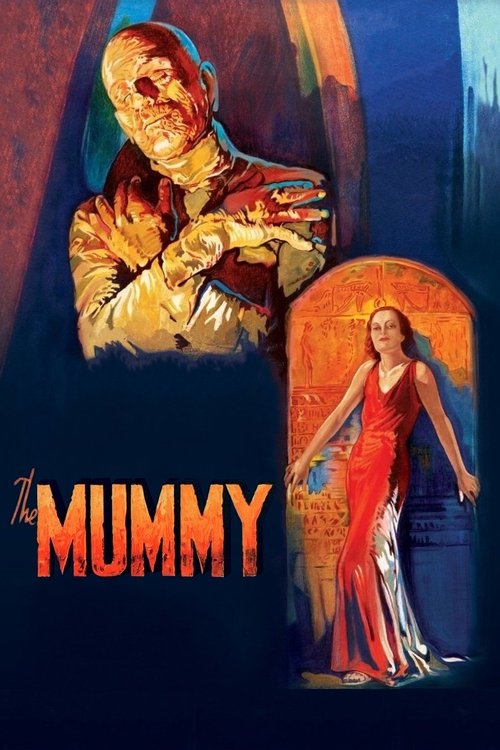
The Mummy (1932)
Directed by Karl Freund
No — The Mummy is not woke, scoring 0 out of 100 on our wokeness meter.
Karl Freund's The Mummy arrives from 1932 with the confidence of a film that has nothing to prove and nothing to teach.
Consciousness Markers
The cast is largely white, and the few non-white roles are exoticized or stereotypical rather than examples of modern inclusive representation.
There are no LGBTQ+ characters, themes, or subtext in the film.
The female lead is primarily a reincarnated love object and damsel to be rescued, with no feminist critique or agency-driven agenda.
The Egyptian setting and Nubian servant character reflect 1930s Orientalist tropes, not modern racial consciousness or social critique.
The film contains no environmental themes or climate commentary.
There is no critique of capitalism, wealth inequality, or class exploitation.
The film does not engage with body positivity or diverse body image themes.
A character's madness is used as a horror trope, not as thoughtful neurodivergent representation.
The film invents supernatural Egyptian lore for horror entertainment rather than revising history through a modern ideological lens.
The film is a mood-driven horror melodrama and does not deliver modern social or political lectures.
Why it received this score
Karl Freund's The Mummy arrives from 1932 with the confidence of a film that has nothing to prove and nothing to teach. A British expedition in Egypt disturbs a buried priest, a scroll is read aloud, and a man wrapped in linen walks out of his own grave. After that, the film becomes mood, shadow, and the slow courtship of a woman who may be the reincarnation of a princess dead three thousand years. The camera lingers on Karloff's face for long stretches, and the film trusts atmosphere to do the work that lesser pictures hand to dialogue.
The social arrangements on display belong entirely to their era. Egypt serves as a backdrop of curses and trances, a place where ancient magic explains everything and local characters exist to be hypnotized. Helen Grosvenor spends most of the running time being summoned, possessed, or carried off, her agency measured in how gracefully she faints. A Nubian servant is enslaved by the villain's sorcery because his bloodline is deemed susceptible, a detail the screenplay offers without a flicker of unease. Madness, meanwhile, is played for a laugh that curdles into a death, and nobody involved seems to think it needs a diagnosis.
None of this is an accusation. A pre-Code horror melodrama from Universal was not built to carry the moral freight of a later century, and it shows no interest in doing so. There is no sermon here, no lesson, no closing address to the audience about how to behave. The film wants one thing: to make us uneasy in the dark, and it succeeds with a patience that modern horror has largely forgotten. As a document of cultural consciousness, it is a clean slate, and there is something almost restful about that. We grade it accordingly, with the solemn gratitude of a sommelier presented a bottle that has never been touched by anything modern. Zero additives. A rare vintage.
Analysis generated by our Consciousness Algorithm
Part of


Synopsis
An ancient Egyptian priest named Imhotep is revived when a British archaeological expedition finds his mummy and one of the researchers accidentally reads an ancient life-giving spell. Imhotep escapes from the field site and searches for the reincarnation of the soul of his lover.
Questions about The Mummy
Is The Mummy woke?
No — The Mummy is not woke, scoring 0 out of 100 on our wokeness meter. That earns it a verdict of Ultra Based.
Does The Mummy have any woke elements?
No. All 10 markers score zero.
How does The Mummy compare to other 1932 movies?
It ranks #4 of the 4 films from 1932 we've scored; their average is 10. The wokest is Freaks (30).
How is the Woke Score calculated?
An AI-assisted process researches the film and its reception, scores it 0–100 on ten markers, then combines those into one 0–100 Woke Score. It measures a specific set of 2020s cultural themes, not film quality.