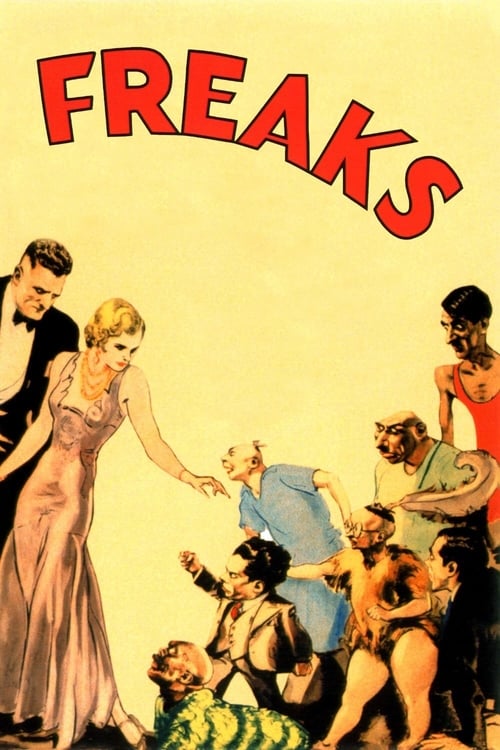
Freaks (1932)
Directed by Tod Browning
No — Freaks is not especially woke, scoring 30 out of 100 on our wokeness meter.
Tod Browning's Freaks arrived in 1932 with the full weight of Metro-Goldwyn-Mayer behind it and promptly died at the box office.
Consciousness Markers
The film's central argument inverts the equation of physical appearance with human worth, presenting disabled bodies as ordinary, loving, and sympathetic while the conventionally beautiful are monstrous — an anti-eugenic, body-accepting stance well ahead of its era.
The film famously cast actual sideshow performers with real disabilities (dwarfs, conjoined twins, microcephaly, limb differences) rather than able-bodied actors, giving its marginalized subjects genuine presence — a casting practice decades ahead of any modern convention, though rooted in a 1932 carnival context rather than a contemporary inclusiveness ethos.
Scholars read the film as a Depression-era parable of the poor 'little people' overthrowing their scornful wealthy 'betters,' with the sideshow underclass triumphing over the grasping rich — a genuine class-conflict narrative, though filtered through horror rather than explicit polemic.
Characters with microcephaly and a stuttering clown appear as part of the troupe, but the film does not thematically examine neurodivergence in any deliberate way.
The film dramatizes its social critique through imagery and narrative rather than direct moralizing; its messages are interpreted by critics rather than preached on screen.
No LGBTQ+ themes or characters are present; the romance and intrigue are entirely heteronormative.
The film offers no feminist agenda; its female lead is a scheming villain who is ultimately mutilated, and the sympathetic women are defined by romantic devotion.
There is no racial consciousness in the film; the cast and narrative concern an entirely white European/American carnival world.
No environmental or climate themes appear in the film.
No historical revisionism is present; the film is a contemporary-set fictional horror drama drawn from a short story.
Why it received this score
Tod Browning's Freaks arrived in 1932 with the full weight of Metro-Goldwyn-Mayer behind it and promptly died at the box office. Audiences found it repellent. The studio cut it from ninety minutes to sixty-four, and the excised footage is gone. What remains is a strange, patient, deeply unfashionable picture about a traveling circus, a scheming trapeze artist, and a community of performers who were, in the most literal sense, cast from life. Browning hired working sideshow professionals: dwarf siblings Harry and Daisy Earles, the conjoined Hilton sisters, Johnny Eck, Schlitzie. No able-bodied star was asked to simulate a disability for the sake of an awards campaign. The practice reads today as an act of conscience. In 1932 it was simply how the material was sourced.
The film's moral geometry is inverted with a straight face throughout. Cleopatra, played by Olga Baclanova, is beautiful, greedy, and murderous. Hans is small, wealthy, and sincere. The performers around him marry, quarrel, gossip, and celebrate the birth of a child. The camera lingers on these ordinary domesticities until the audience's initial revulsion has nowhere left to go. Critics have read the whole enterprise as a Depression parable, the little people against the big people, the underclass versus the grasping rich. That reading holds. The wedding feast chant of "one of us" functions as welcome and threat simultaneously, which is the film's entire trick.
What Freaks does not do is lecture. There is no narrator explaining eugenics, no character delivering a speech about human dignity. The argument lives in the staging, and viewers are left to assemble it themselves. The film contains no racial dimension, no environmental concern, no engagement with gender politics beyond a villainess who receives a punishment of unusual cruelty. It is a horror picture asserting that the beautiful are monstrous, and it makes that case through images alone. The Academy did not nominate it. The National Film Registry eventually preserved it. The intervening decades have been kinder to it than its own studio was.
Analysis generated by our Consciousness Algorithm


Synopsis
A circus' beautiful trapeze artist agrees to marry the leader of side-show performers, but his deformed friends discover she is only marrying him for his inheritance.
Questions about Freaks
Is Freaks woke?
No — Freaks is not especially woke, scoring 30 out of 100 on our wokeness meter. That earns it a verdict of Based.
Does Freaks have any woke elements?
3 of the 10 markers register at 30 or above, led by Body Positivity (55), Representation Casting (48) and Eat the Rich (35). On Body Positivity: The film's central argument inverts the equation of physical appearance with human worth, presenting disabled bodies as ordinary, loving, and sympathetic while the conventionally beautiful are monstrous — an anti-eugenic, body-accepting stance well ahead of its era.
How does Freaks compare to other 1932 movies?
It is the wokest of the 4 films from 1932 we've scored; their average is 10.
How is the Woke Score calculated?
An AI-assisted process researches the film and its reception, scores it 0–100 on ten markers, then combines those into one 0–100 Woke Score. It measures a specific set of 2020s cultural themes, not film quality.