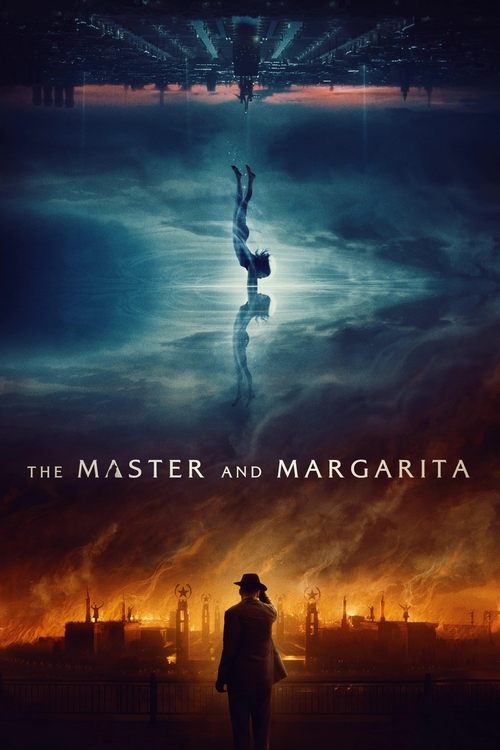
The Master and Margarita (2024)
Directed by Michael Lockshin
Michael Lockshin's adaptation of Bulgakov's unadaptable novel arrives as a genuine curiosity in the taxonomy of modern progressive cinema: a film that is politically charged, internationally cast, and deeply concerned with power and oppression, yet manages to score almost nothing on the standard metrics.
Consciousness Markers
Margarita is a co-titular character who exercises fierce personal agency, abandons her comfortable marriage, and ultimately bargains with Satan himself on her own terms. This is a genuinely strong female arc, though it originates in Bulgakov's 1930s novel rather than any contemporary agenda.
Director Lockshin restructures the novel to fold Bulgakov's own biography into the narrative, and adds an original fantasy sequence in which Moscow burns as an act of symbolic revenge against the Soviet state. These are authorial interventions that reframe historical persecution through a contemporary lens.
The production casts a German actor (August Diehl) and a Danish actor (Claes Bang) in key roles alongside Russian leads. This reflects international art-house ambition more than deliberate diversity programming, and no evidence suggests casting decisions were driven by representation mandates.
The film's anti-authoritarian message is delivered through surrealist spectacle and allegorical fantasy, not through characters delivering speeches at each other. The political point is made obliquely, which is the entire tradition of Bulgakov's original work.
The film skewers corrupt Soviet bureaucrats and the self-serving hypocrisy of the privileged class, but this critique is aimed squarely at authoritarian state power, not capitalism. The satirical targets are apparatchiks, not executives.
The Master's confinement in a psychiatric asylum is a central plot element, and the film treats his institutionalization as a tool of state oppression rather than legitimate medical care. This reads as political commentary on Soviet psychiatry, not modern neurodivergence advocacy.
No LGBTQ+ themes, characters, or subtext are present in the film or its source material adaptation. The score is zero.
The film contains no racial consciousness themes, commentary on race, or race-informed casting choices. The score is zero.
No climate or environmental themes are present. The score is zero.
No body positivity themes or messaging are present. The score is zero.
Why it received this score
Michael Lockshin's adaptation of Bulgakov's unadaptable novel arrives as a genuine curiosity in the taxonomy of modern progressive cinema: a film that is politically charged, internationally cast, and deeply concerned with power and oppression, yet manages to score almost nothing on the standard metrics. This is because its concerns are old ones. Anti-totalitarianism, the resilience of art against state violence, the moral cowardice of the comfortable class: these are the preoccupations of a man writing under Stalin, not a filmmaker calibrating their content for a 2024 streaming audience. The distinction matters, and we are here to make it.
The film's most socially conscious element is, in fact, Margarita herself. Yuliya Snigir plays her as a woman who trades a suffocating bourgeois marriage for a pact with the devil, and the film treats this as entirely reasonable. This is a strong female arc by any measure, though it has been strong since Bulgakov wrote it in the 1930s, which complicates the attribution of credit to contemporary sensibilities. Lockshin does add his own fingerprints: the restructuring of the narrative to mirror Bulgakov's biography, and a climactic Moscow-in-flames sequence that functions as a revenge fantasy against the apparatus of state repression. These choices nudge the film toward the revisionist, but gently. The message arrives wrapped in fire and talking cats rather than in a closing monologue.
What is most striking, from a purely classificatory standpoint, is that this film was denounced by state television, had its director scrubbed from promotional materials, and inspired petitions for criminal prosecution, all while registering almost no score on the markers we use to identify progressive cultural product. It turns out that genuine political courage and the specific aesthetic vocabulary of 2020s social consciousness are not the same thing. The film is, by the standards of this rubric, practically inert. By the standards of almost everything else, it is remarkable.
Analysis generated by our Consciousness Algorithm
Synopsis
A struggling writer in 1930s Soviet Moscow finds his life transformed when a mysterious professor arrives with his bizarre entourage, including a wisecracking trickster, a deadly assassin, a vampire maid, and a giant talking black cat, turning the city upside down while exposing the hypocrisy of those in power.