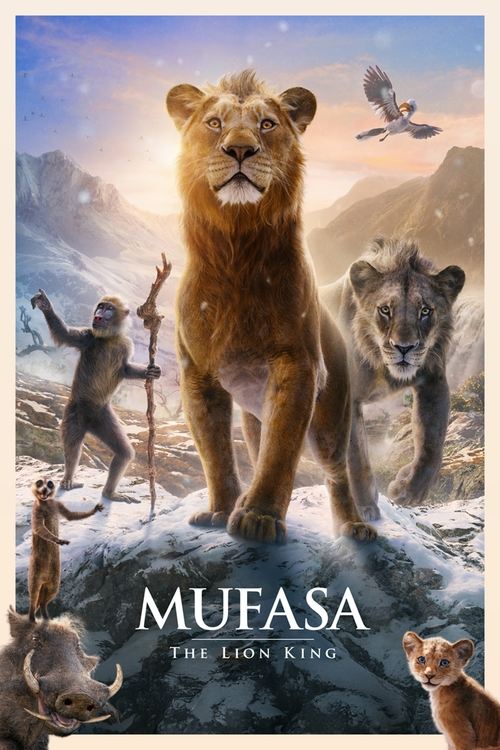
Mufasa: The Lion King (2024)
Directed by Barry Jenkins
Partly · Woke-Adjacent
How we score movies →Consciousness Markers
Deliberate emphasis on African and African-American voice talent with creative agency given to performers. Barry Jenkins prioritized authentic representation in casting decisions, though the result still exists within Disney's narrative framework.
Strong intentional focus on African voices and perspectives in the creative process. Jenkins explicitly discussed centering the voice of Africa in the film's production, though set within a fictional rather than grounded setting.
Subtle commentary on feminism noted in reviews, with female characters given some agency in navigating power. However, these themes remain secondary to the central male-centered prequel narrative.
The film maintains a relatively light, family-oriented tone without heavy-handed messaging. Cultural consciousness is woven into production choices rather than explicit preachiness, though some thematic material feels intentional rather than organic.
The prequel format involves retelling and recontextualizing the franchise mythology, though this constitutes creative retelling rather than revisionist history in the contemporary political sense.
The film operates as a prequel to a corporate franchise, with no apparent critique of systems of power or wealth. The narrative concerns itself with individual destiny rather than structural critique.
As an animated film about anthropomorphic lions, body positivity concerns are largely inapplicable. No evident commentary on body image or acceptance.
No climate-related messaging or environmental consciousness present in the film's premise or available critical discussion.
No representation of or thematic engagement with neurodivergence detected in the film's narrative or available information.
No significant LGBTQ+ themes or representation evident in available information about the film. The narrative focuses on traditional power dynamics and male-centered relationships.


Synopsis
Mufasa, a cub lost and alone, meets a sympathetic lion named Taka, the heir to a royal bloodline. The chance meeting sets in motion an expansive journey of a group of misfits searching for their destiny.
Why it received this score
Barry Jenkins arrives at the Disney machinery with the sensibilities of an auteur confronting the immovable object of franchise obligation. The film's most apparent gesture toward cultural consciousness emerges in its casting choices, particularly the emphasis on African and African-American voice talent and the deliberate centering of creative input from performers with continental connections. Jenkins has spoken extensively about giving these actors agency in their roles, which represents a meaningful departure from the voice-casting cynicism of comparable blockbusters. Yet the prequel format itself constrains what could be genuinely subversive, as we are bound to predetermined narrative endpoints and the familiar iconography of a property that predates contemporary sensibilities by three decades.
The film engages with themes of community, belonging, and the construction of identity through a lens that feels conscious of modern identity politics without being strident about it. There are moments of subtle feminist commentary in how female characters navigate power and agency, though these threads remain secondary to the franchise machinery. The "misfits" framing of the core group gestures toward inclusivity, though one might question whether narrative inclusion constitutes meaningful representation or merely aesthetic diversity layered atop conventional storytelling. The film's relationship to its African setting and mythology remains complicated, grounded in a fictional savanna that exists more in the realm of Disney fantasy than geographical or cultural specificity.
What ultimately limits the film's progressive credentials is its fundamental conservatism as a prequel operating within established boundaries. The social consciousness on display feels like intentional directorial choice filtering through corporate parameters rather than organic artistic vision. This is perhaps the most honest assessment one can offer of any major studio franchise film in 2024: the tension between artistic sensibility and commercial obligation produces something that is earnest without being revolutionary, thoughtful without being challenging, and culturally aware without being culturally transformative.
Analysis generated by our Consciousness Algorithm
Critic Reviews
“Here the Oscar-winning director Barry Jenkins (Moonlight) dives truly deep for a tale of orphanhood, family conflict and the reluctant fight for a throne. It’s often thrilling to watch a film featuring only anthropomorphic animals where the central characters are more rounded than most of their human counterparts at the mainstream multiplex (yes, that means you, Gladiator II).”
“Mufasa never quite bursts free of the constraints placed upon it, but those constraints never stop it from moving, or from being moving. It has a signature, rendered with a steady hand.”
“After having been made and remade for the screen and converted into a long-running hit Broadway show, it might have seemed like “The Lion King” was a played-out property. “Mufasa,” under Jenkins’ poised and creative direction, proves there is still plenty of life left in the long-reining “King.” ”
“Dear Lord, this movie didn’t need to be made. It is profoundly awful. The foreshadowing is relentless. Sorry, Barry Jenkins just can’t direct animation. ”