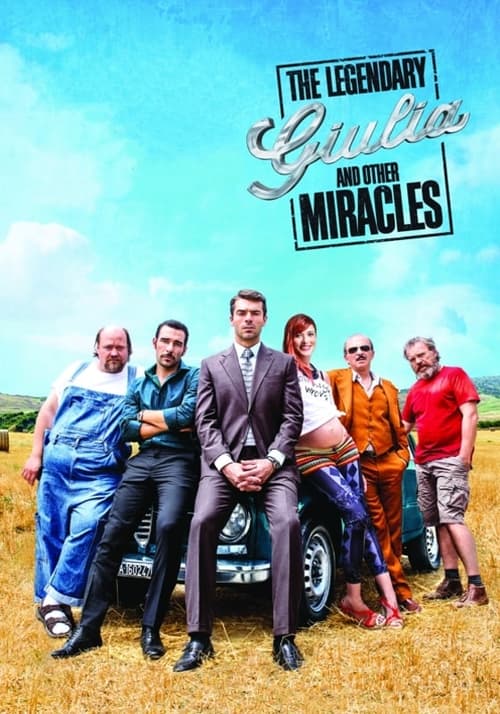
The Legendary Giulia and Other Miracles (2015)
Directed by Edoardo Leo
No — The Legendary Giulia and Other Miracles is not woke, scoring 10 out of 100 on our wokeness meter.
A quintet of Italian men with ruined finances and ruined marriages converge on a country farmhouse none of them can afford, pool their remaining dignity, and attempt to open a bed and breakfast.
Consciousness Markers
The ensemble is a mostly white Italian cast, though it includes Abu, a Ghanaian laborer, and a pregnant woman, Elisa, who exist naturally in the story without commentary.
Sergio is a militant communist and the plot pits scrappy small entrepreneurs against mafia extortion, lending a mild anti-establishment flavor, but the target is organized crime rather than capitalism itself.
Abu, a Ghanaian laborer, and his friends assist in the escape, giving the film a modest immigrant presence, but race is never a subject of commentary or critique.
Elisa is a young pregnant woman recruited specifically to help with cleaning and cooking, a traditional domestic role played for comedy rather than any feminist statement.
This is a breezy Italian ensemble comedy that aims to amuse rather than preach, with only the faintest social observation.
No LGBTQ+ characters, themes, or subtext appear anywhere in the film.
There is no environmental or climate theme in the film.
No body-positive themes or messaging are present.
No neurodivergent characters or themes are depicted.
The film is a contemporary comedy with no historical revisionism.
Why it received this score
A quintet of Italian men with ruined finances and ruined marriages converge on a country farmhouse none of them can afford, pool their remaining dignity, and attempt to open a bed and breakfast. The mafia arrives to collect its share. A communist punches a Camorrista. A car gets buried in the basement and its stereo keeps playing, which the proprietors rebrand as a miracle and a marketing strategy. Edoardo Leo directs himself and a capable ensemble through this amiably shaggy comedy, and the whole enterprise coasts on charm, timing, and the reliable Italian conviction that a group of lovable failures can outwit organized crime through sheer improvisation.
On the matter of social consciousness, the film is a modest specimen. A Ghanaian laborer named Abu appears with his friends to assist in the third-act escape, and a pregnant woman named Elisa is recruited to handle the cleaning and the cooking. Neither presence is interrogated. Race is a fact of the cast list, not a theme. Sergio, the militant communist, supplies a faint anti-establishment tang, though his true enemy is the Camorra's extortion racket and not the machinery of capital itself. The film's grievance is with thugs who demand protection money, which is a grievance nearly everyone can share.
What remains is a lightweight confection with almost no appetite for sermonizing. There is no environmental parable here, no body-positive messaging, no neurodivergent arc, no reconsideration of the historical record. The comedy aims to amuse and largely succeeds, offering only the faintest murmur of social observation along the way. It won Italian awards for its supporting players and for comedy, which tells us what it is: a well-made crowd-pleaser, pleasant, forgettable, and innocent of any agenda beyond getting the audience to the closing credits in a good mood.
Analysis generated by our Consciousness Algorithm
Synopsis
Five down-on-their luck strangers meet by chance while looking at a property in the country none of them are able to afford. They decide to join forces and risk everything to turn it into a B&B, only for the local mafia to show up demanding their "fair" share.
Questions about The Legendary Giulia and Other Miracles
Is The Legendary Giulia and Other Miracles woke?
No — The Legendary Giulia and Other Miracles is not woke, scoring 10 out of 100 on our wokeness meter. That earns it a verdict of Ultra Based.
Does The Legendary Giulia and Other Miracles have any woke elements?
Very few. None of the 10 markers reaches 30, the level where a marker counts as present; the highest is Representation Casting at 22.
How does The Legendary Giulia and Other Miracles compare to other 2015 movies?
It ranks #141 of the 289 films from 2015 we've scored; their average is 15. The wokest is Chi-Raq (78).
How is the Woke Score calculated?
An AI-assisted process researches the film and its reception, scores it 0–100 on ten markers, then combines those into one 0–100 Woke Score. It measures a specific set of 2020s cultural themes, not film quality.