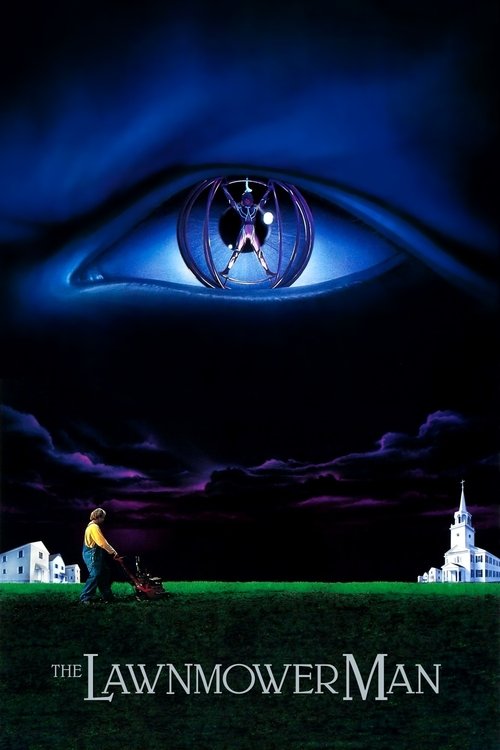
The Lawnmower Man (1992)
Directed by Brett Leonard
No — The Lawnmower Man is not woke, scoring 11 out of 100 on our wokeness meter.
The Lawnmower Man arrived in 1992 trailing litigation, which is a distinguished way for any film to enter the world.
Consciousness Markers
The Shop and Virtual Space Industries are depicted as a clandestine corporate-military complex that hijacks benevolent research for weapons applications, offering a mild anti-establishment critique of institutional exploitation.
Jobe's intellectual disability is central to the plot, but the film frames it as a deficit to be 'enhanced' and cured via science, the opposite of an affirming modern neurodivergence sensibility.
Jobe delivers occasional grandiose monologues about evolution and becoming 'pure energy,' but the film prioritizes genre thrills over preachy messaging.
The cast is uniformly white (Fahey, Brosnan, Wright, Lewis, Norris) with no meaningful diverse casting or inclusive ensemble choices.
There are no LGBTQ+ characters, relationships, or themes anywhere in the film.
Female characters are confined to love interest (Marnie) and mother (Carla) roles; Marnie is lobotomized as a plot device, and no feminist perspective is advanced.
Race is never addressed or thematized; the film engages no racial commentary whatsoever.
There is no environmental or climate theme; the conflict is entirely about technology, intelligence, and power.
The film has no body-positivity content; the disabled protagonist's body is treated as a defect to be corrected rather than celebrated.
This is a wholly fictional science-fiction narrative with no historical events to reinterpret or revise.
Why it received this score
The Lawnmower Man arrived in 1992 trailing litigation, which is a distinguished way for any film to enter the world. Stephen King, whose 1975 short story concerned a Pan-worshipping satyr with a self-operating mower, sued to have his name stripped from the title and won, twice. The surviving screenplay was an unrelated draft called CyberGod, retrofitted with a lawnmower, a victim named Harold Parkette, and the shadowy agency known as The Shop. The finished product is a simulation of an adaptation, wearing the skin of a source it never read.
The narrative concerns Dr. Lawrence Angelo, a researcher at Virtual Space Industries who raises a gardener's cognition through nootropic drugs and computer simulation. Jobe Smith begins intellectually disabled and ends superhuman, and the film treats this as an uncomplicated arc of improvement. His condition is raw material for an experiment, a defect the plot exists to correct. Marnie, his lover, is lobotomized during a cybersex sequence and removed from the story, which is the sort of thing that happens to women in films of this vintage when the plot requires the protagonist to feel something. Nobody in the cast introduces a perspective the film seems interested in examining.
The only political texture comes from The Shop, a clandestine corporate-military apparatus that hijacks benevolent research for weapons work, though the suspicion of institutions never hardens into an argument. Jobe's late monologues about evolution and becoming pure energy carry a faint sermonizing hum before the building explodes. The visual effects were once groundbreaking and now resemble a screen saver with ambitions. The film grossed a great deal of money anyway, which tells us something about 1992 that we may not wish to know.
Analysis generated by our Consciousness Algorithm


Synopsis
A simple man is turned into a genius through the application of computer science.
Questions about The Lawnmower Man
Is The Lawnmower Man woke?
No — The Lawnmower Man is not woke, scoring 11 out of 100 on our wokeness meter. That earns it a verdict of Ultra Based.
Does The Lawnmower Man have any woke elements?
Very few. None of the 10 markers reaches 30, the level where a marker counts as present; the highest is Eat the Rich at 15.
How does The Lawnmower Man compare to other 1992 movies?
It ranks #28 of the 74 films from 1992 we've scored; their average is 12. The wokest is The Crying Game (62).
How is the Woke Score calculated?
An AI-assisted process researches the film and its reception, scores it 0–100 on ten markers, then combines those into one 0–100 Woke Score. It measures a specific set of 2020s cultural themes, not film quality.