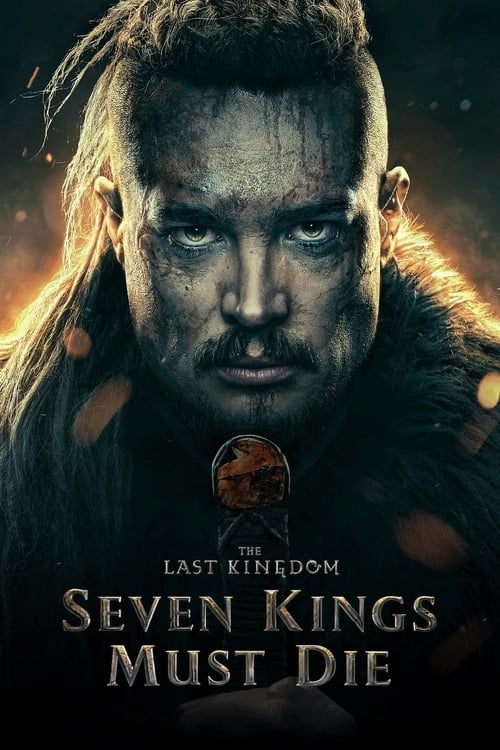
The Last Kingdom: Seven Kings Must Die (2023)
Directed by Edward Bazalgette
No — The Last Kingdom: Seven Kings Must Die is not especially woke, scoring 22 out of 100 on our wokeness meter.
The Last Kingdom: Seven Kings Must Die serves as the feature-length obituary for a television series that spent five seasons converting Bernard Cornwell's Saxon Stories into Sunday-night comfort.
Consciousness Markers
A central plot thread concerns King Aethelstan's homosexuality and his lover/adviser Ingilmundr, with Aethelstan framing his desire as a sin to be atoned for through conquest—an explicit, sustained LGBTQ+ theme.
Female characters like Lady Eadgifu and the prophetess Ingrith have functional roles, but this remains a male-dominated war-and-kingship narrative with no feminist framing.
The film speculatively foregrounds Aethelstan's debated sexuality and emphasizes the blending of peoples and beliefs, but it largely follows conventional historical-fiction conventions rather than reinterpreting history through a modern ideological lens.
This is a battle-driven historical drama that shows rather than preaches; its thematic interest in religion, sexuality, and cultural mixing is embedded in plot rather than delivered as a sermon.
The cast is overwhelmingly white European (British, Danish, Hungarian), consistent with the medieval English/Danish setting; there is no deliberate diverse-casting push beyond the natural historical mix of peoples.
No engagement with racial identity or racial justice themes; the story is a 10th-century dynastic conflict among Saxons, Danes, and Britons.
No environmental or climate themes whatsoever.
No critique of capitalism or wealth; the conflict is feudal and dynastic, not economic.
No body-positivity themes present.
No depiction or discussion of neurodivergence.
Why it received this score
The Last Kingdom: Seven Kings Must Die serves as the feature-length obituary for a television series that spent five seasons converting Bernard Cornwell's Saxon Stories into Sunday-night comfort. Edward of Wessex dies. Three sons squabble. Uhtred of Bebbanburg is hauled from retirement to settle the matter with a sword. The plot then compresses tenth-century succession politics into two hours: a prophecy about seven kings, a massacre at Aegelesburg, forced baptisms, a Danish spy in the royal bedchamber, and a final stand at Brunanburh. The pacing is brisk and the cast is sprawling, which is the courteous way of saying that several characters were quietly deleted and nobody asked the audience.
The film's single substantial concession to contemporary sensibilities is Aethelstan. He is a king tortured by his own desires, and his lover Ingilmundr sits at his right hand, whispering about unification and Christian destiny. Aethelstan believes that conquering all of England will compensate before God for the sin he cannot name aloud. This is handled with real weight, and it is the most modern thing in the picture. Everything else stays in its historical lane. The cast is white European because the setting is white European. The women, Lady Eadgifu and the prophetess Ingrith, do their jobs and then step aside for the shield wall. No sermon about capital, climate, or the body interrupts the carnage.
There is a version of this material that lectures. Seven Kings Must Die is not that version. Its interest in faith, sexuality, and the mingling of peoples is carried by the plot, not announced by a character staring into the middle distance. The speculation about Aethelstan's private life leans on contested history, though the film wears its research lightly and never claims to have settled a scholarly argument. The result is a sturdy, well-mounted conclusion to a sturdy, well-mounted series. It offers a little cultural awareness, a great deal of horse, and a funeral for a fictional warlord who earned one. The sommelier's note: dry, tannic, faintly anachronistic on the finish. The sommelier's note: dry, tannic, faintly anachronistic on the finish.
Analysis generated by our Consciousness Algorithm


Synopsis
In the wake of King Edward's death, Uhtred of Bebbanburg and his comrades adventure across a fractured kingdom in the hopes of uniting England at last.
Questions about The Last Kingdom: Seven Kings Must Die
Is The Last Kingdom: Seven Kings Must Die woke?
No — The Last Kingdom: Seven Kings Must Die is not especially woke, scoring 22 out of 100 on our wokeness meter. That earns it a verdict of Based.
Does The Last Kingdom: Seven Kings Must Die have any woke elements?
1 of the 10 markers register at 30 or above, led by LGBTQ+ Themes (60). On LGBTQ+ Themes: A central plot thread concerns King Aethelstan's homosexuality and his lover/adviser Ingilmundr, with Aethelstan framing his desire as a sin to be atoned for through conquest—an explicit, sustained LGBTQ+ theme.
How does The Last Kingdom: Seven Kings Must Die compare to other 2023 movies?
It ranks #76 of the 200 films from 2023 we've scored; their average is 24. The wokest is Origin (84).
How is the Woke Score calculated?
An AI-assisted process researches the film and its reception, scores it 0–100 on ten markers, then combines those into one 0–100 Woke Score. It measures a specific set of 2020s cultural themes, not film quality.