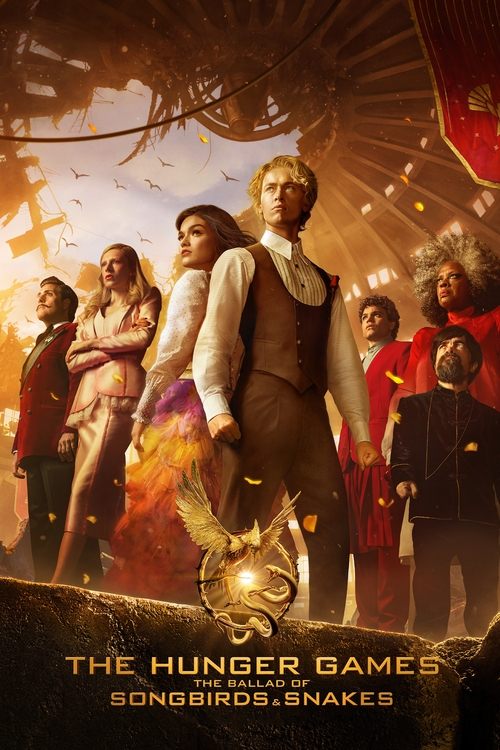
The Hunger Games: The Ballad of Songbirds & Snakes (2023)
Directed by Francis Lawrence
No — The Hunger Games: The Ballad of Songbirds & Snakes is not especially woke, scoring 34 out of 100 on our wokeness meter.
The tenth annual Hunger Games arrive with the Capitol's pastry towers gleaming above districts that cannot feed their children, and the film knows exactly which image it prefers.
Consciousness Markers
The Capitol's decadent wealth set against District starvation, the Games as mass entertainment for the privileged, and the screenwriters' explicit 'filthy allure of wealth' framing give the film a substantial eat-the-rich undercurrent.
The cast is notably diverse for a YA dystopia, with Rachel Zegler, Viola Davis, Josh Andrés Rivera, and Hunter Schafer in prominent roles, continuing the franchise's established pattern of multiracial ensemble casting.
Lucy Gray Baird is a defiant, self-possessed female tribute who drives much of the plot, but the film's perspective remains anchored to Coriolanus Snow's rise, muting any sustained feminist thesis.
The film engages in philosophical discourse about the state of nature and human cruelty via Dr. Gaul and Highbottom, but these ideas are dramatized through Snow's moral descent rather than delivered as direct sermonizing.
Trans actress Hunter Schafer plays Tigris Snow, a casting choice that carries representational weight, though the character's identity is never addressed on screen and no LGBTQ+ themes appear in the narrative.
The film's oppression is framed entirely through Capitol-versus-District class dynamics rather than race; the diverse tribute roster exists without racial commentary.
Panem is a war-ravaged post-apocalyptic setting, but the devastation is attributed to conflict and authoritarianism, not climate change, and no environmental theme is advanced.
No body-positivity themes or messaging are present in the film.
No neurodivergence themes or explicitly neurodivergent characters are present.
The film is a fictional prequel set in an invented dystopia, not a reworking of real historical events.
Why it received this score
The tenth annual Hunger Games arrive with the Capitol's pastry towers gleaming above districts that cannot feed their children, and the film knows exactly which image it prefers. The class grievance here is not subtext; it is the load-bearing wall. Mentors compete for a scholarship while tributes compete for survival, and the screenwriters have spoken openly about the filthy allure of wealth, that Succession-adjacent itch of privileged people clawing at status. The result is a sturdy eat-the-rich undercurrent running beneath the arena bloodsport, though the film is too fond of its velvet and champagne to bite the hand that financed it.
The ensemble is notably multiracial, and Hunter Schafer's turn as Tigris Snow carries representational weight that the script declines to acknowledge. No character remarks on any of this, which is either restraint or indifference, depending on the viewer's patience. Lucy Gray Baird is defiant, self-possessed, and drives the plot with a song and a snake, yet the camera never leaves Coriolanus Snow's shoulder, so the film's feminism stays personal instead of structural. We watch a young woman's charisma get metabolized into a young man's ambition.
Race functions here as class in costume. The districts suffer, the Capitol feasts, and nobody in the frame treats skin color as the fault line. Panem is a wasteland of war and authoritarian habit, not of carbon emissions, and the body-positivity and neurodivergence ledgers remain blank. What the film does offer is argument: Dr. Gaul and Dean Highbottom trade theories about the state of nature and human cruelty, and the ideas land as drama, absorbed through Snow's slow moral rot. It lectures, but it lectures with snakes. A respectable prequel, then. It knows its themes and mostly trusts them to sting on their own.
Analysis generated by our Consciousness Algorithm
Part of


Synopsis
64 years before he becomes the tyrannical president of Panem, Coriolanus Snow sees a chance for a change in fortunes when he mentors Lucy Gray Baird, the female tribute from District 12.
Questions about The Hunger Games: The Ballad of Songbirds & Snakes
Is The Hunger Games: The Ballad of Songbirds & Snakes woke?
No — The Hunger Games: The Ballad of Songbirds & Snakes is not especially woke, scoring 34 out of 100 on our wokeness meter. That earns it a verdict of Based.
Does The Hunger Games: The Ballad of Songbirds & Snakes have any woke elements?
4 of the 10 markers register at 30 or above, led by Eat the Rich (55), Representation Casting (45) and Feminist Agenda (32). On Eat the Rich: The Capitol's decadent wealth set against District starvation, the Games as mass entertainment for the privileged, and the screenwriters' explicit 'filthy allure of wealth' framing give the film a substantial eat-the-rich undercurrent.
How does The Hunger Games: The Ballad of Songbirds & Snakes compare to other 2023 movies?
It ranks #45 of the 200 films from 2023 we've scored; their average is 24. The wokest is Origin (84).
How is the Woke Score calculated?
An AI-assisted process researches the film and its reception, scores it 0–100 on ten markers, then combines those into one 0–100 Woke Score. It measures a specific set of 2020s cultural themes, not film quality.