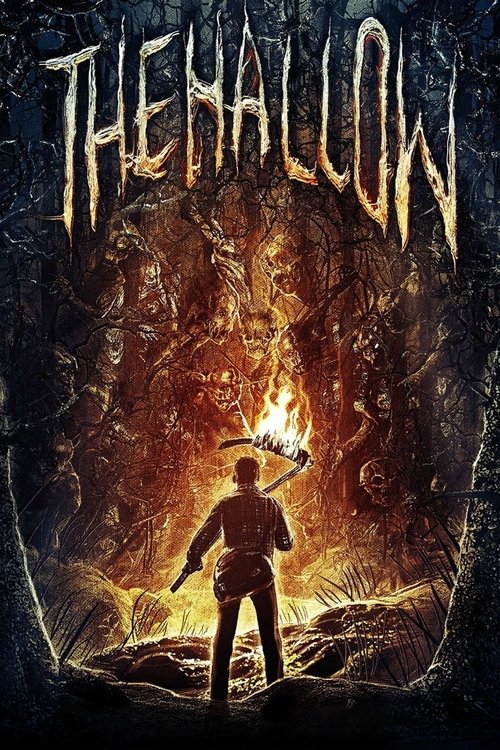
The Hallow (2015)
Directed by Corin Hardy
No — The Hallow is not woke, scoring 8 out of 100 on our wokeness meter.
Corin Hardy's The Hallow arrives with a conservationist named Adam, his wife Claire, and an infant, settling into a remote Irish village so that Adam may survey a forest for future construction.
Consciousness Markers
The protagonist is a conservationist studying plant and fungal life, and the closing shot shows a logging company hauling away fungus-infested timber, implying ecological consequences. The environmental note is atmospheric subtext rather than a crusade.
There is a faint thread of development-versus-nature (the survey for future construction, the logging company at the end), but the film never frames this as a critique of capitalism or wealth.
Claire is a resourceful survivor who fights off the creatures and pursues them into the forest, but this is standard horror-final-girl competence rather than a feminist statement.
The film is a creature-feature horror that prioritizes atmosphere and scares over moral instruction; it never pauses to lecture the audience.
The cast is almost entirely white British and Irish actors, with no deliberate diverse or inclusive casting choices. Representation is incidental at best.
There are no LGBTQ+ characters, relationships, or themes anywhere in the film.
The film engages Irish rural folklore and villagers but makes no commentary on race or racial dynamics whatsoever.
No body-positive themes or messaging are present; the body horror is about monstrous transformation, not body acceptance.
No neurodivergent characters or themes appear in the film.
The film draws on Irish folklore and fairytales but makes no revisionist claims about historical events or figures.
Why it received this score
Corin Hardy's The Hallow arrives with a conservationist named Adam, his wife Claire, and an infant, settling into a remote Irish village so that Adam may survey a forest for future construction. The locals mutter about fairies, banshees, and baby stealers, and soon the family is besieged by practical-effect creatures with stingers and a taste for fungal infection. It is a creature feature assembled with evident love for The Thing and Alien, and it wants above all to frighten you. On the matter of contemporary social instruction, it mostly declines the invitation.
The ledger is thin. Claire proves resourceful, pursuing a creature into the woods and retrieving her child, though this is the standard competence of a horror survivor and not a manifesto. Adam studies plant and fungal life, and the final shot lingers on a logging company hauling away infested timber, a whisper of ecological consequence that never rises to sermon. The development-versus-nature thread is present but unlitigated. There is no racial commentary, no queer presence, no body-acceptance messaging, and the body horror here concerns monstrous transformation, which is a different project entirely. The cast is white British and Irish, cast without apparent design. Nobody lectures. The film is too busy engineering a car-trunk set piece.
What we have, then, is a well-crafted dark fairytale that treats Irish folklore as raw material for scares and lets its themes sit quietly in the moss. It is atmospheric, occasionally nasty, and entirely uninterested in moral instruction. A modest ecological murmur and a faint anti-development sigh are all it offers the cultural auditor. The rest is monsters, and honestly, the monsters are the better company.
Analysis generated by our Consciousness Algorithm


Synopsis
Deep within the darkness of secluded forest land in rural Ireland dwells an ancient evil. Feared by the nearby superstitious villagers as cursed creatures who prey upon the lost, their secrets have been kept from civilization and remain on their hallowed ground. But when a conservationist from London moves in with his wife and infant child in order to survey the land for future construction, his actions unwittingly disturb the horde of demonic forces. Alone in a remote wilderness, he must now ensure his family's survival from their relentless attacks.
Questions about The Hallow
Is The Hallow woke?
No — The Hallow is not woke, scoring 8 out of 100 on our wokeness meter. That earns it a verdict of Ultra Based.
Does The Hallow have any woke elements?
Very few. None of the 10 markers reaches 30, the level where a marker counts as present; the highest is Climate Crusade at 20.
How does The Hallow compare to other 2015 movies?
It ranks #158 of the 289 films from 2015 we've scored; their average is 15. The wokest is Chi-Raq (78).
How is the Woke Score calculated?
An AI-assisted process researches the film and its reception, scores it 0–100 on ten markers, then combines those into one 0–100 Woke Score. It measures a specific set of 2020s cultural themes, not film quality.