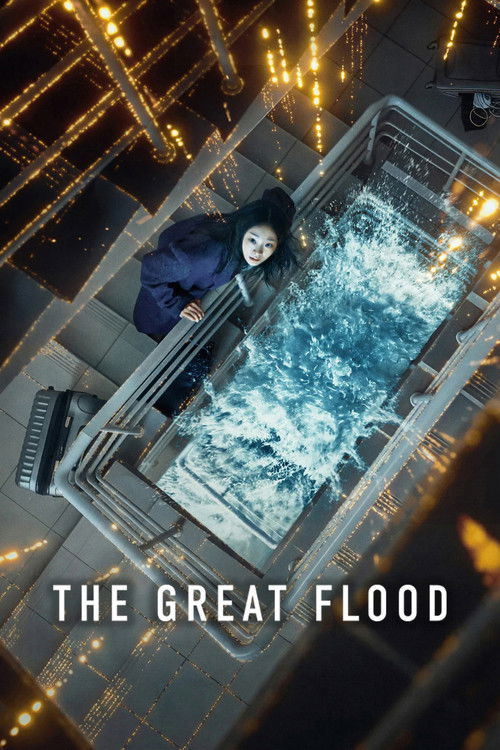
The Great Flood (2025)
Directed by Kim Byung-woo
No — The Great Flood is not especially woke, scoring 25 out of 100 on our wokeness meter.
The Great Flood arrives from South Korea with a title that promises biblical scale and delivers, mostly, an apartment stairwell.
Consciousness Markers
The premise is a global flood and the TMDB keywords explicitly cite climate change and global warming, giving the disaster an environmental charge. However, the in-story cause is an asteroid impact, so the climate message is atmospheric rather than didactic.
Governments and a corporate research center secretly fund survival projects for a select few while abandoning the masses to drown, a clear critique of elite self-preservation. The theme is present but subordinated to the sci-fi survival plot.
The film is meditative and philosophical, exploring AI consciousness and transhumanism, but it prefers mood and repetition over preaching. The ideas are present without a heavy-handed sermon.
A capable woman leads the story as a scientist and mother, but the film treats this as character rather than commentary. There is no explicit feminist thesis driving the plot.
The cast is entirely Korean, which reflects the film's natural setting rather than a deliberate diversity initiative. The female lead as an AI researcher is notable but not framed as a casting statement.
No LGBTQ+ characters, relationships, or themes appear anywhere in the narrative.
The film engages no racial themes, commentary, or identity politics whatsoever.
No body-positivity themes or messaging are present.
No neurodivergence themes or neurodiverse characters are depicted.
The film is a speculative fiction with no historical revisionism.
Why it received this score
The Great Flood arrives from South Korea with a title that promises biblical scale and delivers, mostly, an apartment stairwell. Kim Byung-woo's science fiction disaster picture follows An-na, an AI researcher and recent widow, as she hauls her six-year-old son toward the roof of a thirty-floor complex while the water climbs behind them. It premiered at Busan, then went to Netflix, where it has been watched by a great many people who presumably expected less meditation and more screaming.
The environmental charge here is ambient. The keywords promise global warming, and the imagery of a drowning city supplies it, but the in-story culprit is an asteroid at the South Pole, which keeps the ecological anxiety at the level of weather instead of sermon. Where the film does carry an argument, it concerns institutions: world governments and a corporate research center quietly fund survival for a select few and leave the rest to the water. That is a recognizable critique of elite self-preservation, delivered as plot machinery instead of a lecture. The lead being a competent woman scientist and a mother registers as characterization. Nobody in the film stops to make a point of it, and the cast is Korean because the story is Korean, nothing more.
What the film actually wants to think about is consciousness. The final act reveals that most of what we watched was simulation, a thousand iterations run to refine artificial emotional responses, and the resolution installs mother and son into engineered bodies aboard a space station. This is heavy material handled with restraint. The film repeats itself, circles, lingers, and trusts mood over explanation, which will frustrate viewers who wanted a disaster movie and reward those who wanted a philosophical one. It is sincere and unhurried, and it never once turns to the audience to instruct. For a picture about the end of humanity, it is remarkably polite about it.
Analysis generated by our Consciousness Algorithm


Synopsis
When a raging flood traps a researcher and her young son, a call to a crucial mission puts their escape — and the future of humanity — on the line.
Questions about The Great Flood
Is The Great Flood woke?
No — The Great Flood is not especially woke, scoring 25 out of 100 on our wokeness meter. That earns it a verdict of Based.
Does The Great Flood have any woke elements?
2 of the 10 markers register at 30 or above, led by Climate Crusade (40) and Eat the Rich (30). On Climate Crusade: The premise is a global flood and the TMDB keywords explicitly cite climate change and global warming, giving the disaster an environmental charge.
How does The Great Flood compare to other 2025 movies?
It ranks #82 of the 217 films from 2025 we've scored; their average is 26. The wokest is STRAW (92).
How is the Woke Score calculated?
An AI-assisted process researches the film and its reception, scores it 0–100 on ten markers, then combines those into one 0–100 Woke Score. It measures a specific set of 2020s cultural themes, not film quality.