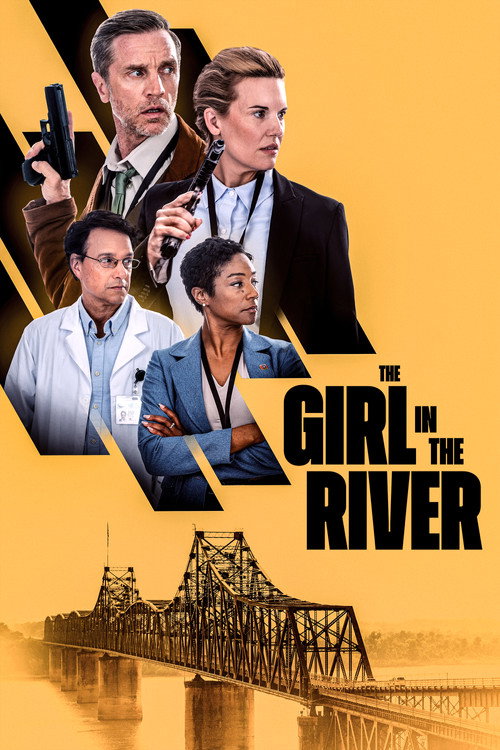
The Girl in the River (2026)
Directed by Brando Benetton
The Girl in the River arrives bearing all the hallmarks of a film that has done its demographic homework without being especially transformed by the experience.
Consciousness Markers
The film places a woman at the investigative center and casts Tiffany Haddish as a Black female police captain in a position of authority. These are deliberate compositional choices, though critics broadly agreed the script treats them as genre furniture rather than as any kind of statement.
The female lead is framed as a competent forensic psychologist in the Clarice Starling mold, which carries some feminist lineage by genre association. The script, however, reportedly leans on 'opposites forced into attraction' tropes, which rather undermines any feminist credentialing.
Haddish's captain navigates friction with a powerful local family in a small Mississippi town, a setting with obvious historical resonance. The film does not appear to engage that resonance explicitly; it is backdrop, not argument.
An influential local family exerts pressure on the investigation, which is a convention as old as the genre itself. There is no indication the film frames this as systemic critique of capital or class structure.
No LGBTQ+ characters, themes, or subtext are present in the available research or critical coverage.
No climate themes, environmental messaging, or ecological framing of any kind appears in the film or its promotional materials.
No body positivity themes or messaging are present in any reviewed material.
No neurodivergent characters or related themes are identified in the research or critical reception.
The film is an original fictional thriller with no historical revisionism or reframing of real events.
Critics and trade coverage make no mention of moralizing, sermonizing, or heavy-handed messaging. The film appears to be a procedural that trusts the audience to simply follow the plot.
Why it received this score
The Girl in the River arrives bearing all the hallmarks of a film that has done its demographic homework without being especially transformed by the experience. Director Brando Benetton, in his feature debut, assembles a cast that checks several visible boxes: a female forensic psychologist at the center of the investigation, a Black female police captain holding local authority, and a rural Mississippi setting that carries the weight of American history in its soil without being asked to carry it on screen. The result is a crime thriller that gestures toward a more conscious version of itself and then, sensibly, gets back to the business of finding a dead girl's twin sister.
The film's most culturally legible move is the casting of Tiffany Haddish in a straight dramatic role, which critics received as a curiosity worth noting but not a cause worth rallying around. Maggie Grace's forensic psychologist draws inevitable comparisons to Clarice Starling, a comparison the film appears to have invited and then failed to fully earn, given that reviewers found the script defaulting to genre comfort: the reluctant partnership, the "opposites forced into attraction" current, the tortured professionals who must set aside their differences to solve the case. These are not progressive gestures. These are conventions with new faces.
What keeps the woke meter from climbing is, frankly, the film's commitment to being a thriller first and a cultural document never. The small-town power dynamics involving a prominent local family are pure procedural DNA, not systemic critique. Nobody lectures anybody about anything of consequence. The pastrami incident notwithstanding, the production appears to have kept its ideological head down and its eye on the mystery. In the current landscape, that kind of restraint is its own data point.
Analysis generated by our Consciousness Algorithm


Synopsis
A seasoned criminologist and a young female psychologist are lured to a remote Mississippi town to investigate the murder of a little girl and the disappearance of her twin sister.