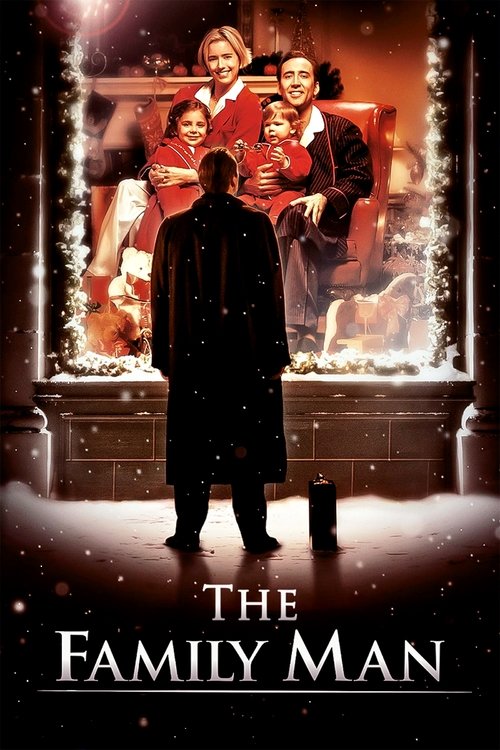
The Family Man (2000)
Directed by Brett Ratner
No — The Family Man is not woke, scoring 11 out of 100 on our wokeness meter.
The Family Man is a 2000 romantic fantasy in which a Wall Street executive gets a glimpse of domestic life.
Consciousness Markers
The film contrasts Jack's hollow Wall Street merger-chasing and Christmas-Day work demands against the warmth of modest suburban family life, offering a mild critique of corporate materialism without any systemic 'eat the rich' argument.
The cast is overwhelmingly white, with Don Cheadle as the lone prominent minority in a supporting mystical role; his presence is unremarked and carries no representational agenda.
The moral about what truly matters in life is delivered through the story's premise rather than explicit preaching, though the film's earnest 'it's a wonderful life' sentiment edges toward sermonizing.
Kate is given a career as a non-profit lawyer and some agency, but the film's emotional architecture is a conventional career-vs-family romance that ultimately prizes domestic fulfillment.
No LGBTQ+ characters, themes, or subtext appear anywhere in the film.
Race is never a subject of the film; Cheadle's guardian-angel figure is cast without any racial commentary.
There is no environmental or climate content whatsoever.
No body-positivity themes or messaging are present.
No neurodivergent characters or themes are depicted.
The film is a contemporary fantasy with no historical subject matter to revise.
Why it received this score
The Family Man is a 2000 romantic fantasy in which a Wall Street executive gets a glimpse of domestic life. Brett Ratner directs with the subtlety of a holiday catalog, but the film's cultural politics are milder than its premise suggests. It wants us to prefer minivans and tire sales to mergers, a gentle rebuke of corporate appetite that never reaches for the pitchfork. Don Cheadle's guardian figure is the lone prominent minority presence, and the film treats him as a magical plot device without comment. That is the extent of its representational ambition.
Kate has a career as a non-profit lawyer and a measure of agency, yet the emotional machinery is a familiar career-versus-family romance. The story ultimately prizes the suburban household, the children, the modest Christmas, and the wife who waits at the center of it. This is not a feminist manifesto; it is a soft-focus endorsement of domestic fulfillment with a briefcase-shaped villain. Race is never a subject. Sexual identity never enters the frame. Climate, body politics, and neurodivergence are absent. The film has no lecture to deliver on those fronts, and it does not pretend otherwise.
Where it does preach, it does so through premise and montage. Jack's conversion from merger-chasing bachelor to devoted father is the sermon, and the sermon is earnest enough to leave a faint residue of moral instruction. The critique of Wall Street is real but narrow: workaholism bad, family good, no systemic argument required. The result is a holiday fantasy that flatters middle-class comfort while avoiding most modern cultural flashpoints. It is pleasant, soft, and mostly harmless, a Christmas movie that believes in love, coffee, and the redemptive power of a tire shop.
Analysis generated by our Consciousness Algorithm
Part of


Synopsis
Jack's lavish, fast-paced lifestyle changes one Christmas night when he stumbles into a grocery store holdup and disarms the gunman. The next morning he wakes up in bed lying next to Kate, his college sweetheart he left in order to pursue his career, and to the horrifying discovery that his former life no longer exists. As he stumbles through this alternate suburban universe, Jack finds himself at a crossroad where he must choose between his high-power career and the woman he loves.
Questions about The Family Man
Is The Family Man woke?
No — The Family Man is not woke, scoring 11 out of 100 on our wokeness meter. That earns it a verdict of Ultra Based.
Does The Family Man have any woke elements?
Very few. None of the 10 markers reaches 30, the level where a marker counts as present; the highest is Eat the Rich at 25.
How does The Family Man compare to other 2000 movies?
It ranks #52 of the 125 films from 2000 we've scored; their average is 13. The wokest is But I'm a Cheerleader (72).
How is the Woke Score calculated?
An AI-assisted process researches the film and its reception, scores it 0–100 on ten markers, then combines those into one 0–100 Woke Score. It measures a specific set of 2020s cultural themes, not film quality.