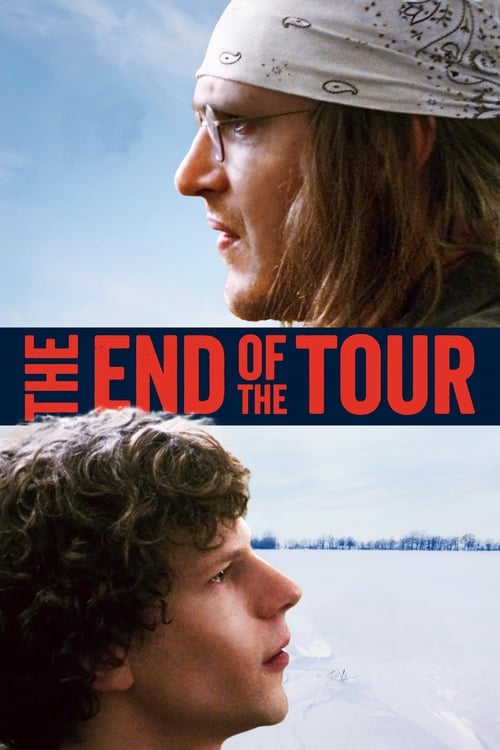
The End of the Tour (2015)
Directed by James Ponsoldt
No — The End of the Tour is not woke, scoring 7 out of 100 on our wokeness meter.
The End of the Tour concerns two white men in a car, then two white men in a hotel room, then two white men walking through the Mall of America.
Consciousness Markers
The film is talky and philosophically inclined—Wallace muses on fame, television, and selfhood—but its didacticism is existential and literary, not a progressive social lecture.
Wallace's depression, institutionalization, and suicide are treated sensitively and form a recurring thread, though the film frames this as mental illness rather than the contemporary neurodivergence movement.
Wallace voices mild unease with fame, commercial success, and the commodification of art, but the film never develops this into a systemic economic critique.
The cast is overwhelmingly white, centered on two white male leads and their white support network; there is no deliberate diversity casting or commentary on representation.
Women exist in the story as friends and colleagues (Betsy, Julie, Sarah, Patty), but none are given an agency-driven or explicitly feminist arc.
No LGBTQ+ characters, themes, or subtext appear anywhere in the film.
The film engages no racial themes or commentary whatsoever; it is a story about two white literary men.
Climate and environmental concerns are entirely absent from the narrative.
No body-image, fat-acceptance, or physical self-esteem themes are present.
The film adapts a real memoir faithfully and makes no attempt to revise or reframe historical record for ideological ends.
Why it received this score
The End of the Tour concerns two white men in a car, then two white men in a hotel room, then two white men walking through the Mall of America. This is not a criticism. It is a census. James Ponsoldt's 2015 film adapts David Lipsky's memoir of the five days he spent interviewing David Foster Wallace in 1996, and it proceeds almost entirely through conversation. The cast is white, the concerns are literary, and the film makes no effort to address this arrangement or apologize for it. There is nothing here to score on representation, and the film does not pretend otherwise.
What registers instead is a quiet, humane treatment of mental illness. Wallace's depression, his institutionalization, and the suicide that opens and closes the frame are handled with restraint, and the film treats them as illness, not as a movement. A few lines gesture at Wallace's discomfort with fame and the way success commodities a writer, but the film never builds this into an argument about systems or economies. It stays personal. Women appear as friends, girlfriends, and escorts (Betsy, Julie, Sarah, Patty), competent and present, yet none of them carries the film's weight or its questions.
The talk is constant and philosophical. Wallace muses on television, on sincerity, on what it means to be a person in a room. It is a great deal of thinking out loud, and the film trusts the audience to keep up. None of it lectures us about society in the contemporary sense. The sermonizing, such as it is, is existential and literary. The film ends where it began, with a death and a man reading from a book, having found in a stranger's company a temporary cure for loneliness. That is the whole of its ambition, and it achieves it. For the purposes of classification, this is a film about interiority, not ideology.
Analysis generated by our Consciousness Algorithm


Synopsis
The story of the five-day interview between Rolling Stone reporter David Lipsky and acclaimed novelist David Foster Wallace, which took place right after the 1996 publication of Wallace's groundbreaking epic novel, 'Infinite Jest.'
Questions about The End of the Tour
Is The End of the Tour woke?
No — The End of the Tour is not woke, scoring 7 out of 100 on our wokeness meter. That earns it a verdict of Ultra Based.
Does The End of the Tour have any woke elements?
Very few. None of the 10 markers reaches 30, the level where a marker counts as present; the highest is Lecture Energy at 18.
How does The End of the Tour compare to other 2015 movies?
It ranks #183 of the 289 films from 2015 we've scored; their average is 15. The wokest is Chi-Raq (78).
How is the Woke Score calculated?
An AI-assisted process researches the film and its reception, scores it 0–100 on ten markers, then combines those into one 0–100 Woke Score. It measures a specific set of 2020s cultural themes, not film quality.