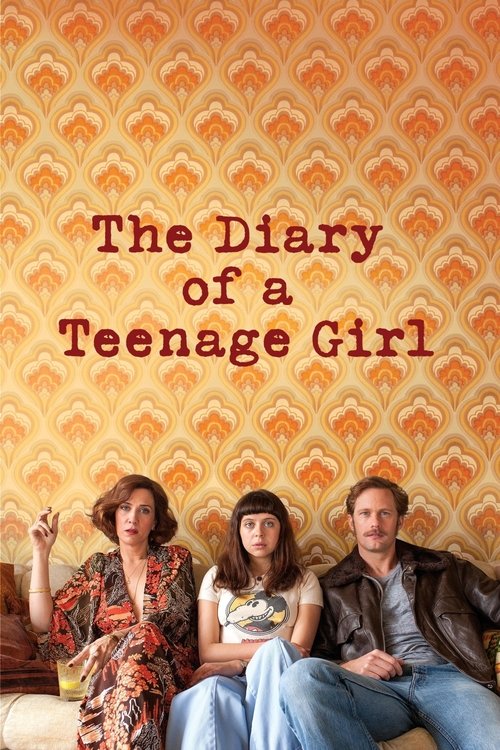
The Diary of a Teenage Girl (2015)
Directed by Marielle Heller
No — The Diary of a Teenage Girl is not especially woke, scoring 34 out of 100 on our wokeness meter.
Marielle Heller's adaptation of Phoebe Gloeckner's hybrid novel arrives with its gaze fixed firmly on its subject, which is the interior life of a fifteen-year-old girl in 1976 San Francisco.
Consciousness Markers
The film is a deliberate, woman-directed portrait of female adolescent sexuality told from the girl's own perspective, refusing to moralize or punish her desire — a squarely feminist reclamation of the coming-of-age gaze.
A female director and a female lead anchor the film, but the cast is otherwise overwhelmingly white and the diversity is more about centering a young woman's voice than about racial or ethnic representation.
Minnie briefly takes up with a risk-taking lesbian, Tabatha, and the film treats queer desire as part of her exploratory adolescence, though it remains a minor subplot rather than a central theme.
Minnie's fear that she is unattractive and her journey toward self-love touch on body image and self-acceptance, though the film frames this as personal growth rather than an explicit body-positivity statement.
The film is widely praised for being non-judgmental and avoiding preachiness, letting its themes emerge through intimate experience rather than explicit messaging.
No engagement with race or racial themes; the story is set in a white bohemian 1970s San Francisco milieu without commentary on racial dynamics.
No environmental or climate content whatsoever.
No economic critique or class-consciousness messaging; the family's financial troubles are personal, not political.
No neurodivergent characters or themes are present.
The 1970s San Francisco setting is period detail, not a revisionist reframing of historical events.
Why it received this score
Marielle Heller's adaptation of Phoebe Gloeckner's hybrid novel arrives with its gaze fixed firmly on its subject, which is the interior life of a fifteen-year-old girl in 1976 San Francisco. Minnie wants things, records them on tape, and draws them, and the film declines to punish her for any of it. That refusal is the whole engine here. A lesser production would have turned Monroe's predation into a moral lesson delivered from a podium. Heller lets the discomfort sit in the room and trusts us to find it. The perspective is female, the authorship is female, and the film treats a girl's desire as a legitimate subject instead of a cautionary anecdote. This is the film's genuine achievement, and it is a substantial one.
The surrounding texture is thinner than the center. The milieu is a white bohemian enclave that never glances sideways at the racial realities of its own city or era, and the family's money troubles register as domestic friction, not as anything resembling a critique of the arrangement that produced them. Minnie worries she is unattractive and eventually lands on self-love, though the film frames this as private growth instead of a statement about bodies. A brief affair with the risk-taking Tabatha gestures at queer experimentation and then moves along. Nothing here is argued. Nothing is announced.
Where the film earns its keep is in what it withholds. There is no speech, no lesson, no character standing in for the audience's conscience. The themes arrive through specific, uncomfortable, frequently funny scenes of a teenager fumbling toward herself. Restraint, in this case, is the entire argument, and it is delivered without a single raised finger.
Analysis generated by our Consciousness Algorithm


Synopsis
Minnie Goetze is a 15-year-old aspiring comic-book artist, coming of age in the haze of the 1970s in San Francisco. Insatiably curious about the world around her, Minnie is a pretty typical teenage girl. Oh, except that she’s sleeping with her mother’s boyfriend.
Questions about The Diary of a Teenage Girl
Is The Diary of a Teenage Girl woke?
No — The Diary of a Teenage Girl is not especially woke, scoring 34 out of 100 on our wokeness meter. That earns it a verdict of Based.
Does The Diary of a Teenage Girl have any woke elements?
3 of the 10 markers register at 30 or above, led by Feminist Agenda (75), LGBTQ+ Themes (35) and Representation Casting (35). On Feminist Agenda: The film is a deliberate, woman-directed portrait of female adolescent sexuality told from the girl's own perspective, refusing to moralize or punish her desire — a squarely feminist reclamation of the coming-of-age gaze.
How does The Diary of a Teenage Girl compare to other 2015 movies?
It ranks #31 of the 289 films from 2015 we've scored; their average is 15. The wokest is Chi-Raq (78).
How is the Woke Score calculated?
An AI-assisted process researches the film and its reception, scores it 0–100 on ten markers, then combines those into one 0–100 Woke Score. It measures a specific set of 2020s cultural themes, not film quality.