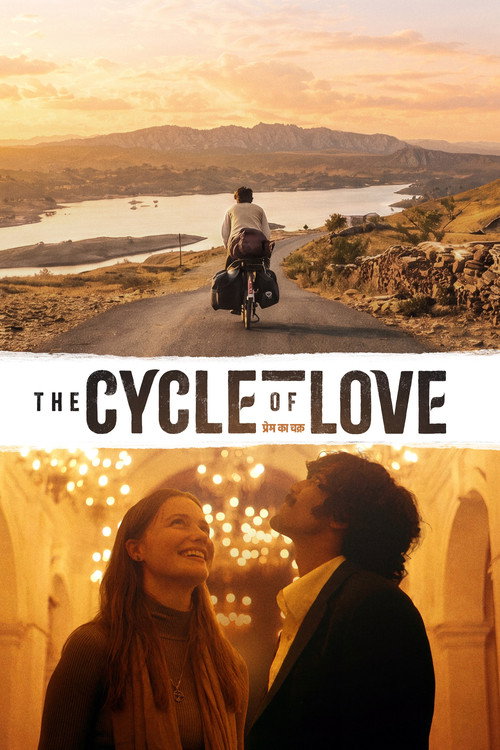
The Cycle of Love (2026)
Directed by Orlando von Einsiedel
Orlando von Einsiedel, a director whose filmography reads like a checklist of global suffering (Syrian rescue workers, endangered gorillas, Afghan girls on skateboards), has here pivoted to something almost aggressively cheerful.
Consciousness Markers
Caste discrimination against Dalits is treated as a central, explicit theme: the film details the systemic prejudice PK faced and the psychological damage it caused. The cross-class and cross-national dynamic between a Dalit street artist and a wealthy Swedish tourist is examined with deliberate social awareness.
The documentary centers on a Dalit protagonist whose caste identity is foregrounded throughout, and the hybrid docudrama format deliberately casts young Indian and Swedish actors to reconstruct a cross-cultural story. The representation is rooted in biography rather than retrofitted diversity, which earns partial credit.
The contrast between PK's poverty and Lotta's wealth is explicitly foregrounded, and the film's emphasis on the generosity of ordinary people along his route functions as a gentle counter-narrative to transactional social relations. The critique is implicit and humanistic rather than structural.
Executive producer Priyanka Chopra Jonas's stated advocacy for women's rights inflects the film's promotional apparatus, and Lotta von Schedvin's role as an independent woman who crosses class and national borders carries a quiet feminist undertone. The film does not, however, frame itself as a feminist document.
The film's production infrastructure, including the Artemis Rising Foundation's social-justice mandate and Priyanka Chopra Jonas's press commentary about caste inequality and cross-cultural empathy, suggests a degree of messaging intent. Critics noted the uplifting social messaging, though the film itself appears to deliver it with a light touch rather than a raised finger.
The film routes its 1977 bicycle journey through Afghanistan, Iran, and Pakistan, countries now synonymous with geopolitical hostility, and frames them as places of ordinary human kindness. This functions as a quiet corrective to contemporary narratives about those regions, though it is a side effect of the story rather than the film's thesis.
No LGBTQ+ themes, characters, or framing are present in any available material about this film.
No climate or environmental themes are present in any available material about this film.
No body positivity themes or framing are present in any available material about this film.
No neurodivergence themes or framing are present in any available material about this film.
Why it received this score
Orlando von Einsiedel, a director whose filmography reads like a checklist of global suffering (Syrian rescue workers, endangered gorillas, Afghan girls on skateboards), has here pivoted to something almost aggressively cheerful. The Cycle of Love documents the true story of PK Mahanandia, a Dalit street artist from Odisha who cycled approximately 6,000 miles across India, Pakistan, Afghanistan, Iran, Turkey, and Europe in 1977 to reunite with a Swedish woman he had fallen in love with in Delhi. The film does not shy away from the caste discrimination that shaped PK's psychology, and it earns its social consciousness credentials honestly: the oppression is real, the wounds are documented, and the contrast between a man born into the lowest rung of a hierarchical society and the wealthy Scandinavian who loved him anyway is examined with genuine care. This is not a case of progressive themes being imported from a production spreadsheet. They are the story.
Where the film's cultural-awareness apparatus becomes more visible is in the infrastructure surrounding it. Priyanka Chopra Jonas, serving as executive producer, conducted a press campaign that framed the film as a vehicle for addressing caste inequality and inspiring audiences to look past social divides. The Artemis Rising Foundation, dedicated to funding media with social-justice and gender-equality mandates, provided production support. The result is a documentary with a genuinely moving subject that has been wrapped in the full ceremonial garments of purposeful cinema. The film itself, by all accounts, wears those garments lightly. The apparatus is heavier.
The hybrid docudrama format, in which young actors retrace PK's route and interact with real people along the way, is a clever device that softens the distance between then and now. Critics used words like "delicate" and "heartwarming," which in this taxonomy are not red flags but simply accurate descriptions. The Cycle of Love scores modestly on the social-consciousness scale not because it is unserious about its themes, but because those themes are inseparable from the facts of a man's life. It is harder to accuse a documentary of agenda when the agenda is the biography. We note this with something approaching respect.
Analysis generated by our Consciousness Algorithm
Synopsis
Explores the romantic journey of PK Mahanandia, a Delhi street artist who trekked 6,000 miles by bicycle in 1977, venturing across continents to reunite with the woman he loved.