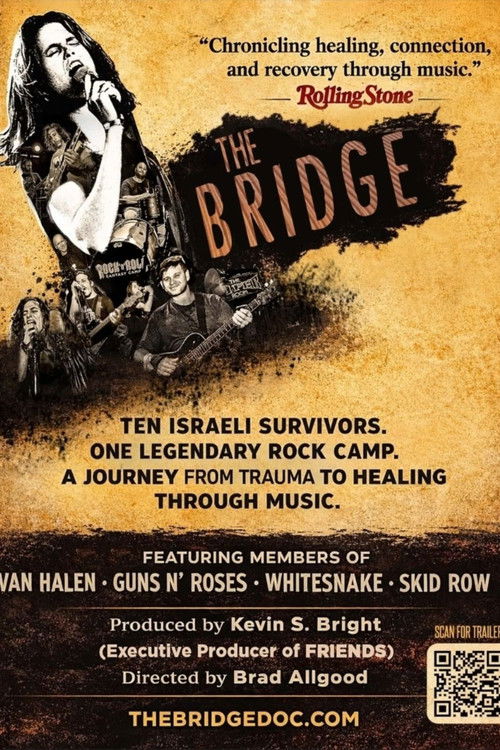
The Bridge (2026)
Directed by Brad Allgood
Brad Allgood's documentary arrives with a premise that could not be more earnest: ten young Israelis who survived the October 7 attacks are flown to Los Angeles, handed guitars, and placed in the company of aging rock veterans from Guns N' Roses and Black Sabbath.
Consciousness Markers
The film carries a gentle implicit argument that these survivors deserve witness and that music heals, but it delivers this through experience rather than sermonizing. The energy is testimonial, not preachy.
The cast is drawn entirely from the documentary's actual subjects, young Israeli survivors of the October 7 attacks. There is no engineered demographic balancing or identity-conscious casting framework at work.
No LGBTQ+ themes, characters, or framing are present in any available material about the film.
The film includes female participants among the survivors but advances no feminist agenda or gender-politics framework. Women appear as human beings in a documentary, which is not the same thing.
Race is not a lens through which the film operates. The subjects' identity is national and communal, rooted in the specific context of the October 7 attacks, not in a racial consciousness framework.
No climate themes, environmental messaging, or ecological subtext of any kind appears in the film or its surrounding materials.
The film is produced in partnership with a commercial enterprise (Rock 'n' Roll Fantasy Camp) and shows no anti-capitalist sentiment whatsoever.
Body image is entirely absent as a theme. The film does not engage with appearance, size, or physical self-acceptance in any capacity.
Neurodivergence does not feature as a theme. The psychological dimension of the film concerns trauma and PTSD in a clinical and human sense, not neurodivergent identity.
The film documents a recent event and presents no revisionist reframing of history. If anything, it is an act of straightforward commemoration.
Why it received this score
Brad Allgood's documentary arrives with a premise that could not be more earnest: ten young Israelis who survived the October 7 attacks are flown to Los Angeles, handed guitars, and placed in the company of aging rock veterans from Guns N' Roses and Black Sabbath. The film makes no attempt to dress this up as anything other than what it is, which is a humanitarian gesture captured on camera. There is no ideological architecture here, no thesis about systemic structures or intersectional harm. The bridge of the title is the one between trauma and something that might, eventually, resemble living.
The film sits entirely outside the vocabulary of contemporary progressive cultural production. Its subjects are Israeli Jews processing an atrocity. Its therapeutic instrument is classic rock. Its producers include the creator of "Friends" and the founder of Rock 'n' Roll Fantasy Camp. The film's circuit of community screenings, Jewish cultural centers, and October 7 memorial events places it in a lane that the modern woke-scoring apparatus is simply not designed to evaluate. There are no lectures here about representation, no structural critiques embedded in the B-roll. The closest the film comes to a political statement is the implicit one that these particular victims deserve to be seen, which is a position, but not a progressive social justice framework.
On the spectrum we are charged with measuring, "The Bridge" scores so low across so many categories that the spreadsheet begins to feel faintly absurd. This is a film about grief and music and the particular stubbornness of the human impulse to continue. It is not trying to change the culture. It is trying to document ten people who were changed by it, against their will, in a single night. The scoring apparatus has been consulted. It has very little to report.
Analysis generated by our Consciousness Algorithm
Synopsis
Young Israeli survivors of the October 7 attacks travel to Los Angeles for Rock 'n' Roll Fantasy Camp, discovering healing and strength through music and shared resilience.