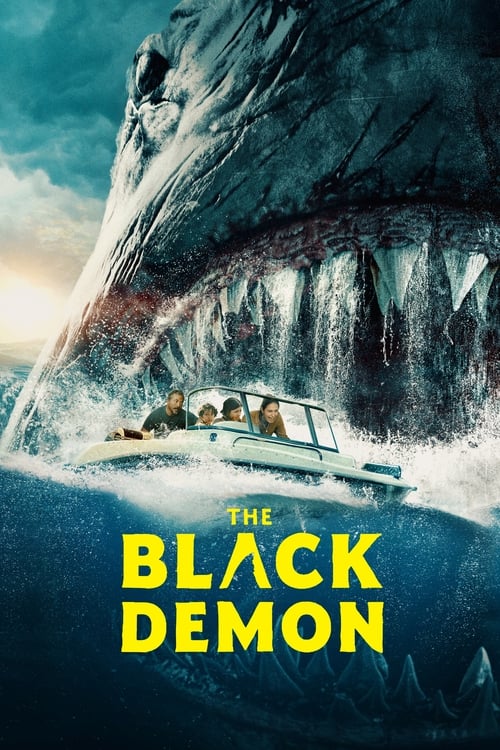
The Black Demon (2023)
Directed by Adrian Grünberg
Partly — The Black Demon is somewhat woke, scoring 52 out of 100 on our wokeness meter.
The Black Demon arrives with the quiet confidence of a film that knows which boxes it intends to tick and lacks the budget to tick them elaborately.
Consciousness Markers
The shark is explicitly a vengeful agent of the rain god Tlaloc punishing humans for despoiling nature; the oil spill, ignored warnings, and Paul's final sacrificial seal of the leak make ecological catastrophe the engine of the plot.
Nixon Oil is a cartoonishly predatory corporation that hides hazardous conditions via self-inspections, abandons its workers, and schemes to scapegoat and kill its own inspector to dodge liability for the spill.
The film frames an American oil corporation (Nixon Oil) exploiting and poisoning a Mexican coastal community, with locals hostile toward the gringo inspector, giving it a mild postcolonial/racial-justice undertone.
The cast is overwhelmingly Mexican and Latino (Cedillo, Urrejola, Chaparro, Jiménez, etc.), but this flows naturally from the Baja California setting rather than from any deliberate diversity mandate, with a white American lead still anchoring the film.
The environmental and corporate-greed message is delivered, but critics noted it stays shallow and is never fully built upon, so the sermonizing remains intermittent rather than relentless.
Ines is given an active investigative role, uncovering the ignored safety reports that expose the company's negligence, but the film offers no broader feminist thesis or critique of patriarchy.
No LGBTQ+ characters, relationships, or themes appear anywhere in the film.
No body-positivity themes or narratives about body image, size, or appearance are present.
No characters are depicted as neurodivergent, and the film raises no themes of neurodiversity.
The film invokes Aztec mythology (Tlaloc) as flavor but makes no historical claims and revises no historical record.
Why it received this score
The Black Demon arrives with the quiet confidence of a film that knows which boxes it intends to tick and lacks the budget to tick them elaborately. A megalodon menaces a crumbling oil rig off Baja California, and the shark, we are told, is an instrument of the rain god Tlaloc, dispatched to punish those who despoil the earth. The cast is almost entirely Mexican and Latino, which reads as an honest consequence of the setting instead of a casting directive, though a white American lead still stands at the center holding the flashlight. The film's social conscience is real but modest, worn like a windbreaker over a creature feature.
Nixon Oil is the villain here, a corporation so predatory it could only exist in a screenplay. It conceals hazards through self-inspections, abandons its workers, and plots to scapegoat its own inspector for a spill it caused. The critique lands with the subtlety of a two-by-four, though the film never sustains it. Ines, the wife, digs up the ignored safety reports and becomes the conscience of the operation, a gesture toward female agency that stops short of any larger argument about the men who signed the paperwork. The locals resent the gringo inspector, and the film lets that resentment sit there, a mild postcolonial note in a movie mostly about teeth.
Where the film does commit is the environment. The spill, the silenced warnings, the sacrificial sealing of the leak: ecological ruin is the engine of the plot, and the shark is less a monster than a collection of grievances with fins. The sermonizing, however, comes and goes. Critics found the ideas shallow and never built upon, and they were right. There is no body positivity, no neurodivergence, no LGBTQ presence, no rewriting of the historical record. What remains is a lean B-movie with a guilty conscience, occasionally preaching, mostly chomping. It is daft, it is sincere, and it is over before the sermon can find a second act.
Analysis generated by our Consciousness Algorithm


Synopsis
Oilman Paul Sturges' idyllic family vacation turns into a nightmare when they encounter a ferocious megalodon shark that will stop at nothing to protect its territory. Stranded and under constant attack, Paul and his family must somehow find a way to get his family back to shore alive before it strikes again in this epic battle between humans and nature.
Questions about The Black Demon
Is The Black Demon woke?
Partly — The Black Demon is somewhat woke, scoring 52 out of 100 on our wokeness meter. That earns it a verdict of Woke-Adjacent.
What makes The Black Demon woke?
5 of the 10 markers register at 30 or above, led by Climate Crusade (70), Eat the Rich (65) and Racial Consciousness (42). On Climate Crusade: The shark is explicitly a vengeful agent of the rain god Tlaloc punishing humans for despoiling nature; the oil spill, ignored warnings, and Paul's final sacrificial seal of the leak make ecological catastrophe the engine of the plot.
How does The Black Demon compare to other 2023 movies?
It ranks #26 of the 200 films from 2023 we've scored; their average is 24. The wokest is Origin (84).
How is the Woke Score calculated?
An AI-assisted process researches the film and its reception, scores it 0–100 on ten markers, then combines those into one 0–100 Woke Score. It measures a specific set of 2020s cultural themes, not film quality.