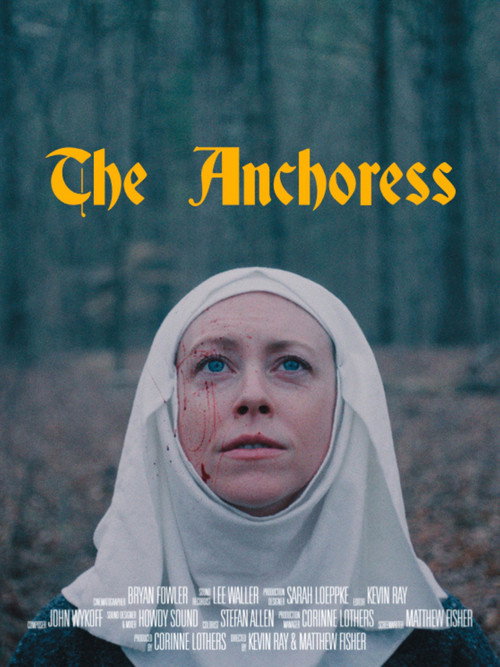
The Anchoress (2026)
Directed by Matthew Fisher
The Anchoress arrives as a fifteen-minute short film from the festival circuit, which means it has approximately the running time of a network television cold open in which to establish medieval atmosphere, introduce a female protagonist seeking divine communion, and then have something horrifying emerge from the trees.
Consciousness Markers
A woman alone in the wilderness, fighting a supernatural threat without male rescue, carries a faint feminist structural logic. The narrative does not appear to editorialize about it, however.
The film centers on a female protagonist in the lead role, though in a medieval setting where a solitary woman of faith is a historically grounded archetype rather than a progressive casting statement. No evidence of broader diversity-as-agenda casting.
The injection of sci-fi and time-travel elements into a medieval religious setting gently destabilizes the period's own cosmology, though this reads more as genre play than ideological revisionism.
No LGBTQ+ themes, characters, or subtext identified in the research or premise of this 15-minute medieval horror short.
No evidence of racial consciousness themes, commentary, or casting choices framed around racial identity in any available research or synopsis.
Set in the Middle Ages, the film has no discernible climate or environmental messaging. The woods are a source of horror, not a cathedral of ecological grief.
No anti-capitalist themes identified. The economic system of medieval feudalism is not interrogated, at least not in the surviving fifteen minutes.
No body positivity themes or related commentary identified in the research or premise.
No neurodivergence themes or representation identified. A woman hearing from God in the Middle Ages is theology, not a neurodiversity narrative.
No evidence of sermonizing, heavy-handed messaging, or lecture energy in any festival coverage or critical commentary. The film appears to be concerned with scaring people, which is refreshing.
Why it received this score
The Anchoress arrives as a fifteen-minute short film from the festival circuit, which means it has approximately the running time of a network television cold open in which to establish medieval atmosphere, introduce a female protagonist seeking divine communion, and then have something horrifying emerge from the trees. Director Matthew Fisher, a professor of cinema at Lee University, has accomplished all three of these things. We note this without irony.
The film's premise, a solitary woman of faith in the wilderness who encounters a creature with apparent sci-fi and time-travel properties, is the kind of premise that in lesser hands would buckle under the weight of its own genre ambitions. Here, the religious and the extraterrestrial are placed in proximity and left to regard each other with mutual suspicion, which is precisely the correct approach. The female protagonist survives or does not survive on the strength of the story's internal logic, not as a vessel for commentary. The monk is present. He does not save her. Whether this is thematically intentional or simply a function of the runtime is a question the film declines to answer, and we respect that.
What is most remarkable about The Anchoress, from the perspective of this particular classification exercise, is how little it seems to want from us beyond our attention and perhaps our mild dread. There is no lecture. There is no knowing glance at the camera. There is a woman, a forest, and something that should not exist in the fourteenth century. By the standards of contemporary genre filmmaking, this constitutes an act of near-radical restraint.
Analysis generated by our Consciousness Algorithm
Synopsis
In the Middle Ages, a young woman pursues holy solitude in the wild -- but when a horrifying trespasser emerges from the woods, she must fight for her life.