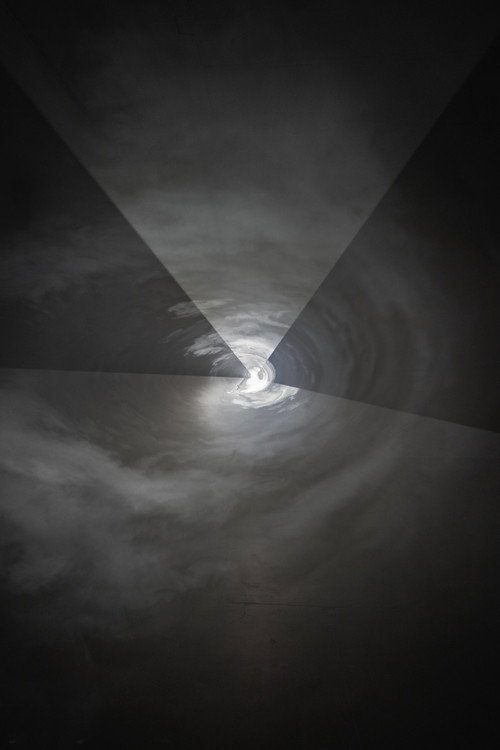
Swarm (2026)
Directed by Anthony McCall
Anthony McCall's Swarm presents the analyst with a singular challenge: how does one apply a sociocultural scoring rubric to fifteen minutes of rotating light cones and an intensifying soundscape.
Consciousness Markers
There is no cast. There are no characters. There are two cones of light. Representation concerns do not apply to geometry.
No narrative, no characters, no LGBTQ+ themes of any kind. The light cones rotate in opposite directions, which is not a metaphor for anything, as far as we can determine.
No feminist content is present or even architecturally possible in a 15-minute abstract light installation. The work has no gender.
No racial themes, no characters, no dialogue. The haze through which the light travels is impartial.
Drones are referenced thematically, but as an ambient social presence, not as an ecological indictment. No climate messaging is present.
The work premiered at a private commercial gallery in New York, which is not the typical launchpad for anti-capitalist screeds. No such content exists here.
No bodies appear on screen. The audience's bodies are present in the gallery, but the work makes no comment on them.
No characters, no neurodivergence themes. The intensifying soundscape may be challenging for some attendees, but this is incidental, not thematic.
The work engages with no historical narrative whatsoever. It is light in a room.
Without dialogue, characters, or narrative, the work is physically incapable of lecturing the audience. It is, in this respect, a remarkable achievement.
Why it received this score
Anthony McCall's Swarm presents the analyst with a singular challenge: how does one apply a sociocultural scoring rubric to fifteen minutes of rotating light cones and an intensifying soundscape. We have attempted to do so with the same rigor we bring to conventional cinema, and we report the results with a steady hand. There are no characters. There is no dialogue. The drones referenced in the conceptual framing are not on screen; they are, at most, a mood. The work scores a zero across all ten markers, a result we have triple-checked and stand behind entirely.
This is not a criticism. McCall has spent fifty years perfecting the art of placing a beam of light in a darkened room and inviting people to walk through it, and Swarm represents the continued maturation of that practice. The collaboration with composer David Grubbs produces an auditory experience that reportedly intensifies over the fifteen-minute duration, which is more narrative arc than many films with actual narratives manage. The drone theme functions as a loose conceptual anchor, a nod toward the ambient surveillance texture of contemporary life, but it stops well short of argument. It simply gestures, and then the light rotates.
In a cultural moment saturated with films straining to communicate their progressive credentials through casting choices, subplot engineering, and third-act speeches, Swarm communicates nothing of the sort. It communicates light, space, and the slow passage of time. We find this, on reflection, almost aggressive in its neutrality. A perfect zero is a rare and, in its own way, distinguished score. McCall has achieved something few filmmakers manage: a work that is completely, irreducibly itself, and entirely immune to our instruments.
Analysis generated by our Consciousness Algorithm
Synopsis
Swarm, 2026, McCall's most recent work, premiering in the exhibition, draws on the rising significance of drones as an increasing presence in daily life. The installation is composed of two conical-light volumes that rotate slowly in opposite directions, one clockwise and the other counterclockwise, over a duration of fifteen minutes. Accompanying the mesmerizing visuals is a rich soundscape that gradually intensifies as a powerful auditory experience. The dramatic, progressive soundtrack serves as a continuation of the ongoing collaboration between McCall and Grubbs.