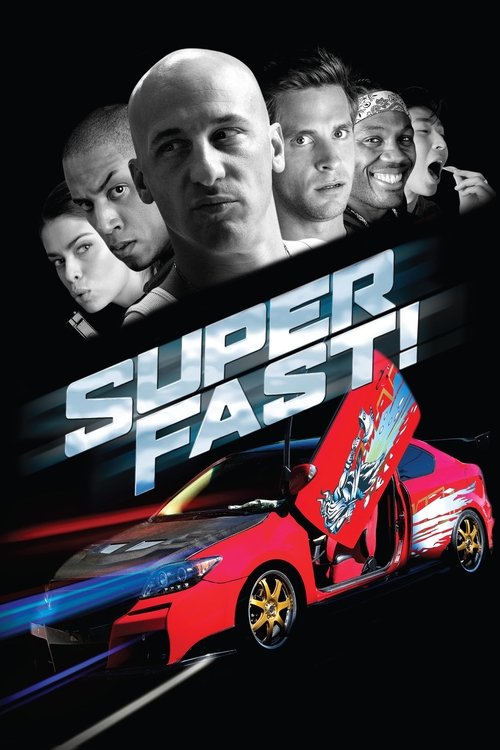
Superfast! (2015)
Directed by Jason Friedberg
No — Superfast! is not woke, scoring 8 out of 100 on our wokeness meter.
Superfast! is a 2015 spoof of the Fast & Furious series, directed by Jason Friedberg, timed to the release of Furious 7, and assembled from the customary materials: head bonks, fart noises, and a plot about an undercover cop infiltrating a street-racing crew to reach a Los Angeles kingpin who stores his cash in a taco restaurant.
Consciousness Markers
Vin's 'lesbian girlfriend Michelle' and her end-of-film relationship with Officer Canaro give the spoof a same-sex pairing, but it is played as a throwaway punchline rather than a genuine LGBTQ theme.
The cast is ethnically mixed (Latino, Black, Asian performers), but the diversity exists mainly to service broad ethnic-stereotype gags like 'Cool Asian Guy' and 'Rapper Cameo' rather than any deliberate inclusive casting ethos.
Jordana and Michelle have some agency in the plot, but the film's humor is aggressively crude and objectifying, offering no feminist sensibility.
Ethnicity appears only as caricature fodder for jokes; there is no engagement with racial themes or consciousness.
The only 'climate' reference is a gag about an argument over a car's climate control, which has nothing to do with environmental themes.
The heist plot targets a crime kingpin's cash, not capitalism; no economic critique is present.
No body-positivity content; the film's comedy relies on crude physical gags and mockery.
No neurodivergent characters or themes are present.
The film is a contemporary spoof with no historical subject matter to revise.
A lowbrow Friedberg/Seltzer spoof delivers slapstick and fart jokes, not moralizing or messaging.
Why it received this score
Superfast! is a 2015 spoof of the Fast & Furious series, directed by Jason Friedberg, timed to the release of Furious 7, and assembled from the customary materials: head bonks, fart noises, and a plot about an undercover cop infiltrating a street-racing crew to reach a Los Angeles kingpin who stores his cash in a taco restaurant. The parody does what parody does. It winks, it nudges, it misses. Critics were unkind and the box office was a shrug. None of this constitutes a crime. The film never aspired to more.
On the ledger of social consciousness, the needle barely trembles. The cast is ethnically mixed, with Latino, Black, and Asian performers, but the diversity exists to service broad stereotype gags, the Cool Asian Guy and the Rapper Cameo among them, so the inclusive gesture is decorative at best. A same-sex pairing surfaces when Vin's lesbian girlfriend Michelle takes up with Officer Canaro in the closing reel, a development played for a laugh instead of any genuine romantic weight. Jordana and Michelle do possess some agency in the plot, though the surrounding humor is crude and objectifying enough to cancel the credit.
Everything else registers at zero, and we report this without disappointment, only fatigue. A gag about a car's climate control is not an environmental statement. A heist aimed at a criminal's cash is not a critique of capital. There is no body positivity, no neurodivergence, no revision of history, and no sermonizing, which is its own small mercy. The film wants to make you groan. It succeeds, and then it is over.
Analysis generated by our Consciousness Algorithm


Synopsis
Undercover cop Lucas White joins Vin Serento's gang of illegal street racers. They are fast and they are furious and they plan to double cross Los Angeles kingpin Juan Carlos de la Sol, who hides his cash in a downtown Taco Bell.
Questions about Superfast!
Is Superfast! woke?
No — Superfast! is not woke, scoring 8 out of 100 on our wokeness meter. That earns it a verdict of Ultra Based.
Does Superfast! have any woke elements?
Very few. None of the 10 markers reaches 30, the level where a marker counts as present; the highest is LGBTQ+ Themes at 20.
How does Superfast! compare to other 2015 movies?
It ranks #158 of the 289 films from 2015 we've scored; their average is 15. The wokest is Chi-Raq (78).
How is the Woke Score calculated?
An AI-assisted process researches the film and its reception, scores it 0–100 on ten markers, then combines those into one 0–100 Woke Score. It measures a specific set of 2020s cultural themes, not film quality.