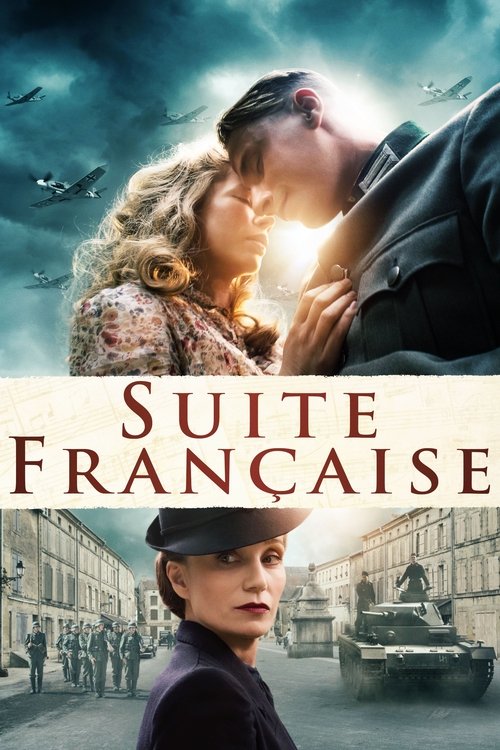
Suite Française (2015)
Directed by Saul Dibb
No — Suite Française is not woke, scoring 9 out of 100 on our wokeness meter.
Suite Française arrives with impeccable credentials for a film of its type: a beloved posthumous novel, a cast of serious British and French actors, a composer of note, and the bucolic misery of occupied France rendered in soft focus.
Consciousness Markers
Lucile is a central female protagonist who gradually asserts agency against a controlling mother-in-law and helps the Resistance, but the film frames this as personal drama rather than a feminist statement.
The cast is entirely white European, with no meaningful racial or ethnic diversity; the film does not engage with representation as a theme.
No LGBTQ+ characters, relationships, or themes appear in the narrative.
The film does not address modern racial justice or systemic racism; the Holocaust is acknowledged only in a postscript about the author, not as a thematic focus.
No environmental or climate themes are present.
Class tensions exist between villagers and aristocracy, but the film does not critique capitalism or wealth as a system.
No body positivity themes are present.
No neurodivergent characters or themes are present.
The film is a straightforward adaptation of a historical novel, not a revisionist reinterpretation of history for ideological purposes.
The film is an understated period romance and does not preach or lecture on social issues.
Why it received this score
Suite Française arrives with impeccable credentials for a film of its type: a beloved posthumous novel, a cast of serious British and French actors, a composer of note, and the bucolic misery of occupied France rendered in soft focus. It concerns Lucile Angellier, trapped in a provincial house with a mother-in-law who treats her like furniture, and the refined German officer billeted in the spare room. They fall in love. The war intrudes. We have seen this before, and we will see it again, which is not a complaint so much as a meteorological observation.
The film's cultural inventory is thin. The cast is uniformly white and European, and no effort is made to interrogate that fact. There are no queer characters, no environmental themes, no body politics, no neurodivergent figures, no critique of capital, and no revisionist reading of the period. The Holocaust appears only as a postscript about the author, which is a fact of history, not a thesis. Instead we get a patient, well-tailored weepie that trusts its audience to feel things without being told to.
Lucile does carry the picture, and she does acquire a spine. She defies her mother-in-law, hides a fugitive in the attic, and talks her way past a German checkpoint. The film treats this as character development, which it is, and declines to make a speech about it, which is to its credit. It is a love story about a woman discovering she has opinions, set against a war that will not wait for her. The result is tasteful, restrained, and entirely untroubled by the anxieties of the present decade. A decent vintage, poured carefully, and best not examined for sediment.
Analysis generated by our Consciousness Algorithm


Synopsis
France, 1940. In the first days of occupation, beautiful Lucile Angellier is trapped in a stifled existence with her controlling mother-in-law as they both await news of her husband: a prisoner of war. Parisian refugees start to pour into their small town, soon followed by a regiment of German soldiers who take up residence in the villagers' own homes. Lucile initially tries to ignore Bruno von Falk, the handsome and refined German officer staying with them. But soon, a powerful love draws them together and leads them into the tragedy of war.
Questions about Suite Française
Is Suite Française woke?
No — Suite Française is not woke, scoring 9 out of 100 on our wokeness meter. That earns it a verdict of Ultra Based.
Does Suite Française have any woke elements?
Very few. None of the 10 markers reaches 30, the level where a marker counts as present; the highest is Feminist Agenda at 15.
How does Suite Française compare to other 2015 movies?
It ranks #151 of the 289 films from 2015 we've scored; their average is 15. The wokest is Chi-Raq (78).
How is the Woke Score calculated?
An AI-assisted process researches the film and its reception, scores it 0–100 on ten markers, then combines those into one 0–100 Woke Score. It measures a specific set of 2020s cultural themes, not film quality.