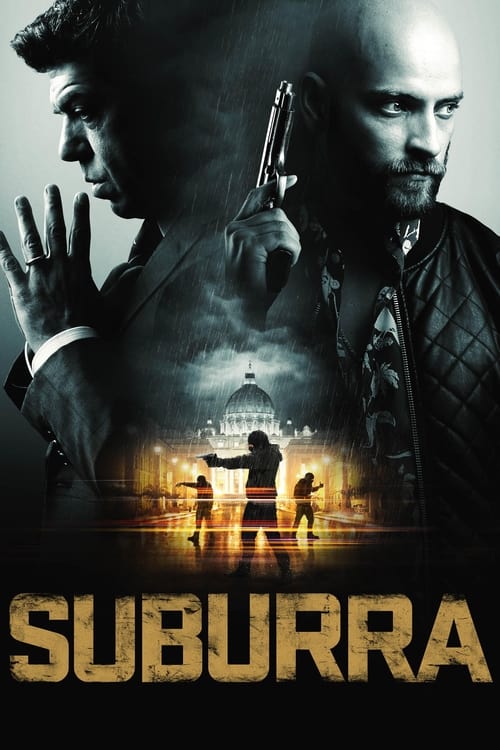
Suburra (2015)
Directed by Stefano Sollima
No — Suburra is not woke, scoring 7 out of 100 on our wokeness meter.
Suburra arrives from 2015 Italy with the grim assurance of a neo-noir that knows exactly what it is: a tale of political corruption, Vatican banking, real estate speculation, and organized crime in Rome.
Consciousness Markers
The plot indicts political corruption, Vatican banking, and real-estate speculation, but as genre cynicism rather than an explicit eat-the-rich polemic.
The cast is entirely Italian, reflecting the film's native setting; the Romani Anacleti family appears as a natural narrative element rather than a diversity statement.
Female characters (Viola, Sabrina, Yelena) are largely defined by prostitution, victimhood, or personal vendetta; there is no feminist thesis or agency-driven framing.
The Romani crime family is present as a plot mechanism, but the film makes no racial commentary or consciousness-raising gesture.
A grim, morally ambiguous crime drama that shows rather than preaches; no didactic messaging.
No LGBTQ+ characters or themes appear anywhere in the film.
No environmental or climate themes whatsoever.
No body-positivity themes or messaging.
No neurodivergence themes or characters.
Inspired by the real Mafia Capitale events, but it dramatizes rather than revises history; no counter-narrative agenda.
Why it received this score
Suburra arrives from 2015 Italy with the grim assurance of a neo-noir that knows exactly what it is: a tale of political corruption, Vatican banking, real estate speculation, and organized crime in Rome. Stefano Sollima directs with a cold eye, and the film's pleasures are procedural and moral, not sermonizing. It is inspired by the Mafia Capitale events, yet it dramatizes history instead of revising it. The cast is entirely Italian, which suits the setting; the Romani Anacleti family appears as a narrative fixture, not a diversity statement. There is no LGBTQ presence, no climate concern, no body positivity, no neurodivergent thread. These absences are not failures. They are simply the film's boundaries.
Where the film brushes against social consciousness, it does so obliquely. The plot indicts corruption at the highest levels: an MP, a Vatican cardinal, a mob boss called Samurai, all circling a waterfront development. That is cynicism as genre furniture, not an eat-the-rich polemic. The women in the story, Viola, Sabrina, Yelena, are shaped by prostitution, victimhood, or personal revenge. No feminist thesis organizes their suffering. The Romani crime family is present, but the film offers no racial commentary. It observes the machinery of power and leaves the audience to draw conclusions. The result is a crime drama that shows rather than lectures, and its moral ambiguity is the point.
The film remains a well-received Italian thriller with a 91 percent approval rating and a modest box office. It has been adapted into a Netflix series and a later spinoff, which suggests the material has legs. But as a cultural artifact of the 2020s progressive checklist, it is nearly barren. It does not preach, does not diversify for its own sake, and does not rewrite the past to flatter the present. This is not a criticism. It is a classification. Suburra is a film about power, money, and violence, and it treats those subjects with the seriousness they deserve. The score reflects a work that is socially aware only in the way a coroner is aware of a body: professionally, and without sentiment.
Analysis generated by our Consciousness Algorithm


Synopsis
A gangster known as "Samurai" wants to turn the waterfront of Rome into a new Las Vegas. All the local mob bosses have agreed to work for this common goal. But peace is not to last long.
Questions about Suburra
Is Suburra woke?
No — Suburra is not woke, scoring 7 out of 100 on our wokeness meter. That earns it a verdict of Ultra Based.
Does Suburra have any woke elements?
Very few. None of the 10 markers reaches 30, the level where a marker counts as present; the highest is Eat the Rich at 22.
How does Suburra compare to other 2015 movies?
It ranks #183 of the 289 films from 2015 we've scored; their average is 15. The wokest is Chi-Raq (78).
How is the Woke Score calculated?
An AI-assisted process researches the film and its reception, scores it 0–100 on ten markers, then combines those into one 0–100 Woke Score. It measures a specific set of 2020s cultural themes, not film quality.