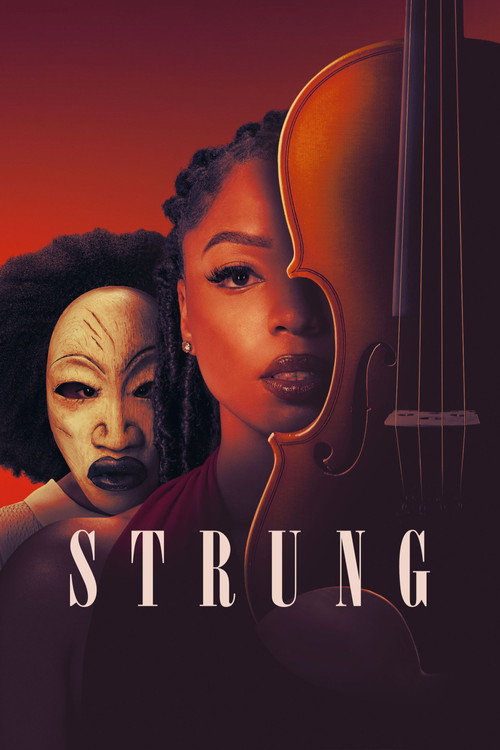
Strung (2026)
Directed by Malcolm D. Lee
Strung arrives as a film that knows exactly what it is doing and would like you to know that it knows.
Consciousness Markers
The film deploys an all-Black lead cast, helmed by a Black female protagonist, in the historically white-coded world of classical music performance. This is not incidental casting; the entire premise is constructed around the friction of that placement, and the production premiered at the American Black Film Festival as a deliberate cultural statement.
Race is woven structurally into the plot: the villain's motivation is preserving old-money bloodline 'purity' against the legacy of a hip-hop artist, and the film explicitly stages the tension between a working-class Black artist and an elite, secretive family. The Zulu-influenced mask worn by the child character adds a layer of diasporic cultural symbolism.
The film's central conflict is built on class tension between a couch-surfing struggling artist and an opulent elite family, with the villain's scheme rooted in protecting generational wealth and social status. The critique is genre-functional rather than ideological, but it is present and legible.
The central figure is a vulnerable Black woman whose psychological autonomy is systematically stripped away by a powerful matriarch, and the film frames her reclamation of safety as the dramatic arc. The 'shrinking violet' protagonist trope, however, complicates any clean feminist reading.
The film's commentary on fine arts elitism and racial exclusion in classical music is delivered through genre mechanics rather than dialogue sermons, which keeps the lecturing quotient manageable. Critics noting the Tyler Perry melodrama influence suggest the messaging occasionally tips into the on-the-nose, but it does not appear to be the film's primary mode.
No LGBTQ+ themes, characters, or narrative elements are present in the available research or plot summary. The score is 0.
No climate, environmental, or ecological themes are present. The score is 0.
No body positivity themes or related narrative elements are identifiable in the research. The score is 0.
No neurodivergence themes are present. The score is 0.
The film is an original psychological thriller set in the contemporary present. No historical revisionism is present. The score is 0.
Why it received this score
Strung arrives as a film that knows exactly what it is doing and would like you to know that it knows. Malcolm D. Lee, a director whose previous credits include the cheerful ensemble comedy Girls Trip, here places a Black female classical violinist inside a gothic thriller about bloodline purity and old money, a setting choice that does roughly as much cultural signaling as the rest of the film's runtime combined. The premise is tidy: a struggling artist enters the orbit of a wealthy, secretive family and discovers that the wealthy and secretive are, in fact, up to something. The revelation that the matriarch is attempting to preserve her family's legacy against the contaminating influence of a deceased hip-hop artist is the kind of villain motivation that arrives with its own thesis statement pre-written.
The film's representation credentials are not subtle, and they are not trying to be. An all-Black cast navigating the traditionally white preserve of classical music performance, premiering at the 30th American Black Film Festival, produced by Tyler Perry and Jason Blum in a collaboration that critics described with the energy of someone watching two very different appliances being plugged into the same socket. The class commentary is real and functional: the tension between the couch-surfing protagonist and the opulent family she serves carries genuine weight, and the Zulu-influenced mask worn by the child character Zuri suggests someone on the production team was thinking seriously about diasporic symbolism. Whether the film earns that symbolism or simply wears it is a question the genre mechanics leave open.
What keeps the score from stratospheric heights is restraint in delivery. The racial and class consciousness is embedded in the plot architecture rather than delivered as monologue, and the horror machinery of Blumhouse keeps the film moving too briskly for extended sermonizing. The lecturing impulse is present but leashed. This is, in the taxonomy of progressive cinema, a film that makes its points through casting and villain motivation instead of through characters pausing to explain society to each other. We award points for efficiency.
Analysis generated by our Consciousness Algorithm


Synopsis
A talented violinist's prestigious new role as a music tutor for an enigmatic, elite family spirals into a psychological battle for her safety and sanity.
Critic Reviews
“Though the story itself is comically predictable, Chloe Bailey's earnest portrayal and the lure of the iconic Lynn Whitfield make the movie fun to watch even as the narrative completely unravels at the seams.”
“The film drags on and the central tension flickers until the whole thing feels less like a purpose-built feature than a limited series hastily stitched into one, with Lee ham-handedly propping the door open for a sequel.”
“Tyler Perry produced Strung, and that fact will mean different things to different viewers.”
“The hypersexualization of women, the lessening of women into roles that relate to the male figure in their lives- I heavily disagree with.”