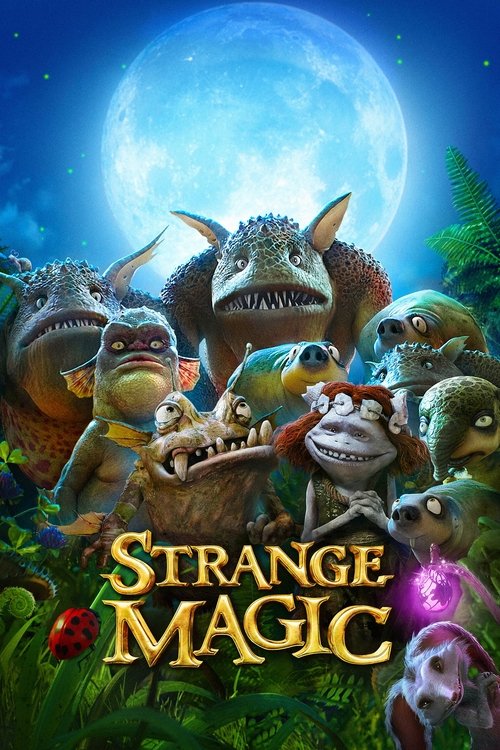
Strange Magic (2015)
Directed by Gary Rydstrom
No — Strange Magic is not especially woke, scoring 30 out of 100 on our wokeness meter.
George Lucas spent fifteen years assembling this thing, a jukebox fairy tale he pitched to his own daughters and to the world as Star Wars for girls.
Consciousness Markers
George Lucas explicitly pitched this as 'Star Wars for a female audience' and 'one for 12-year-old girls,' centering a warrior fairy princess (Marianne) who defies her father, rejects her philandering fiancé, and drives the plot; the female-forward framing is genuine and intentional.
The voice cast is moderately diverse, with Elijah Kelley voicing the elf Sunny (a romantic lead) and Maya Rudolph as Griselda, but the film makes no comment on this and it reads as ordinary ensemble casting rather than a deliberate representation statement.
The film's stated theme of 'finding beauty in strange places' and loving someone for their mind rather than their looks, embodied by Marianne falling for the outwardly monstrous Bog King, gestures at a look-past-appearances message, though it is framed as inner beauty rather than an explicit body-positivity statement.
The film carries a thematic message about love and inner beauty, but it is delivered through song and story rather than direct moralizing or preachy exposition.
There are no LGBTQ+ characters, relationships, or themes anywhere in the film.
The film features a Black-coded romantic lead in Sunny but engages with no racial themes, commentary, or consciousness whatsoever.
No environmental or climate themes are present in this fairy-tale musical.
No economic critique, class commentary, or anti-wealth themes appear in the story.
No neurodivergent characters or themes are depicted.
The film is a fantasy inspired by Shakespeare's A Midsummer Night's Dream and makes no historical claims to revise.
Why it received this score
George Lucas spent fifteen years assembling this thing, a jukebox fairy tale he pitched to his own daughters and to the world as Star Wars for girls. The resulting object, released in the dead of January 2015, was received as one of the more expensive mistakes in recent animation, grossing $13.6 million against a budget that could have funded several small principalities. Critics were not kind. The film survives as a curiosity, which is the kindest thing we can say about it.
The female-forward engineering is real and deliberate. Marianne, a warrior fairy princess, watches her fiancé kiss another fairy on her wedding day, swears off love, defies her father, and spends the final act punching Roland into a crevice. Lucas wanted a story for twelve-year-old girls and built the machinery to match. The voice cast is reasonably integrated, with Elijah Kelley voicing the elf Sunny as a genuine romantic lead, though the film never asks us to notice and never comments on it. That is ensemble casting, not a statement, and the distinction matters for the ledger. On matters of sexuality, race, class, and climate, the film is a void. Sunny's story carries no racial consciousness. Nobody organizes a union in the Dark Forest.
The thematic engine is inner beauty. Lucas described the moral as falling in love with a mind instead of a face, and the Beast here pointedly does not transform. Marianne chooses the scaly Bog King over the handsome one. It is a look-past-appearances gesture, framed as inner beauty rather than anything more explicit about bodies. The sermonizing is minimal, since the film prefers to make its points through song, which is at least a more tolerable delivery mechanism than a monologue. A fairy musical from 2015 has no obligation to every cause, and it meets almost none of them. We file it accordingly, without malice, and move on to the next specimen.
Analysis generated by our Consciousness Algorithm
Part of


Synopsis
A love potion works its devious charms on fairies, elves and the swamp-dwelling Bog King as they all try to possess the potion for themselves.
Questions about Strange Magic
Is Strange Magic woke?
No — Strange Magic is not especially woke, scoring 30 out of 100 on our wokeness meter. That earns it a verdict of Based.
Does Strange Magic have any woke elements?
3 of the 10 markers register at 30 or above, led by Feminist Agenda (60), Representation Casting (35) and Body Positivity (30). On Feminist Agenda: George Lucas explicitly pitched this as 'Star Wars for a female audience' and 'one for 12-year-old girls,' centering a warrior fairy princess (Marianne) who defies her father, rejects her philandering fiancé, and drives the plot; the female-forward framing is genuine and intentional.
How does Strange Magic compare to other 2015 movies?
It ranks #36 of the 289 films from 2015 we've scored; their average is 15. The wokest is Chi-Raq (78).
How is the Woke Score calculated?
An AI-assisted process researches the film and its reception, scores it 0–100 on ten markers, then combines those into one 0–100 Woke Score. It measures a specific set of 2020s cultural themes, not film quality.