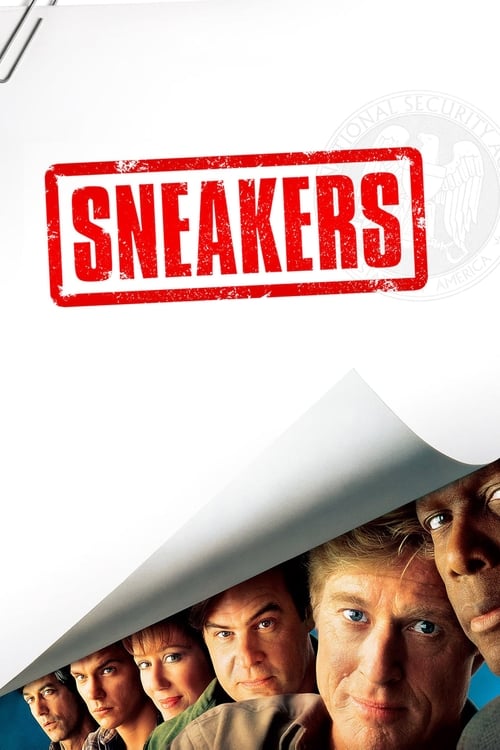
Sneakers (1992)
Directed by Phil Alden Robinson
No — Sneakers is not woke, scoring 18 out of 100 on our wokeness meter.
Sneakers arrives from 1992 as a caper comedy with an ensemble that would have looked like a casting director's fever dream of inclusiveness, though nobody involved seems to have been informed of the significance.
Consciousness Markers
Cosmo's scheme to erase financial and ownership records to make rich and poor equal is an explicit wealth-redistribution premise, and the ending bankrupts the RNC while funding activist groups, though the hero rejects the plan as too extreme.
The ensemble is notably diverse for 1992, with Sidney Poitier as a former CIA operative and a blind phone phreaker (Whistler) as a key team member, but their presence is natural and uncommented upon rather than a modern representation statement.
The 'too many secrets' privacy-and-surveillance theme gestures at government overreach, but it is delivered through breezy caper plotting rather than preachy sermonizing.
Mary McDonnell's Liz is competent and central to the heist, but she functions largely as the ex-girlfriend/seduction asset rather than advancing any feminist thesis.
A Black actor anchors the team and the finale donates to the United Negro College Fund, but the film engages no racial consciousness as a theme.
The closing news report notes anonymous donations to Greenpeace, a fleeting environmental gesture with no thematic weight.
No LGBTQ+ characters, themes, or subtext appear anywhere in the film.
No body-positivity themes or messaging of any kind.
Mother's paranoia and eccentricity are played for comedy, not framed as neurodivergence.
The film is a fictional caper with no revisionist historical claims.
Why it received this score
Sneakers arrives from 1992 as a caper comedy with an ensemble that would have looked like a casting director's fever dream of inclusiveness, though nobody involved seems to have been informed of the significance. Sidney Poitier plays a former CIA operative with the weary authority he brought to everything. David Strathairn plays a blind phone phreak whose ears do the heavy lifting. Robert Redford leads them with the easy charm of a man who has never once been asked to explain his own charisma. The film presents this group without comment, which is to say it treats them as people rather than a statement. That restraint now reads as an artifact from a lost civilization.
The plot's engine is Ben Kingsley's Cosmo, who wants to erase financial and ownership records so that rich and poor become equal. This is an explicit redistribution fantasy, and the film takes it seriously enough to hand it to the villain. Martin rejects it as too extreme, the correct position for a studio picture in 1992. The finale bankrupts the Republican National Committee and routes anonymous money to Amnesty International, Greenpeace, and the United Negro College Fund, a tidy gesture of institutional mischief that costs the film nothing and satisfies everyone.
What lingers is the phrase about too many secrets, a surveillance anxiety the film delivers through banter and heist mechanics instead of sermons. The characters worry about who watches whom, then go steal a box. It is a breezy film about a genuinely grim idea, and it never lectures. A modest artifact of pre-millennial cultural awareness, wearing its conscience lightly and asking nothing of the audience beyond two pleasant hours.
Analysis generated by our Consciousness Algorithm
Part of


Synopsis
When shadowy U.S. intelligence agents blackmail a reformed computer hacker and his eccentric team of security experts into stealing a code-breaking 'black box' from a Soviet-funded genius, they uncover a bigger conspiracy. Now, he and his 'sneakers' must save themselves and the world economy by retrieving the box from their blackmailers.
Questions about Sneakers
Is Sneakers woke?
No — Sneakers is not woke, scoring 18 out of 100 on our wokeness meter. That earns it a verdict of Ultra Based.
Does Sneakers have any woke elements?
2 of the 10 markers register at 30 or above, led by Eat the Rich (40) and Representation Casting (30). On Eat the Rich: Cosmo's scheme to erase financial and ownership records to make rich and poor equal is an explicit wealth-redistribution premise, and the ending bankrupts the RNC while funding activist groups, though the hero rejects the plan as too extreme.
How does Sneakers compare to other 1992 movies?
It ranks #14 of the 74 films from 1992 we've scored; their average is 12. The wokest is The Crying Game (62).
How is the Woke Score calculated?
An AI-assisted process researches the film and its reception, scores it 0–100 on ten markers, then combines those into one 0–100 Woke Score. It measures a specific set of 2020s cultural themes, not film quality.