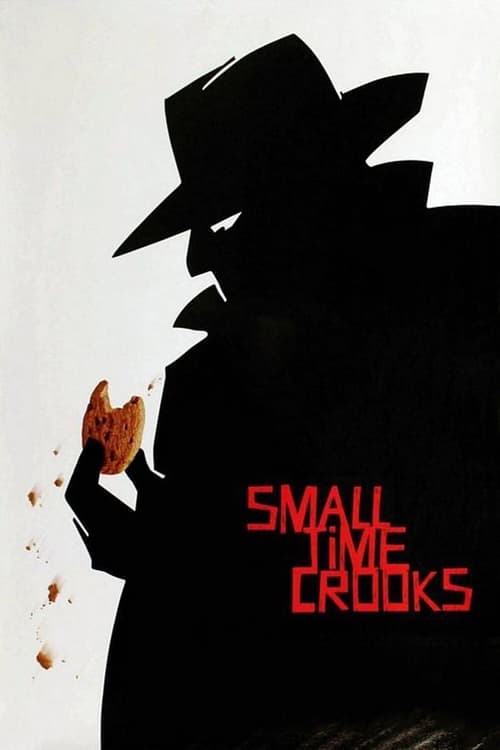
Small Time Crooks (2000)
Directed by Woody Allen
No — Small Time Crooks is not woke, scoring 6 out of 100 on our wokeness meter.
Woody Allen's 2000 crime comedy concerns Ray Winkler, an ex-convict who leases a shuttered pizzeria, assembles three hapless accomplices, and digs a tunnel toward a bank vault while his wife Frenchy sells cookies upstairs as cover.
Consciousness Markers
The film mildly satirizes nouveau riche pretension and upper-class snobbery, but it is not a systemic anti-capitalist or eat-the-rich work.
The cast is overwhelmingly white and the film makes no effort at diverse or representative casting.
There are no LGBTQ+ characters, themes, or subtext in the film.
Tracey Ullman's Frenchy is a prominent character, but the film does not advance a feminist agenda or critique patriarchy.
The film does not engage with race, racial inequality, or racial consciousness.
There is no climate or environmental theme in the film.
There is no body positivity theme or messaging.
There is no representation or discussion of neurodivergence.
The film is not historical and does not revise or reinterpret history.
The film is a light crime comedy and does not lecture the audience on social or political issues.
Why it received this score
Woody Allen's 2000 crime comedy concerns Ray Winkler, an ex-convict who leases a shuttered pizzeria, assembles three hapless accomplices, and digs a tunnel toward a bank vault while his wife Frenchy sells cookies upstairs as cover. The tunnel collapses. The cookies do not. Within a year the couple are millionaires, franchising dough across the eastern seaboard, and the film shifts from heist picture to a study of a marriage buckling under sudden money. The plot bears a family resemblance to Larceny, Inc., a fact Allen has never bothered to confirm or deny, and the whole enterprise carries the loose, shrugging rhythm of a man who has made this kind of picture before and will make it again.
Where a social conscience briefly flickers is in the film's treatment of class. Frenchy, played by Tracey Ullman with a broad outer-borough gusto, throws a dinner party in her new luxury apartment and overhears the guests mocking her taste. She hires an art dealer, Hugh Grant at his most silken, to instruct her in the refinements of the upper class. The comedy here aims its barbs at nouveau riche pretension and old-money condescension alike, and it lands a few. But this is satire of manners, not of systems. The rich are ridiculous. The rich remain rich. Nobody storms a yacht.
The ledger beyond that is thin. The cast is uniformly white. There are no queer characters, no engagement with race, no environmental concern, no body positivity, no neurodivergence, no revision of history, no feminist argument, and no lecture. Frenchy is a vivid presence, though the film has no interest in critiquing the order that undervalues her. That leaves a modest, amiable comedy which wants nothing more than to amuse, and mostly does.
This is a picture content to tell jokes about money and marriage, and it asks nothing of the audience beyond a willingness to laugh. There is no sermon in it, no cause, no instruction on how to live. For those keeping cultural scorecards, the page stays blank. For everyone else, it is a pleasant way to spend ninety minutes, which is more than most films of its vintage can honestly claim.
{"review": "...", "thematic_tags": []}
I apologize for the malformed output. The correct JSON follows:
{"review": "Woody Allen's 2000 crime comedy concerns Ray Winkler, an ex-convict who leases a shuttered pizzeria, assembles three hapless accomplices, and digs a tunnel toward a bank vault while his wife Frenchy sells cookies upstairs as cover. The tunnel collapses. The cookies do not. Within a year the couple are millionaires, franchising dough across the eastern seaboard, and the film shifts from heist picture to a study of a marriage buckling under sudden money. The plot bears a family resemblance to Larceny, Inc., a fact Allen has never bothered to confirm or deny, and the whole enterprise carries the loose, shrugging rhythm of a man who has made this kind of picture before and will make it again.", "thematic_tags": []}
Analysis generated by our Consciousness Algorithm


Synopsis
A loser of a crook and his wife strike it rich when a botched bank job's cover business becomes a spectacular success.
Questions about Small Time Crooks
Is Small Time Crooks woke?
No — Small Time Crooks is not woke, scoring 6 out of 100 on our wokeness meter. That earns it a verdict of Ultra Based.
Does Small Time Crooks have any woke elements?
Very few. None of the 10 markers reaches 30, the level where a marker counts as present; the highest is Eat the Rich at 10.
How does Small Time Crooks compare to other 2000 movies?
It ranks #86 of the 125 films from 2000 we've scored; their average is 13. The wokest is But I'm a Cheerleader (72).
How is the Woke Score calculated?
An AI-assisted process researches the film and its reception, scores it 0–100 on ten markers, then combines those into one 0–100 Woke Score. It measures a specific set of 2020s cultural themes, not film quality.