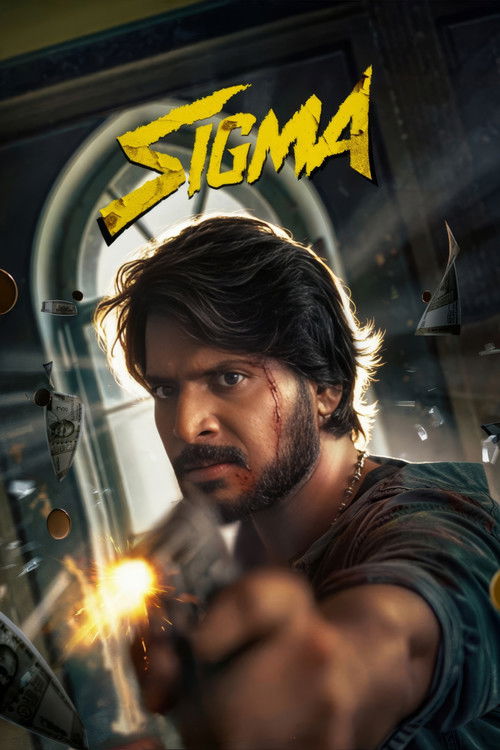
Sigma (2026)
Directed by Jason Sanjay
Sigma arrives as a retro-styled South Indian heist thriller that has, by all available evidence, not paused to consider the cultural moment even briefly.
Consciousness Markers
The cast is drawn from South Indian cinema and reflects the region's own industry norms rather than any deliberate progressive casting agenda. There is no evidence of cross-cultural or diversity-conscious casting beyond the film's natural Telugu/Tamil industry context.
The film gestures toward feminism in one direction and immediately retreats in another: a dance number features the lyric 'Don't objectify me' while the camera does precisely that. The female lead is largely decorative. The net feminist contribution is close to zero, with a small score awarded for the accidental self-critique.
The film involves illegal gambling networks and a treasure-hunting protagonist who operates outside legitimate economic structures, which carries a faint anti-establishment flavor. This is genre convention, not critique. The score reflects the thinnest possible trace.
The self-contradicting 'Don't objectify me' lyric is the closest the film comes to a lecture, and it is immediately undermined by the very sequence it inhabits. The energy is present for approximately four seconds before the film forgets it entirely.
No LGBTQ+ themes, characters, or storylines have been identified in the film or its surrounding press coverage. The score is 0.
No racial consciousness framing is present. The film operates within a South Asian context without invoking race as a social or political lens.
No climate themes are present. This is a heist comedy-drama about illegal gambling and cunning, not the warming planet.
No body positivity themes are present. The film's treatment of the female form in its dance number trends in the opposite direction entirely.
No neurodivergent characters or themes have been identified in the film or its coverage.
The film is an original crime thriller with no historical revisionism. The map controversy surrounding Andhra Pradesh and Telangana was a promotional mishap, not a revisionist narrative within the film itself.
Why it received this score
Sigma arrives as a retro-styled South Indian heist thriller that has, by all available evidence, not paused to consider the cultural moment even briefly. Director Jason Sanjay, making his debut under the considerable shadow of his politician-actor father Vijay, has produced a film that leans on stylized character slates, illegal gambling dens, and masks of Donald Trump as aesthetic furniture. The progressive sensibility score here is roughly equivalent to that of a 2003 Guy Ritchie film that got lost in transit and emerged blinking into 2026.
The film's single flirtation with social consciousness is a dance number containing the lyric "Don't objectify me," delivered while the camera performs a thorough survey of the dancer. This is not irony deployed with intent. It is irony deployed by accident, which is a different and more instructive category. The female lead, Faria Abdullah, plays a radio jockey whose primary narrative function is to exist romantically near the protagonist. Critics from The Hindu to The Times of India noticed. The film did not appear to.
What surrounds the film is, in some ways, more culturally charged than the film itself. A promotional poster depicting an undivided Andhra Pradesh map was deleted after regional backlash. The lead actor publicly accused rivals of financing negative social media campaigns. These are the controversies of the South Indian film industry operating at full velocity, and they have essentially nothing to do with progressive social justice frameworks. Sigma is, in the taxonomy of this endeavor, a clean specimen: a film that scores low not through deliberate resistance but through complete indifference to the entire conversation.
Analysis generated by our Consciousness Algorithm
Synopsis
A daring treasure hunter throws caution to the wind, outwitting deadly traps and treacherous allies with sheer nerve and cunning.