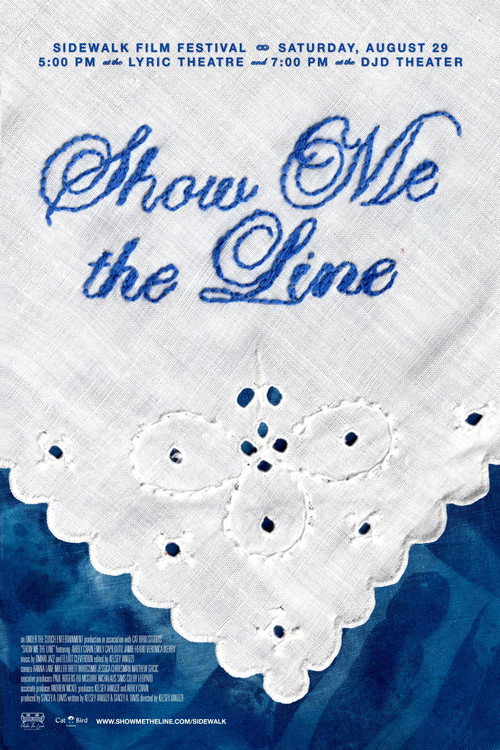
Show Me the Line (2026)
Directed by Kelsey Ianuzzi
Show Me the Line arrives with the quiet confidence of a documentary that has already decided what it thinks and would like the Alabama state legislature to agree.
Consciousness Markers
Bodily autonomy is not a subtext here, it is the entire text. Abbey Crain's on-record declaration that the Alabama Supreme Court holds more power over her body than she does is the film's animating thesis, and the documentary is structured around reclaiming female creative and reproductive agency from state authority.
The film was screened at a political campaign event, covered by outlets calling it 'mandatory viewing for Congress,' and featured in local civic discourse about judicial elections. It is, by design and documented reception, a piece of advocacy cinema that knows exactly what it wants the audience to conclude.
The film consciously assembles a gallery of women whose fertility stories have gone unheard, framing the curation itself as an act of amplification. The subjects are positioned as overlooked by systems of power, though the diversity effort is implicit rather than foregrounded as a structural principle.
The film engages meaningfully with the physical experience of fertility treatment, including miscarriage, genetic testing, and the clinical indignities of IVF. This constitutes medical dignity advocacy, which overlaps with but is not identical to body positivity as a cultural movement.
The Alabama setting and the film's interest in communities 'overlooked' by systems suggest some awareness of racial and socioeconomic disparity in reproductive healthcare access, but no specific racial justice framing emerges as a distinct or documented thread.
The film constructs a counter-narrative to conservative legal doctrine on embryonic personhood, positioning the 2024 Alabama ruling as a rupture rather than a protection. This is contemporary political reframing, however, not historical revisionism in the strict sense.
No LGBTQ+ themes, characters, or framing appear in any available evidence. The film's reproductive rights lens is entirely heterosexual in its documented scope.
No climate themes, environmental messaging, or ecological framing of any kind appear in the film's documentation.
The film does not engage with economic critiques of the healthcare or fertility industry. The antagonist is a court ruling, not a corporation or economic system.
No neurodivergence themes or representation appear in any documented evidence about the film.
Why it received this score
Show Me the Line arrives with the quiet confidence of a documentary that has already decided what it thinks and would like the Alabama state legislature to agree. Director Kelsey Ianuzzi, herself an IVF baby, follows journalist and visual artist Abbey Crain through the aftermath of the February 2024 Alabama Supreme Court ruling that classified frozen embryos as children under wrongful death law, a decision that temporarily shuttered fertility clinics across the state and generated the kind of institutional chaos that documentaries find irresistible. Crain responds with paintbrushes and portraits, which is a more graceful response than most people would manage, and the film is at its best when it simply lets her work speak.
The feminist register is not subtle, nor does it pretend to be. Crain's documented fury at the idea that a court held more authority over her embryos than she did is the film's emotional and political spine, and Ianuzzi organizes the documentary around recovering that authority through art and community. The "overlooked women" framing, the language of amplifying unheard stories, the careful assembly of a chorus of patients whose portraits become the film's visual argument: all of it is executed with genuine craft and genuine conviction. The lecture energy is present throughout, culminating in a screening at a judicial campaign event and coverage suggesting Congress should be compelled to watch it. The film does not disagree with this assessment.
What keeps Show Me the Line from collapsing into a pure pamphlet is that Crain is a compelling subject and the stakes are personal in a way that resists easy abstraction. The film earned its Audience Choice Award at the Sidewalk Film Festival, which is the audience doing its own amplifying. Ianuzzi is too skilled a filmmaker to let the advocacy fully swallow the human material. The result is a documentary that believes deeply in its cause, wears that belief on its sleeve, and is entirely unapologetic about both facts.
Analysis generated by our Consciousness Algorithm
Synopsis
When an Alabama ruling disrupts access to IVF, acclaimed journalist and visual artist Abbey Crain has already been in fertility treatment for over 5 years. Overnight, her dreams of motherhood—and her embryos—are out of reach. But Crain refuses to surrender her creative power. With a pen and paintbrush, she embarks on a journey to honor fellow patients. Driven to celebrate portraits of everyday people and amplify their unheard stories of joy, anguish, beauty, and determination, Crain connects with a group of remarkable women. Together, they cultivate hope from the unsettled landscape that overlooked them.