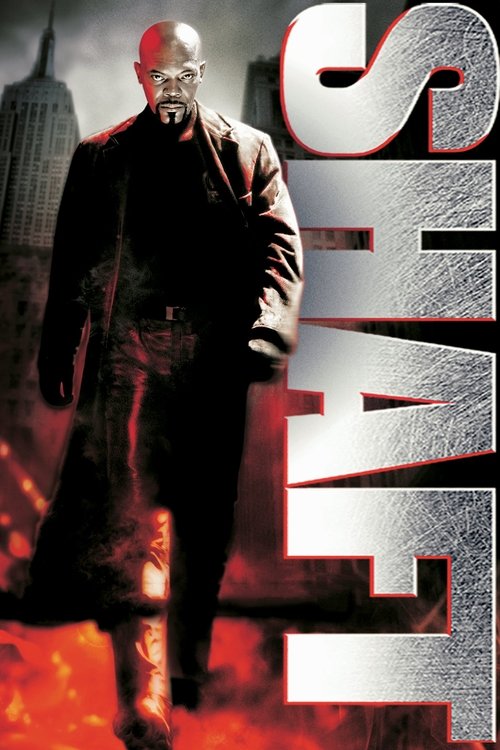
Shaft (2000)
Directed by John Singleton
No — Shaft is not especially woke, scoring 34 out of 100 on our wokeness meter.
John Singleton's Shaft arrives in 2000 as a curious hybrid, a sequel to the 1971 picture that also functions as a reintroduction, with Samuel L. Jackson inheriting the leather coat from Richard Roundtree and Christian Bale supplying the villainy as Walter Wade Jr., a real estate heir who kills a Black man outside a restaurant and assumes his father's money will handle the paperwork.
Consciousness Markers
The plot turns on a wealthy white man's racially motivated killing of a Black man and his attempts to buy his way out of a conviction, with Singleton foregrounding the racial inequities of the justice system.
A Black-led studio action film with a majority-Black principal cast (Jackson, Williams, Wright, Rhymes, Roundtree) and a Black director, though the diversity is native to the blaxploitation lineage rather than a modern casting initiative.
Wade's fortune and influence repeatedly subvert the legal process, giving the film a clear 'the rich buy their way out' undercurrent, though it is never framed as systemic critique.
Social commentary on race and moneyed privilege is present but embedded in genre action rather than delivered as a sermon.
Vanessa Williams' Detective Carmen Vasquez is competent and survives via a bulletproof vest, but the film is thoroughly male-driven and offers no feminist thesis.
No LGBTQ+ characters, themes, or subtext appear anywhere in the film.
No environmental or climate themes are present.
No body-positivity themes or messaging.
No neurodivergent characters or themes.
No historical revisionism; the film is a contemporary crime thriller.
Why it received this score
John Singleton's Shaft arrives in 2000 as a curious hybrid, a sequel to the 1971 picture that also functions as a reintroduction, with Samuel L. Jackson inheriting the leather coat from Richard Roundtree and Christian Bale supplying the villainy as Walter Wade Jr., a real estate heir who kills a Black man outside a restaurant and assumes his father's money will handle the paperwork. The plot is a genre engine, but the fuel is racial. The eyewitness is bought. The bail is insultingly small because a broken nose embarrassed a judge. The courtroom is treated as a formality that wealth can schedule at its convenience.
The film's social consciousness is real but bounded. Its Black ensemble is substantial and its director is Black, though this reflects the blaxploitation lineage the project inherited, not a contemporary casting mandate. The portrait of a rich man purchasing his way past a murder charge carries an unmistakable eat-the-rich hum, yet the film never generalizes it into an argument about the system. Vanessa Williams' Detective Carmen Vasquez is competent, survives a chest wound thanks to a bulletproof vest, and is otherwise given little to do in a story that belongs to men. What the film does not contain is equally legible. No queer characters. No environmental anxiety. No meditation on bodies or brains. No reworking of the historical record.
Singleton keeps his commentary inside the action, which is the correct instinct and also the reason the film ages as entertainment instead of a tract. The sermon stays in the pulpit. What remains is a star vehicle with a conscience it declines to lecture about, and a villain whose racism is presented as a personal defect that money enables. Twenty-five years on, the picture reads as a transitional object: more socially alert than the average studio thriller of its moment, far less insistent than the ones that followed. It knows what it is, and it is content to be that.
Analysis generated by our Consciousness Algorithm
Part of


Synopsis
New York police detective John Shaft arrests Walter Wade Jr. for a racially motivated slaying. But the only eyewitness disappears, and Wade jumps bail for Switzerland. Two years later Wade returns to face trial, confident his money and influence will get him acquitted -- especially since he's paid a drug kingpin to kill the witness.
Questions about Shaft
Is Shaft woke?
No — Shaft is not especially woke, scoring 34 out of 100 on our wokeness meter. That earns it a verdict of Based.
Does Shaft have any woke elements?
3 of the 10 markers register at 30 or above, led by Racial Consciousness (65), Representation Casting (62) and Eat the Rich (35). On Racial Consciousness: The plot turns on a wealthy white man's racially motivated killing of a Black man and his attempts to buy his way out of a conviction, with Singleton foregrounding the racial inequities of the justice system.
How does Shaft compare to other 2000 movies?
It ranks #10 of the 125 films from 2000 we've scored; their average is 13. The wokest is But I'm a Cheerleader (72).
How is the Woke Score calculated?
An AI-assisted process researches the film and its reception, scores it 0–100 on ten markers, then combines those into one 0–100 Woke Score. It measures a specific set of 2020s cultural themes, not film quality.