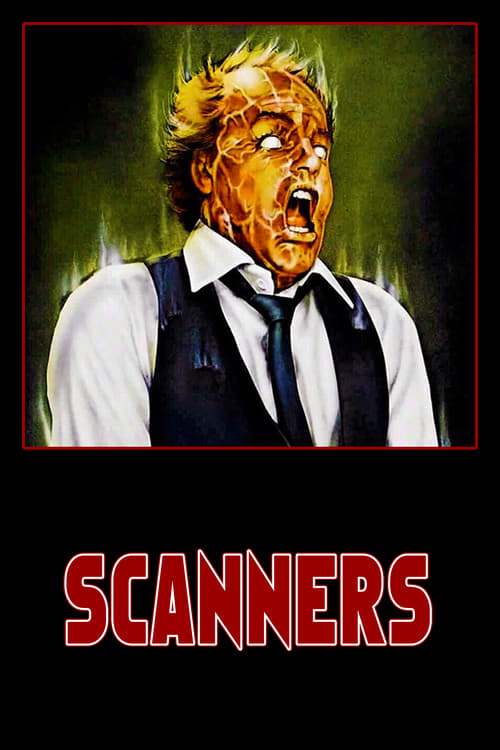
Scanners (1981)
Directed by David Cronenberg
No — Scanners is not woke, scoring 5 out of 100 on our wokeness meter.
Scanners arrives from 1981, a Canadian production assembled under a tax shelter and shot in Montreal on a budget of four million dollars, and it has the nerve to concern itself with psychic espionage instead of the moral improvement of its audience.
Consciousness Markers
ConSec and Biocarbon Amalgamate are sinister corporations weaponizing people, a standard paranoid-thriller trope rather than a pointed modern critique of capitalism or wealth inequality.
Dr. Ruth's exposition about scanners and the marketing demonstration are functional plot lectures rather than didactic social messaging aimed at the audience.
Kim Obrist is a capable female scanner, but she is a supporting figure in a male-driven narrative, and the film advances no feminist thesis about gender or patriarchy.
A 1981 Canadian production with an entirely white principal cast; no deliberate diversity casting or commentary on representation exists in the film or its production.
No LGBTQ+ characters, themes, or subtext appear in the film; the story concerns psychic espionage and a family duel.
The film engages no racial themes whatsoever; its conflict is between scanners and non-scanners, with no attention to race or systemic racism.
Environmental themes are entirely absent; the menace is psychic power and corporate conspiracy, not ecological collapse.
The film's fixation is on grotesque body horror (the exploding head, the incinerated duel), the philosophical opposite of body-positivity messaging about diverse bodies.
Vale's hearing of voices is framed as a pathology to be controlled, not as a positive neurodivergent identity; the film pathologizes rather than celebrates difference.
No historical revisionism is attempted; the film is set in a contemporary-ish present and allegorizes 1960s radicals only implicitly, without rewriting any real history.
Why it received this score
Scanners arrives from 1981, a Canadian production assembled under a tax shelter and shot in Montreal on a budget of four million dollars, and it has the nerve to concern itself with psychic espionage instead of the moral improvement of its audience. The cast is uniformly white, the narrative is driven by men, and the film's central preoccupation is the spectacle of a head detonating under the pressure of a rival's mind. There is no instructive subtext about representation, no meditation on identity, no invitation to examine our complicity in anything. It simply wants to show us a man's skull coming apart, and it does so with a shotgun and leftover hamburger meat.
One could search for progressive currents and find only the faintest traces. Kim Obrist is competent and survives, which is more than most of the men manage, but she exists to serve a story about two brothers and their father. ConSec and Biocarbon Amalgamate are sinister corporations weaponizing human beings, though this is the standard paranoia of the era, the same suspicion of institutions that powered a hundred thrillers before anyone thought to call it a critique of capital. Dr. Ruth delivers exposition about scanners and ephemerol because the plot requires it, not because the audience needs correction. The film treats psychic difference as pathology, something to be drugged and controlled, which is the opposite of a celebratory posture toward atypical minds.
The body horror is the point, and it is gloriously at odds with any contemporary wellness of the flesh. Bodies here explode, incinerate, and betray their owners. Cronenberg's scanners are not a marginalized community deserving of affirmation; they are a weapon and a disease, and the film's resolution involves a mind swapping into another man's corpse. No historical record is revised, no climate anxiety is indulged, no lecture is delivered. It is a nasty, efficient genre picture from a colder cultural moment, and it has aged into a cult object precisely because it refuses to flatter anyone. The head still explodes. That is the entire thesis.
Analysis generated by our Consciousness Algorithm


Synopsis
A scientist trains a man with an advanced telepathic ability called 'scanning' to stop a dangerous Scanner with extraordinary psychic powers from waging war against non-Scanners.
Questions about Scanners
Is Scanners woke?
No — Scanners is not woke, scoring 5 out of 100 on our wokeness meter. That earns it a verdict of Ultra Based.
Does Scanners have any woke elements?
Very few. None of the 10 markers reaches 30, the level where a marker counts as present; the highest is Eat the Rich at 15.
How does Scanners compare to other 1981 movies?
It ranks #13 of the 43 films from 1981 we've scored; their average is 5. The wokest is The Fox and the Hound (18).
How is the Woke Score calculated?
An AI-assisted process researches the film and its reception, scores it 0–100 on ten markers, then combines those into one 0–100 Woke Score. It measures a specific set of 2020s cultural themes, not film quality.