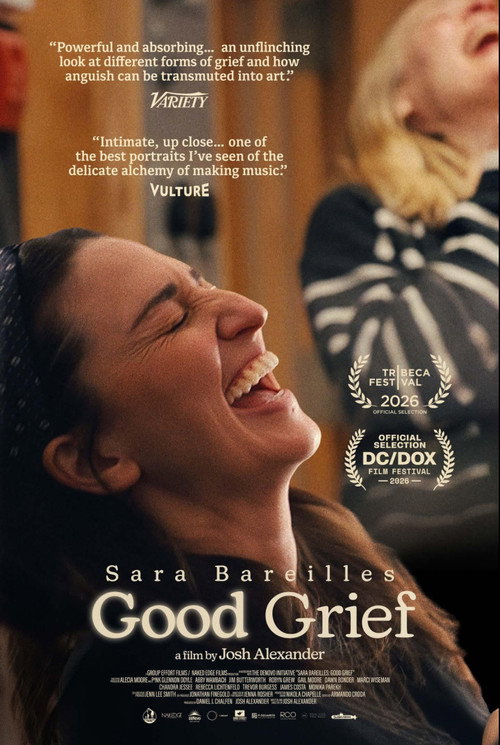
Sara Bareilles: Good Grief (2026)
Directed by Josh Alexander
Josh Alexander's documentary deposits Sara Bareilles and her longtime collaborators in a Woodstock recording studio for six days and then simply watches what happens.
Consciousness Markers
Bareilles's candid discussion of IVF and fertility struggles brings women's reproductive health into the frame with genuine personal weight. The framing is testimonial and emotional, stopping well short of programmatic feminist messaging.
The film acknowledges Bareilles's connections to LGBTQ+ artists including Brandi Carlile and the late queer poet Andrea Gibson, and her history with 'Brave' as an LGBTQ+ anthem. These elements are present but treated as biographical fact rather than advocacy.
The collaborators are a genuinely diverse group, but this is a documentary about Bareilles's actual long-term bandmates. The diversity reflects her real creative circle, not a casting decision made for optics.
The film's emotional destigmatization of grief and mental health vulnerability carries a mild implicit message, but Bareilles's stated conclusion, that grief opened her to more political compassion rather than less, actively works against any preachy register.
No racial consciousness themes are present in the film's content or framing. The director's prior work engages with race, but this film does not.
No climate themes of any kind appear in this documentary.
No anti-capitalist framing is present. The film does not engage with the music industry's economics or any broader critique of capital.
Body positivity is not a theme in this film.
Neurodivergence is not addressed in the film's content or reception.
This is a contemporary documentary with no historical revisionism.
Why it received this score
Josh Alexander's documentary deposits Sara Bareilles and her longtime collaborators in a Woodstock recording studio for six days and then simply watches what happens. The result is a film about grief, which is a universal human condition, processed through songwriting, which is a professional skill, and the whole enterprise is so genuinely felt that one keeps waiting for the ideological scaffolding to appear. It mostly does not. Bareilles discusses IVF treatments and the particular anguish of fertility struggles with an openness that reads as personal testimony rather than policy advocacy. The film notes her connections to LGBTQ+ artists, including the late poet Andrea Gibson and Brandi Carlile, with the casual warmth of someone describing her actual friends. This is, it turns out, a documentary about a musician making an album while grieving several people she loved. The subject matter is permitted to be what it is.
Director Josh Alexander has previously made films about Al Sharpton and race in the American South, a portfolio that might lead the alert viewer to brace for a pivot. The pivot does not come. Notably, Bareilles herself describes how sitting with grief softened her view of political anger in others, generating not a sharper edge but a more compassionate one. This is, by the standards of contemporary documentary filmmaking, almost perversely apolitical. The film's emotional register is high, and a minority critical view has called it self-indulgent, which is a fair concern to raise about any documentary that features sustained crying. We will simply note that sustained crying about dead friends is not, as a category, a progressive political act.
The progressive cultural coordinates are present but lightly worn. "Brave," Bareilles's most famous song, has a well-established life as an LGBTQ+ empowerment anthem, and that history travels with her into any room she enters. The film does not disown this. It also does not lecture us about it. What we have here is a music documentary that trusts its subject to be interesting enough without converting her grief into a platform. In the current landscape, that restraint is its own minor achievement.
Analysis generated by our Consciousness Algorithm
Synopsis
Seven years after her Grammy Award-winning "Amidst the Chaos", Sara Bareilles reunites with her closest collaborators to record a new album. What emerges is an intimate, cinematic process that lays bare the musician's deep connections and inspirations in Josh Alexander's moving music documentary.