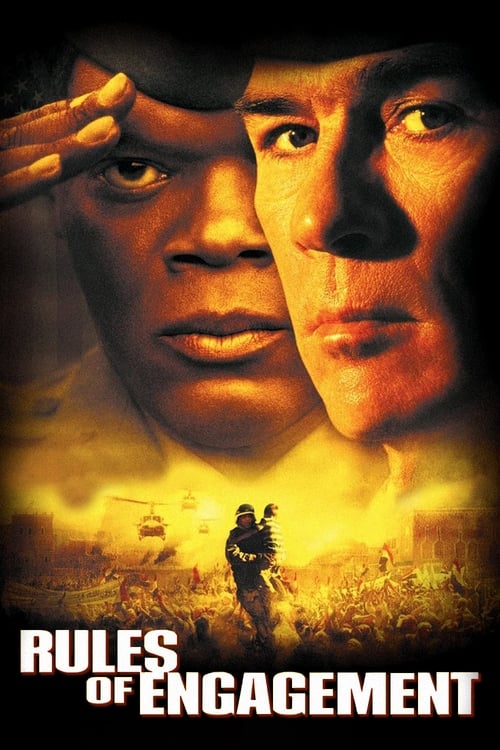
Rules of Engagement (2000)
Directed by William Friedkin
No — Rules of Engagement is not woke, scoring 13 out of 100 on our wokeness meter.
Rules of Engagement arrives from the year 2000 with a full complement of convictions that have since fallen out of fashion.
Consciousness Markers
Samuel L. Jackson anchors a major studio war drama as a Marine colonel, with Blair Underwood and Ben Kingsley in supporting roles — notable for 2000, but the casting is colorblind rather than remarked upon.
The film sermonizes about military honor and the burdens of command, but its moralizing runs in a hawkish, not a progressive-woke, direction.
No LGBTQ+ characters, themes, or subtext of any kind.
A relentlessly male military-courtroom drama; Anne Archer's ambassador's wife exists only as a reluctant witness and domestic fixture.
No engagement with racial justice themes; the film's central controversy was the opposite accusation — that it trafficked in anti-Arab stereotyping.
No environmental content whatsoever.
The villain here is political expediency and a cover-up by the National Security Advisor, not capital or class.
No body-positivity themes; bodies appear only as combat wounds and casualties.
No neurodivergent characters or themes.
If anything the reverse: critics noted an anachronistic fondness for Vietnam-era militarism rather than any re-centering of marginalized historical perspectives.
Why it received this score
Rules of Engagement arrives from the year 2000 with a full complement of convictions that have since fallen out of fashion. William Friedkin directs a screenplay that passed through the hands of James Webb and Stephen Gaghan, and the result is a war picture that doubles as a courtroom picture and never once doubts the righteousness of the Marine Corps. A colonel orders his men to fire into a crowd outside the American embassy in Yemen. Eighty-three people die. The film's interest lies in whether the colonel's career survives, not in the crowd.
On the matter of social consciousness, the ledger is thin. Samuel L. Jackson carries the film as Colonel Terry Childers, a major studio war drama anchored by a Black actor, with Blair Underwood and Ben Kingsley in support. That casting is notable for its moment and entirely unremarked within the film; no character pauses to consider it, and the screenplay never treats race as a subject. Anne Archer appears as the ambassador's wife, a reluctant witness and domestic presence who exists to be interviewed in a kitchen. There is no engagement with sexuality, with the body as anything but a wound, with capital as a villain, or with the climate. The antagonist is a National Security Advisor with a videotape and a lighter, which is a political sin, not an economic one.
The sermonizing, such as it exists, concerns honor and command and the weight a man carries when he shouts an order that kills civilians. It is a hawkish sermon, delivered without apology. Critics at the time noted something stranger than propaganda: a fondness for Vietnam that felt borrowed from an earlier decade, as though the intervening thirty years had not occurred. The American-Arab Anti-Discrimination Committee called it the most racist film ever made against Arabs by Hollywood. Friedkin disagreed. The court-martial concludes, the colonel retires honorably, and the film salutes. We are left to file it under period pieces, which is where such artifacts belong.
Analysis generated by our Consciousness Algorithm
Part of


Synopsis
A Marine Colonel is brought to court-martial after ordering his men to fire on demonstrators surrounding the American embassy in Yemen.
Questions about Rules of Engagement
Is Rules of Engagement woke?
No — Rules of Engagement is not woke, scoring 13 out of 100 on our wokeness meter. That earns it a verdict of Ultra Based.
Does Rules of Engagement have any woke elements?
1 of the 10 markers register at 30 or above, led by Representation Casting (30). On Representation Casting: Samuel L.
How does Rules of Engagement compare to other 2000 movies?
It ranks #41 of the 125 films from 2000 we've scored; their average is 13. The wokest is But I'm a Cheerleader (72).
How is the Woke Score calculated?
An AI-assisted process researches the film and its reception, scores it 0–100 on ten markers, then combines those into one 0–100 Woke Score. It measures a specific set of 2020s cultural themes, not film quality.